


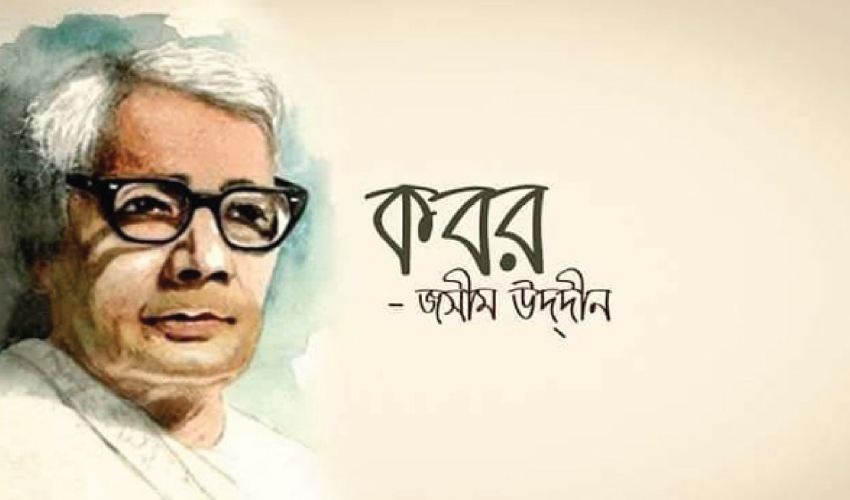
By Ayman Anika
I first read Kobor (The Grave) as a school text, the way most people in Bangladesh encounter Jasimuddin. It was presented as something simple. A village poem. A grandfather speaking. A grave. A child asking questions. It seemed easy to understand, almost too easy. At that age, I thought I had understood it.
I was wrong.
A hundred years after its publication, which was approximately in 1925, Kobor refuses to stay within the boundaries we assign to it. It is not simply a poem about death. It is not even just a poem about grief. The more I return to it, the more it feels like a quiet dismantling of how we understand memory, loss, and storytelling itself.
What unsettles me most is how ordinary it is.
There is no grand philosophical language in Kobor. No abstract meditation on mortality. Instead, there is a conversation. A child asks questions, and an old man responds. That is all. Yet within that exchange, something irreversible happens. The past is reconstructed, but never fully recovered.
The Voice That Does Not Explain Everything
What strikes me now is the grandfather’s voice. When I first read the poem, I assumed he was explaining things to the child. Now I hear hesitation, evasion, and fragments.
He does not narrate in a structured way. He circles around memory. He recalls, pauses, and returns again. It feels less like storytelling and more like someone trying to hold together something that is already slipping away.
This is important because we are often taught to see Jasimuddin as a “simple” poet. Kobor contradicts that assumption. The language is simple, but the structure is not. The poem is built on absence. What is not said matters as much as what is said.
The grandfather never gives the child a complete account. He cannot. Memory does not work like that.
The Child as a Listener, Not a Learner
Another detail that I overlooked earlier is the role of the child. We are used to thinking of the child as someone who is being taught. But in Kobor, the child is not simply receiving knowledge.
The child interrupts.
The child asks direct, uncomfortable questions. Questions that the grandfather cannot fully answer. In doing so, the child exposes the limits of memory.
I find this dynamic fascinating. The poem does not present wisdom flowing smoothly from one generation to another. Instead, it shows a tension. The older generation carries memory, but the younger generation challenges how that memory is told.
This is not nostalgia. It is friction.
In many literary traditions, death is treated as something distant or elevated. In Kobor, death is immediate and domestic. It exists within the family, within the village, within everyday life.
The grave is not symbolic in an abstract sense. It is physical. It is located. It belongs to someone who was loved, who lived, who was part of daily routines. This grounding changes how I read the poem. It removes any possibility of romanticizing death. There is no aesthetic distance. The loss is direct, and it remains unresolved.
Even after the story is told, nothing is concluded.
Memory as Reconstruction, Not Preservation
One of the most compelling aspects of Kobor is how it treats memory. We often assume memory preserves the past. The poem suggests something else. Memory reconstructs, and in doing so, it alters.
The grandfather’s recollection is not stable. It shifts as he speaks. Details emerge and fade. The act of remembering becomes part of the poem itself. This is where I think Kobor becomes unexpectedly modern. It does not present memory as reliable. It presents memory as fragile and incomplete.
The child’s questions intensify this instability. Each question forces the grandfather to revisit the past, but each attempt reveals gaps rather than clarity.
Jasimuddin is often categorized as a poet of simplicity. I think this label is misleading. Kobor is simple only on the surface.
The vocabulary is accessible. The setting is familiar. But the emotional structure is complex. The poem operates through silence, interruption, and partial revelation.
What appears straightforward is actually carefully controlled. This is why the poem works across generations. It allows a young reader to engage with it at one level, while offering something far more layered to an older reader.
I now see Kobor less as a “simple poem” and more as a carefully constructed emotional space.
The Village as a Site of Memory
There is another aspect that becomes clearer with time. The village in Kobor is not just a setting. It is a repository of memory.
The grave exists within that landscape, but so do the relationships, routines, and histories that give it meaning. When the grandfather speaks, he is not just recalling a person. He is recalling a way of life. This is what makes the poem feel increasingly distant today. The village that Kobor presents is not the village we see now. That distance creates a new layer of reading.
I am not only reading about loss within the poem. I am also aware of a larger cultural loss outside it.
A hundred years later, Kobor continues to be taught, recited, and remembered. But I think we often reduce it to a moral lesson or a sentimental story.
That approach misses its deeper complexity. For me, the poem matters because it refuses closure. It does not resolve grief. It does not offer comfort in any conventional sense. Instead, it leaves the reader in a space of uncertainty.
The conversation ends, but the questions remain.
Returning to Kobor now, I no longer see it as a childhood text. I see it as a poem that changes depending on when you read it. At one point, it feels like a story. Later, it feels like a memory. Eventually, it begins to feel like an absence.
That transformation is what makes it endure.
Jasimuddin did not need complexity in language to achieve depth. He built it into the structure of the poem itself. And perhaps that is why Kobor, even after a hundred years, still feels unfinished.