



The two most unusual plots that can top the list of 2026 k-drama binge
By Mahjabin Rahman
Time flies fast these days, doesn’t it? There was a time when binge-watching K-dramas day and night felt completely normal for our generation. Now, we are the same people rushing to work, attending classes, meeting deadlines and dealing with everyday responsibilities. By the end of the day, if we manage to beat the exhaustion, we return to our screens looking for a story that can light up our world for a few hours.
But K-dramas no longer need to be all sunshine, romance and predictable happy endings. While the charm of light-hearted stories will never disappear, audiences today are increasingly drawn to narratives that challenge them, leave them questioning characters’ motives and linger in their minds long after the final episode.
This year was a feast for thriller K-drama fans. Suspense, mystery, psychological twists, we got it all. But out of the many dramas that kept us glued to our screens, two of them completely took over my brain.
These are the dramas that actually made me think. The kind that made me want to start a luxury brand one moment and cry my heart out the next. They put feelings into words that my heart was far too tired to even acknowledge. And honestly, isn’t that what great storytelling is supposed to do?

The Art of Sarah
If someone had told me at the beginning of the year that a K-drama about luxury brands, ambition and deception would have me completely hooked, I probably would have laughed. Yet The Art of Sarah did exactly that.
At first glance, it looks like a glamorous story filled with high fashion, wealth and the kind of lifestyle most people can only dream about. The world of luxury often appears dazzling, almost untouchable, as if its sparkle could never fade. But The Art of Sarah peels back that glittering facade and reveals something far more unsettling. Beneath all the beauty, prestige and carefully curated perfection lies a world that can be surprisingly shallow, lonely and dark.
There were moments while watching, the glamour felt suffocating. Every sparkling event, designer outfit and picture-perfect appearance seemed to hide another layer of pressure, insecurity or deception. The drama explores ambition in its rawest form, asking just how far a person is willing to go to become someone else or perhaps become the person they have always wanted to be.
What makes The Art of Sarah stand out is that every episode peels back another layer of its characters, making you question who is telling the truth and who is simply performing a carefully crafted role. And somehow, between all the manipulation, mystery and stunning visuals, it manages to keep you emotionally invested in people you are not always sure you should be rooting for.
Another thing worth mentioning is the chemistry between the two leads. Surprisingly, this is not a romance-driven drama, yet the tension and connection between them are impossible to ignore. Their dynamic adds another layer of intrigue to the story, proving that chemistry does not always need a love story at its center to make fans ship for them. In many ways, it makes the emotional stakes even more compelling.
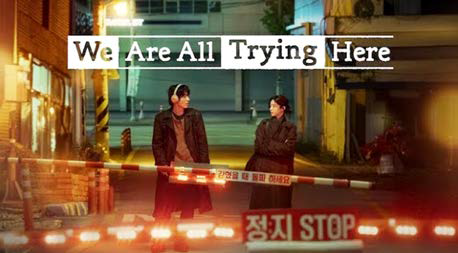
We Are All Trying Here
We Are All Trying Here is a deeply focused, introspective K-drama that dives into the uncomfortable realities of ambition, self-doubt and burnout within the film industry. At its core, it follows two broken individuals trying to function in a world that constantly reminds them of what they are not.
Hwang Dong-man, played by Koo Kyo-hwan, is an aspiring director who has written fourteen scripts over twenty years without ever managing to turn one into a finished film. On the surface, he appears loud, chaotic and almost irritatingly restless. But underneath that constant noise is a man eaten by insecurity, envy and a belief that he has already failed in life. His comparison with more successful peers only deepens that sense of inadequacy, making him both frustrating and painfully human.
Opposite him is Byeon Eun-a, a producer with a sharp, almost ruthless way of evaluating scripts. She seems emotionally detached, the kind of person who cannot be easily shaken. Yet that composure is only a surface-level defense. Beneath it lies unresolved childhood trauma and emotional exhaustion that occasionally breaks through in unexpected ways, revealing just how fragile she really is.
What makes this drama stand out is how closely it mirrors the silent struggles of everyday ambition. It does not romanticize failure or success. Rather, it shows the in-between space where people are constantly trying, constantly falling short and still expected to move forward. Because that is what life often feels like. That is life.
At its heart, the story is less about filmmaking and more about identity. It asks a difficult question: what happens when you give your entire life to something, only to realize the world is still moving without you? And more importantly, how do you continue living with that truth?
As Dong-man and Eun-a slowly cross paths and begin to understand each other’s pain, the drama shifts from isolation to connection. Not that this connection fixes everything, but their connection simply makes survival a little less lonely.
One of the most powerful moments in the drama is the cardigan scene, where silence says more than words ever could. When asked about its meaning and audience interpretation, the actor behind Dong-man reflected, “My interpretation of the cardigan scene’s reception is not important. I present that to the audience, and the reception is also the audience’s. I think everyone’s interpretation is valid.” That response fits the drama perfectly. It shows that instead of locking emotion into one meaning it allows viewers to carry their own understanding of love, comfort and distance within that moment.
The emotional weight of the series also feels deeply connected to writer Park Hae-young, known for My Mister and My Liberation Notes. Across her works, she consistently brings out the silent struggles of life that people often hide from the world. Her characters never make a scene out of their pain. They live with it, endure it and often carry it alone in silence just like so many of us do in real life. In We Are All Trying Here, she once again captures that unspoken exhaustion of existence, where simply surviving each day becomes its own kind of resistance.
In the end, We Are All Trying Here is not about victories or clean resolutions. Instead, it is about the understanding that everyone is struggling in their own way, and sometimes just trying is the only thing people can truly afford to do.
So with these two dramas, one wrapped in luxury and ambition and the other rooted in the struggle of simply getting through each day, we are left with something surprisingly similar underneath it all. They may tell completely different stories but they circle the same truth in different ways.
Life is what we make of it, whether we are chasing success in a world of glamour or trying to survive the weight of our own failures. And maybe that is exactly why these two dramas ended up at the top of this mid-year binge list. They are not similar but they leave you with the same thought in the end.