



Searching for Louis I. Kahn beyond the blueprint
By Ayman Anika
Some documentaries begin with a mystery. My Architect: A Son’s Journey begins with an omission.
The camera does not open on a grand building or a celebrated architect standing beside a model. Instead, Nathaniel Kahn reads the obituary of his father, Louis I. Kahn, published in The New York Times in March 1974. It records the death of a major American architect, a man whose brick-and-concrete forms had influenced an entire generation. It names his wife and daughter.

Nathaniel is not there.
“When I first read that obituary,” he says, “I was looking for my own name.”
That missing name becomes the doorway into one of the most unusual films ever made about architecture. Released in 2003, My Architect is not a conventional portrait of a master. It is a son’s investigation into a father who achieved permanence in buildings but remained elusive in life.
Louis Kahn never married Nathaniel’s mother, landscape architect Harriet Pattison. He never lived with them. Nathaniel saw him only occasionally and was 11 when his father died. What remains are a few photographs, fragments of memory and a monumental body of work that seems, at times, more accessible than the man who created it.
The film’s title is quietly possessive. Not “Louis Kahn,” not “The Architecture of Louis Kahn,” but My Architect. Nathaniel must first reclaim the right to call the famous man his own.
My Architect was nominated for the Academy Award for Best Documentary Feature, but its importance lies beyond awards. It remains compelling because it refuses the neat satisfaction of either celebration or exposure.
Death in transit
Kahn’s death has the strange, bleak quality of an unfinished screenplay.
Returning from India, he collapsed at New York’s Pennsylvania Station, apparently after suffering a heart attack. He died bankrupt and alone. The address in his passport had been crossed out, and his body reportedly remained unidentified for several days.
Nathaniel cannot stop circling the details. Why had Kahn crossed out the address? Who had he spoken to? Was he planning, as Harriet believed, to leave his wife and finally live with Nathaniel and his mother?
The questions sound like clues, but My Architect gradually reveals that there will be no final discovery hidden in an archive. Kahn’s life cannot be solved. It can only be approached through testimony, architecture and contradiction.
Nathaniel travels through the film like a polite detective carrying an old emotional wound. He is courteous, curious and occasionally awkward. That awkwardness becomes one of the film’s strengths. He is not pretending to be an objective historian. Every question is both professional and personal.
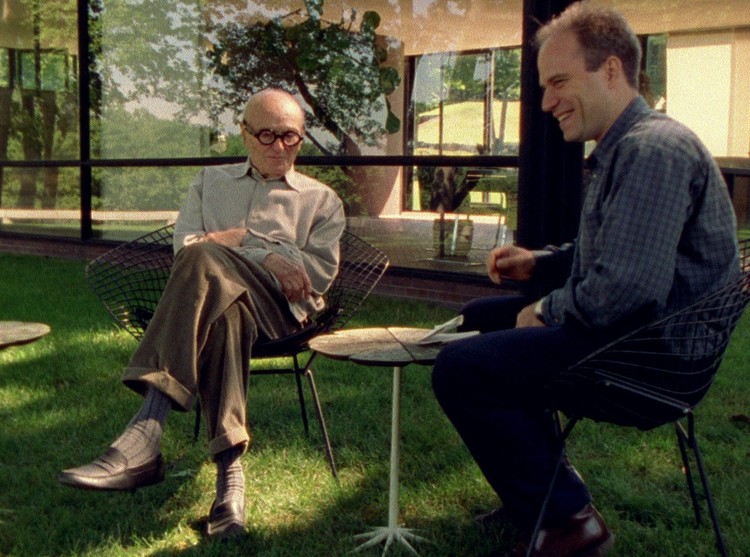
When he meets architect Philip Johnson, Johnson greets him with immediate recognition: “You’re Lou’s son.”
It is a simple sentence, but in a film built around erasure, it lands with unusual force.
The architect architects could not forget
The parade of famous architects in My Architect could easily have turned the film into a shrine. Instead, their admiration only deepens the mystery.
Philip Johnson calls Kahn perhaps the most beloved architect of their time. He compares him with Frank Lloyd Wright, Ludwig Mies van der Rohe and Le Corbusier, yet insists that Kahn possessed a warmth the others lacked. Johnson even suggests that all his own buildings do not add up to what Kahn achieved in a handful of works.
I. M. Pei makes a similar point. Quantity is not the measure of architectural success, he argues. Three or four masterpieces can matter more than dozens of respectable buildings.
Kahn did not leave behind a vast catalogue, but the list is formidable: the Salk Institute, the Kimbell Art Museum, Phillips Exeter Academy Library, the Yale University Art Gallery, the Yale Center for British Art and the National Parliament complex in Dhaka.
Nathaniel had already felt the weight of that legacy as a student at Yale. His father’s first major building and one of his last stood across the street from each other. Nathaniel wandered through them on weekends, moving through silent galleries and half expecting Kahn to appear around a corner.
That image captures the film’s emotional method. The son keeps entering buildings because he cannot enter the father’s life.
“What do you want, brick?”
The most famous archival footage in the documentary shows Kahn describing a conversation with a brick.
“What do you want, brick?” the architect asks.
The brick replies that it wants an arch.
Kahn proposes a cheaper concrete lintel. The brick remains unmoved. It still wants an arch.
The story has often been repeated because it is charming, but in the film it reveals something deeper. Kahn believed that materials possessed an internal logic. The architect’s responsibility was not simply to dominate them, but to listen.
His buildings appear heavy, disciplined and almost ancient, even when made from modern materials. Art historian Vincent Scully describes Kahn’s attraction to symmetry, order, geometric clarity, monumental weight and permanence. These are not buildings designed to be fashionable. They seem to want to outlive fashion altogether.
Project manager Jack MacAllister connects Kahn’s architectural honesty to his body. Kahn’s face was scarred in childhood after an accident involving burning coal. MacAllister suggests that Kahn’s refusal to hide marks of construction may have emerged from a personal understanding of visible imperfection.
For Kahn, a building’s scars could be revealed rather than covered. Difficulty could become character.
The idea is compelling, but the film also quietly complicates it. Kahn accepted exposure in materials more easily than in his private life.
Three families and a perfect geometry
Vincent Scully speaks of Kahn’s work as timeless and almost spiritual. Then Nathaniel asks whether he knew that Kahn had three families at the same time.
Scully did not.
For years, he says, he did not even know that Kahn was married.
The cut is devastating. The architect who pursued clarity, order and ideal geometry had organised his personal life through secrecy and separation.
Kahn was married to Esther Kahn, with whom he had a daughter, Sue Ann. He also had a daughter, Alexandra, with architect Anne Tyng, and Nathaniel with Harriet Pattison.
Anne Tyng’s interview is among the film’s most revealing. She describes Kahn as charming, charismatic and completely undomestic. He practically lived in his office, sleeping in short intervals on a bench. Work, he believed, was the only dependable thing.
It is a brutal philosophy, especially when heard by his son.
Yet My Architect resists turning Kahn into a villain. The film understands that emotional damage and genuine affection can exist in the same person. Kahn appears to have loved intensely, but without the ordinary discipline required to make love reliable.
The useful enemy
Every monument needs someone willing to throw a stone at it.
In My Architect, that person is Philadelphia city planner Edmund Bacon.
Nathaniel approaches Bacon because he has heard that the planner was Kahn’s professional nemesis. Bacon does not disappoint. He dismisses Kahn’s proposals for downtown Philadelphia as brutal, impractical and insensitive. When Nathaniel gently suggests that their conflict may have involved two strong egos, Bacon erupts. No, he insists, Kahn simply did not understand.
The exchange is funny, uncomfortable and essential.
Without Bacon, the documentary might drift too close to worship. His anger disrupts the idea of the misunderstood genius whose every failure must be blamed on lesser minds. Kahn could be visionary, but he could also misjudge a problem, frustrate collaborators and become trapped inside his own imagination.
The scene reminds us that great artists do not become universally correct simply because history admires them.
Dhaka, where the film changes shape
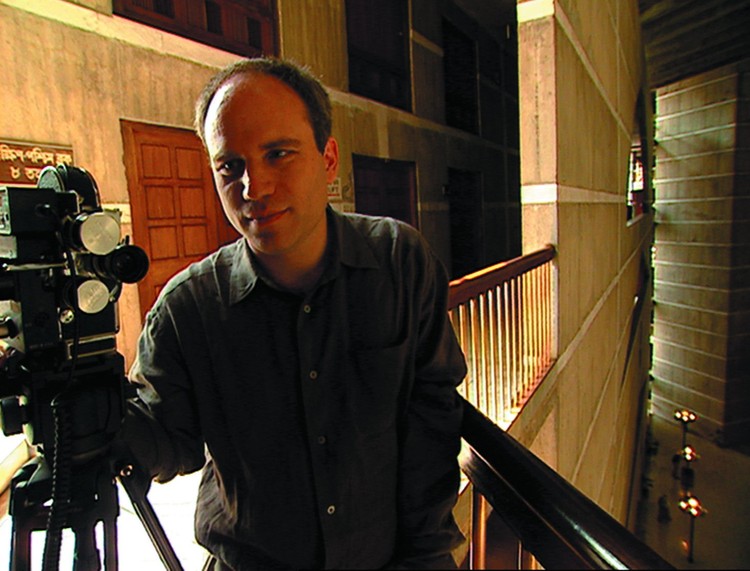
The documentary reaches its emotional and architectural peak when Nathaniel arrives at Jatiyo Sangsad Bhaban.
Until then, he has been gathering pieces of his father from other people. In Dhaka, the building itself seems to take over the conversation.
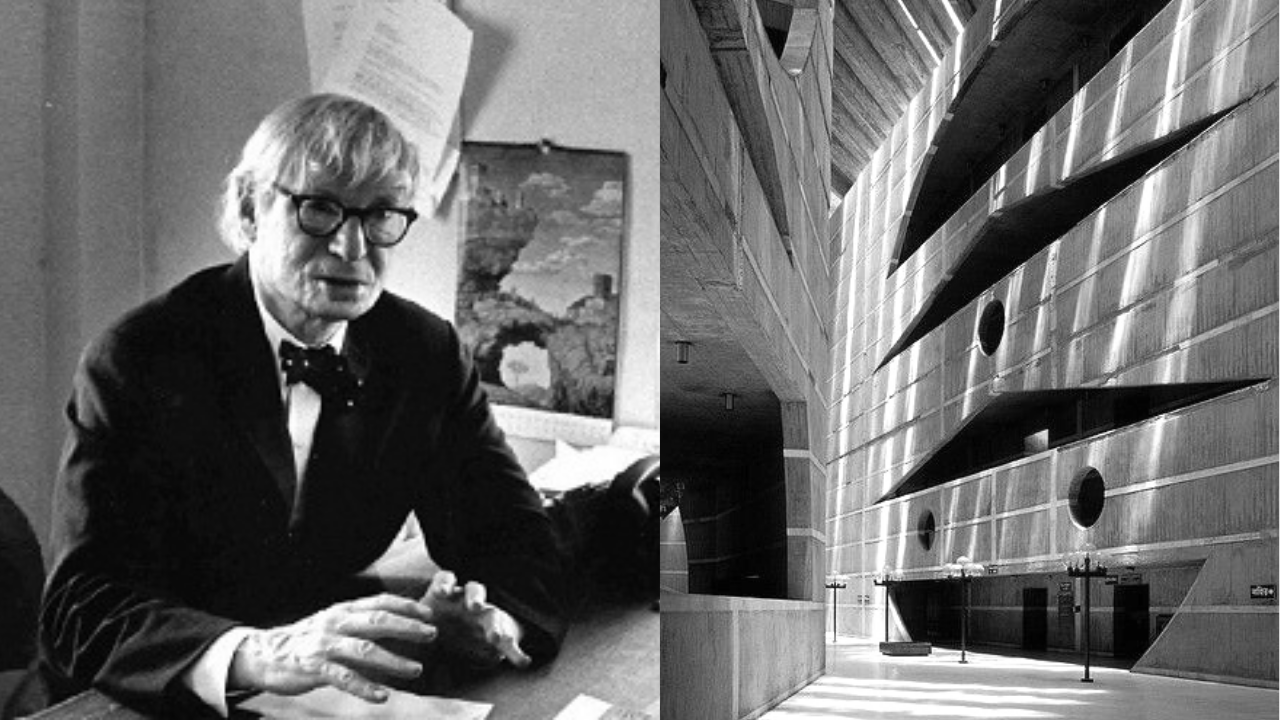
The Parliament complex does not enter the film as a decorative finale. It arrives like an answer too large to be spoken plainly. Vast concrete planes rise above water. Circular and triangular openings cut through the walls. Light moves across surfaces that appear both severe and strangely tender.
Kahn received the commission in the 1960s, when the site was intended for the legislature of Pakistan’s second capital. History transformed the project. Bangladesh emerged through war and independence, Kahn died before completion, and the complex was eventually completed in 1982 as the Parliament of a new nation.
The building therefore carries meanings that exceed even its architect’s intentions. It is at once inherited and remade by history.
Nathaniel walks through it as a filmmaker, a visitor and a son. The scale is monumental, but the sequence remains intimate. One senses that he is no longer merely studying Kahn’s work. He is trying to determine whether this building contains a part of the man that family life never revealed.
Shamsul Wares, the translator
Inside the Parliament complex, Bangladeshi architect and educator Shamsul Wares gives Nathaniel what no archive has managed to provide.
Wares had worked with Louis Kahn and understood the intellectual and emotional force of the project. In the documentary, he does more than explain the building. He interprets Kahn himself.
He describes the commission as an immense responsibility, one that Kahn accepted with extraordinary seriousness despite uncertainty, financial limitations and the possibility that he might never see the work completed.
Then Wares offers the film’s most generous and difficult idea. Kahn, he suggests, may have possessed an enormous amount of love, but his love was distributed so widely that he sometimes failed to see the people closest to him.
It is not an excuse. Wares does not claim that a masterpiece can replace a father’s presence. Instead, he gives Nathaniel a language for holding two truths at once. Kahn could love humanity through space, light and form, while failing to make that love dependable at home.
Wares becomes, briefly, the interpreter between an absent father and an adult son.
After interviews with world-famous architects, angry rivals and former lovers, it is this calm conversation in Dhaka that brings the film closest to resolution.
Inside the Parliament complex, Bangladeshi architect and educator Shamsul Wares gives Nathaniel what no archive has managed to provide. Wares had worked with Louis Kahn and understood the intellectual and emotional force of the project. In the documentary, he does more than explain the building. He interprets Kahn himself.
Can a building say sorry?
No building can apologise.
Concrete cannot explain an absence. A corridor cannot acknowledge a child omitted from an obituary. A monumental chamber cannot replace the ordinary rituals of family life.
Yet My Architect asks whether architecture can reveal something when speech has failed.
Nathaniel finds his father in partial forms: in Johnson’s admiration, Tyng’s memories, Bacon’s rage, MacAllister’s loyalty, Scully’s reverence and the tears of music-barge captain Robert Boudreau, who recognises Nathaniel and embraces him.
Each person carries a different Kahn. No version is complete.
The buildings are incomplete evidence too, but they are the most enduring evidence Nathaniel has.
A masterpiece about what cannot be resolved
My Architect was nominated for the Academy Award for Best Documentary Feature, but its importance lies beyond awards. It remains compelling because it refuses the neat satisfaction of either celebration or exposure.
It does not rescue Louis Kahn from criticism. It does not reduce him to his failures. It allows magnificence and neglect to occupy the same frame.
The documentary is also quietly funny. Nathaniel’s gentle manner, the bluntness of his interviewees and the oddness of architectural celebrity prevent the film from becoming solemn. Rabbi Kramer, Kahn’s cousin, responds to Nathaniel’s phone call with comic enthusiasm, announcing that he is photogenic. Philip Johnson speaks with affection and vanity. Bacon practically detonates on camera.
These moments make the film feel alive rather than reverential.
By the end, Nathaniel has not discovered the one true Louis Kahn. He has discovered why there cannot be one.
Kahn was the scarred boy who became an architect of monumental forms. He was the artist who listened to bricks and ignored emotional boundaries. He was beloved by colleagues, resented by others and divided among three families. He designed buildings that feel permanent while living a life of constant instability.
The final achievement of My Architect is not forgiveness. It is recognition.
Nathaniel does not find the father he wanted. He finds the father who existed, scattered across memories, buildings and unfinished promises.
And in the vast light-filled spaces of Jatiyo Sangsad Bhaban, with Shamsul Wares helping him understand what words alone could not, the son finally comes closest to meeting him.
Nathaniel does not find the father he wanted. He finds the father who existed, scattered across memories, buildings and unfinished promises.