



Abak Hussain
Louis I Kahn is a name familiar to most Bangladeshis. It is a name every schoolchild learns as part of their core education: the parliament building on Sher-e-Bangla Nagar was designed by the architect Louis I Kahn. I certainly learnt this unforgettable factual nugget as a child from my government issued textbooks, but that was as far as the knowledge went. I knew nothing about the man, what else he designed, what were his professional habits, what was he like as a human, as a family man?
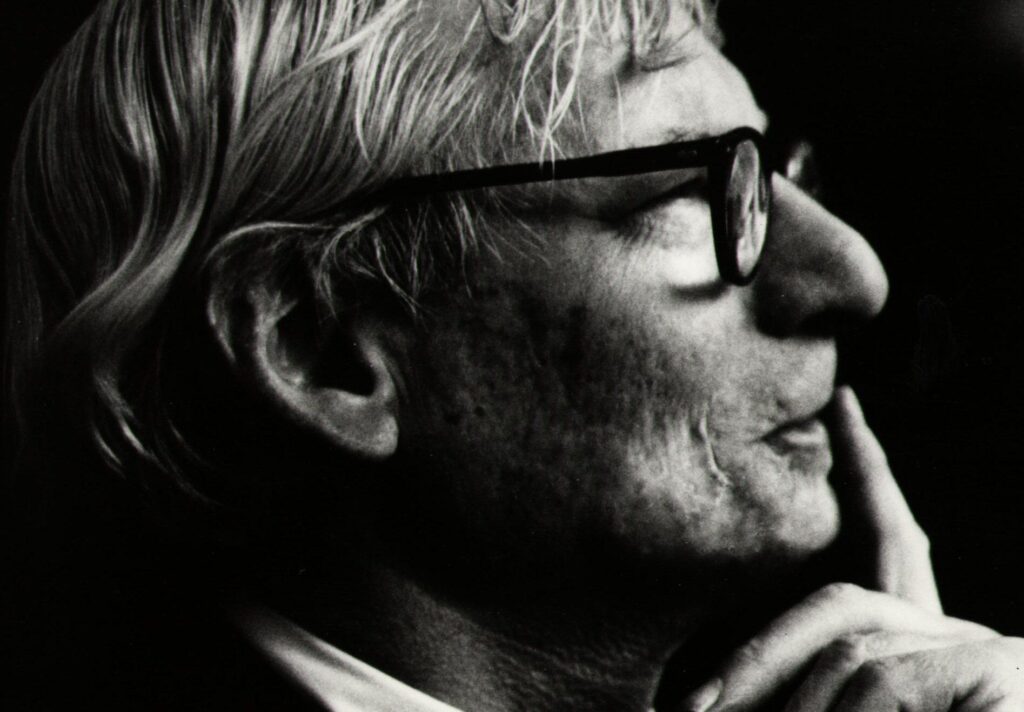
Photo Source: Robert Lautmann
Turns out, for a long time, neither did his son, the two-time Oscar nominated film-maker Nathaniel Kahn. So the rest of us may be forgiven for our ignorance. But learning about him, as well as following Nathaniel from place to place trying to excavate the story of his father, is well worth the trip. At the end of the film My Architect: A Son’s Journey (2003) we are left with a better understanding of Louis I Kahn as a man who was neither hero nor villain, but an extremely talented architect who was often neglectful towards his loved ones. He was a workaholic who was not always quite as successful financially as some of his colleagues, and a man who quickly fell in love and got embroiled in affairs he later did not know how to deal with. He was a flawed human being, and in this film he gains three-dimensions; no longer merely a foreign-sounding name we memorized in school. Nathaniel ends up gaining a deep sense of not only his father, but also himself.
Louis Kahn was born in 1901 in what is now Estonia, and in his early childhood, his family emigrated to the United States. Based in Philadelphia, through hard work and talent, Kahn was able to establish himself as an architect of great repute. His most significant project on US soil is probably the Salk Institute in California. He also designed the awe-inspiring Phillips Exeter Academy Library in New Hampshire along with many other projects. He was a believer of quality over quantity, so his catalogue is not quite as long as that of many others among his contemporaries, but what he has done tends to have an aesthetic excellence that is hard to forget. This is why in the field of architecture, globally, Kahn is known as one of the all-time greats.
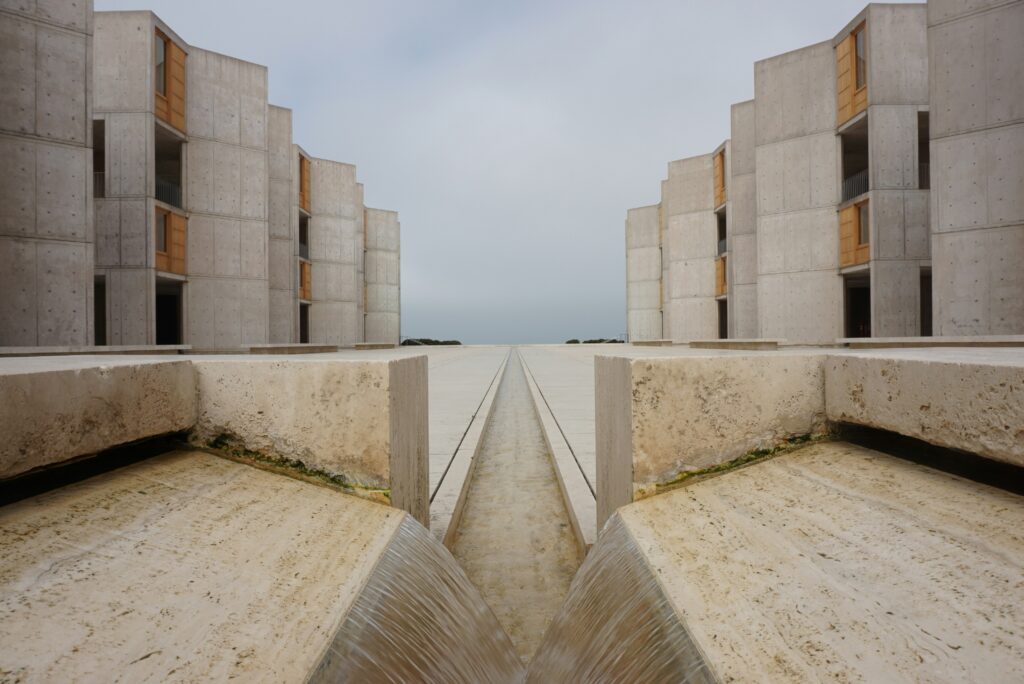
Photo Source: Adam Bignell
Moving out of home turf, he designed the Indian Institute of Management in Ahmedabad. In the early Sixties, before Bangladesh was yet an independent nation, Kahn got the last project that would be his swan song and his lasting claim to fame: The National Assembly Building in Dhaka, which was to later become our parliament building, or Jatiya Sangsad Bhaban. But as fate would have it, in 1974, returning from a work trip to South Asia, back home in Penn Station in New York, Kahn suffered a heart attack. He died around the age of 73, while our Sangsad Bhaban was still a work in progress. The structure would not be finished until the early 80s, so the great architect never got to see his own masterpiece in all its completed glory.
While Louis never got to see his own final work, his son Nathaniel never really got to know Louis. Kahn had three children from three different women – Kahn had never married Nathaniel’s mother Harriett Pattison, who was also an architect. At the time of Kahn’s sudden death at Penn Station New York in 1974, Nathaniel was only 11 years old. He had many fragments of memories of his father. A certain feeling pervaded his life, but he never quite got a handle on it, until many years later as an adult when he set out to really understand the man who had until now been a myth. This brilliant film, ultimately, is a meditation on how a myth turns into a father.
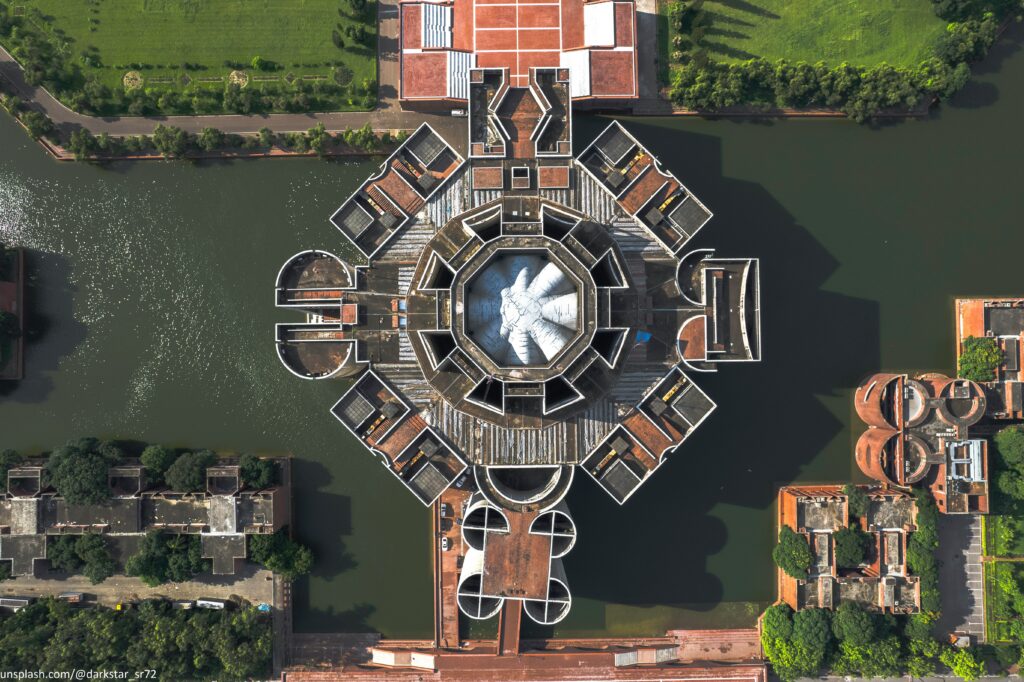
Photo Source: Darkstar
In his quest to find the man behind the myth, Nathaniel interviews a number of people who knew or had some connection to his father. Many of them are architectural legends. Nathaniel talks to Philip Johnson, Frank Gehry, and IM Pei. But this film is about a boy’s search for his father, not a who’s-who of the Mount Rushmore of architecture, so he also interviews cab drivers who drove his father around, the Rabbi who officiated his wedding, and, perhaps most wrenchingly, his own mother. Harriett, who fell in love with Louis and had a son (Nathaniel) with him. His mother is reluctant to speak ill of the great architect. “You gotta admit mom,” Nathaniel confronts his mother at one point, “what he did to us … it was pretty bad. Don’t you think so?” Pondering for a second, Harriet quietly says, “Yeah …” “Don’t you ever get angry?” Nathaniel shoots back at her. “No …” says Harriet, and then, “well I did get angry sometimes but I thought … I don’t know …” and she trails off into herself. It is a devastating scene, and it left me reeling when I first saw it years ago, and again when I rewatched it just now.
The conclusion of the movie happens right here in Bangladesh, where Nathaniel finally gets to tour the parliament building. The interior is exquisite, with natural light falling through the windows Kahn strategically designed. “He never saw this,” Nathaniel mutters to himself, and perhaps to his cameraman. Here he talks to architect Shamsul Wares, who tells Nathaniel that Kahn had tremendous love for the world. One wonders: does that excuse the fact that he never had enough time for the ones who needed his love the most? Does being a great artist excuse someone from being an absent father? But those are not questions that any film can really answer; those are matters we must decide for ourselves.
Abak Hussain is Contributing Editor at MW Bangladesh.