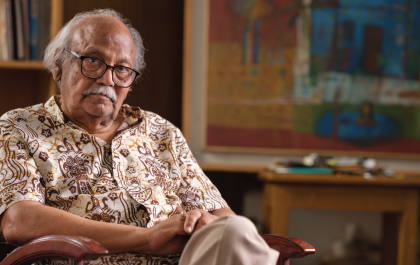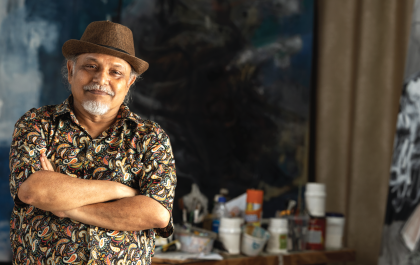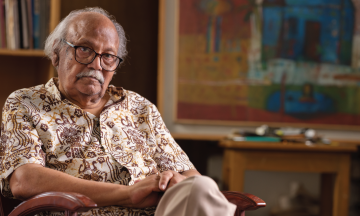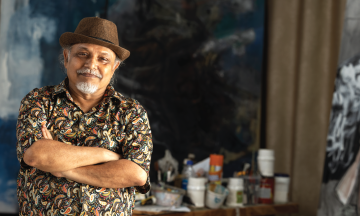




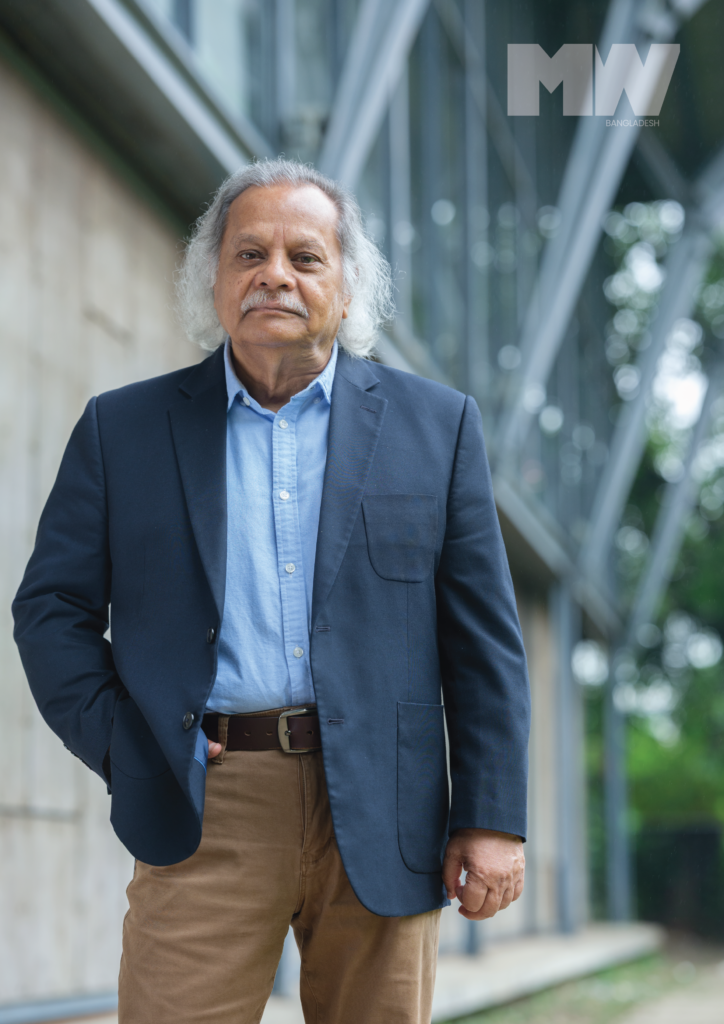
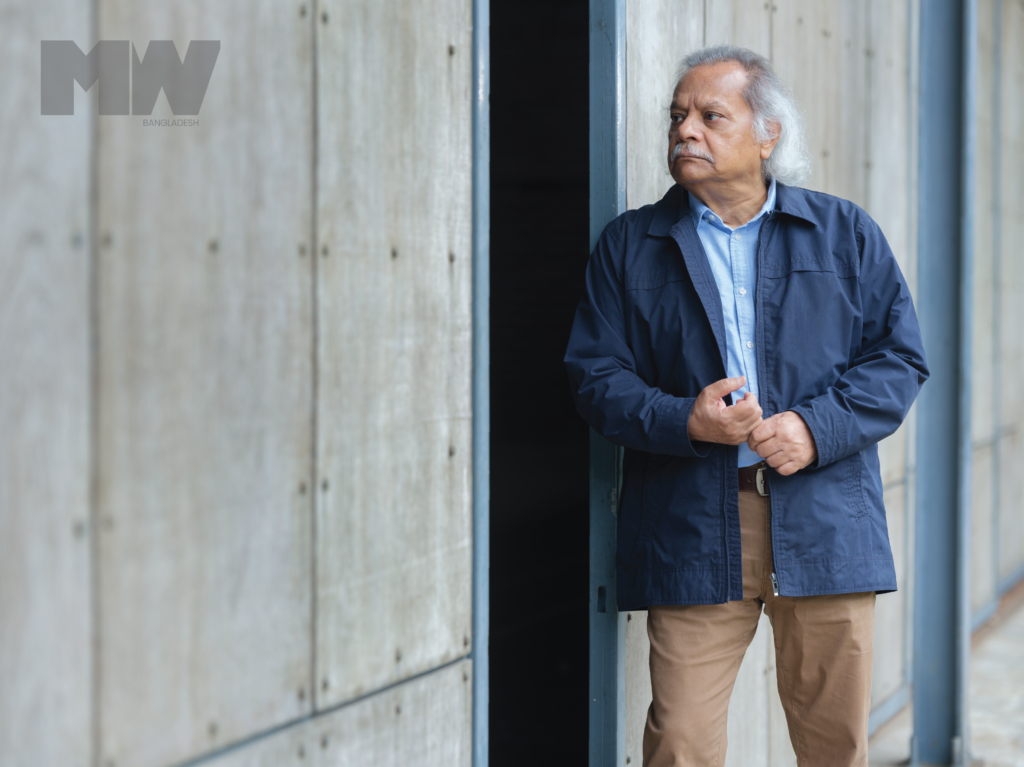
More than any other art form, architecture can work towards the cause of social justice and equality. Architecture creates the places we work, the homes we live in, and the public spaces we move through in our daily lives. As such, architecture creates reality instead of simply mirroring it. The architect Shamsul Wares, in a career spanning more than five decades, has created this reality for us, designing schools, parks, mosques, commercial buildings, and residences. Alongside, he has served as faculty in BUET and later University of Asia Pacific, mentoring countless others who would later make names in the field in their own right. Here is his story.
By Abak Hussain
For well over five decades, architect Shamsul Wares has worked tirelessly both as an architect as well as a teacher. To give a comprehensive CV of all the work he has accomplished would be a daunting task: his project catalogue is simply too long! But looking through his work over the decades, one thing becomes clear. There is a simple, functional honesty to his designs and his choice of projects. His works look to improve the quality of life and serve a purpose.
He has poured his energy into many projects where his involvement may not be common knowledge. Some highlights from his vast career include the VC’s Bungalow in BUET, Shishu Park, National Botanical Gardens, Ibn Sina Pharmaceutical Complex, Bangladesh Livestock Research Institute, Udayan Uchcha Madhyamik Bidyalaya, Motalib Plaza, and many, many residential structures. To look through the master plans and various models from his catalogue provides a fascinating glimpse under the hood, while looking at photographs of many of these familiar structures, often constructed with the iconic red brick, serve as a reminder of just how much architects like Shamsul Wares shape the reality of our day-to-day urban life.
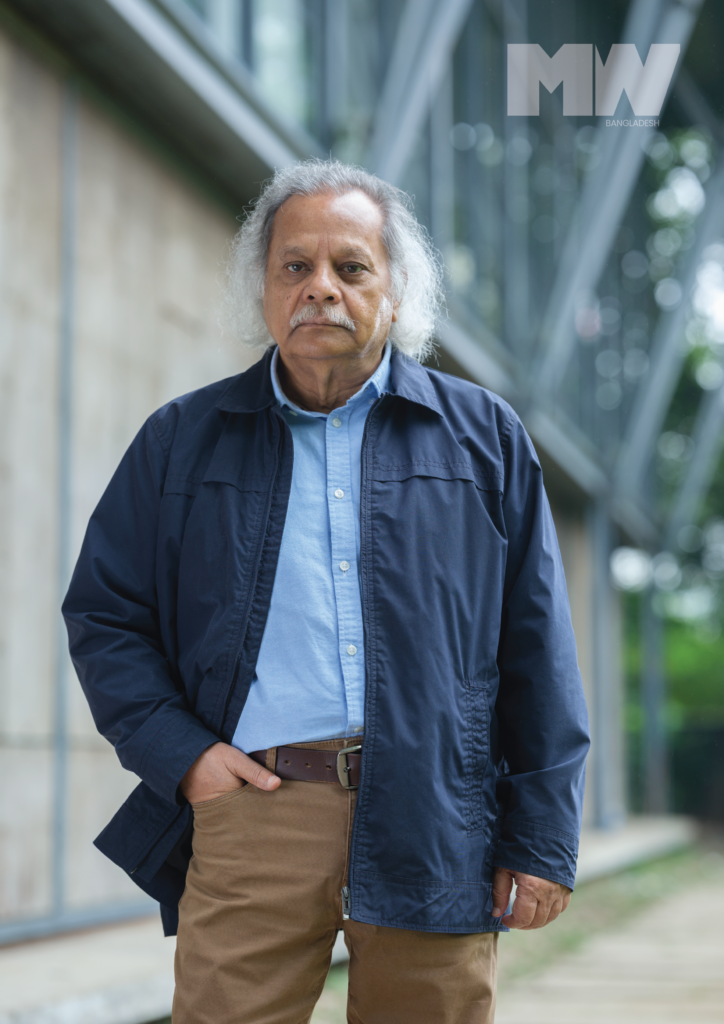
On a rainy day at his picturesque home, we sat down for a conversation. It quickly became clear that his interests are broad, and his vision is deep. His strong concern for social justice, equality, and the standard of human life looms large over everything. Perhaps that explains why most of his projects seem necessary for society rather than indulgent. Schools, mosques, factories – these are all projects that take many complex factors of functionality into consideration, and do not care for ostentation or vanity.
He was born on January 21, 1946 in Bangshal, Old Dhaka. Shamsul Wares’s lengthy architectural career began in earnest when he started working as a junior architect under Muzharul Islam, who is widely considered the pioneer of Bangladeshi architecture. After this brief stint, he continued on his own henceforth as a professional architect. An architecture graduate of BUET, he embarked on an academic career that has continued along with his architectural work. He was a faculty member of BUET from 1972 to 2003, and then Professor and Dean at the School of Environmental Science and Design at the University of Asia Pacific from 2003 to 2015. He has also served as advisor at the State University of Bangladesh.
Among numerous awards, he has won the Life Time Achievement Award for architectural education (2009) awarded by the Institute of Architects in Bangladesh (IAB). He also received the prestigious IAB Gold Medal for architectural education in 2017. He has served as a technical expert committee member for multiple government organizations over the years, including the Ministry of Public Works, Ministry of Cultural Affairs, Dhaka University, and Export Promotion Bureau. He was president of IAB for two terms, from 1995 to 1997 and again from 1997 to 1999. Furthermore, Shamsul Wares has been a jury member for various international design competitions, including the Architect of the Year Award (AYA) in New Delhi (1997, 1999), ARCASIA Award for Architecture in Dhaka (2003), and CAA 7th International Student Design Competition (2006).
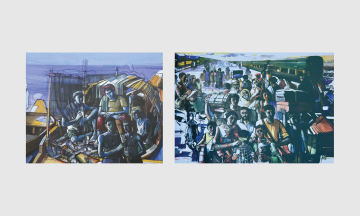
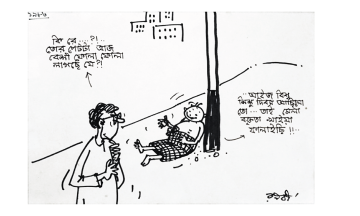
In addition to all this, Wares is also known as an art critic. He has written around 200 articles on art and architecture in both Bangla and English over the course of the last 50 years. These have been published in various local daily newspapers, journals, and magazines. A compilation volume of about 80 of these pieces is forthcoming from UPL.
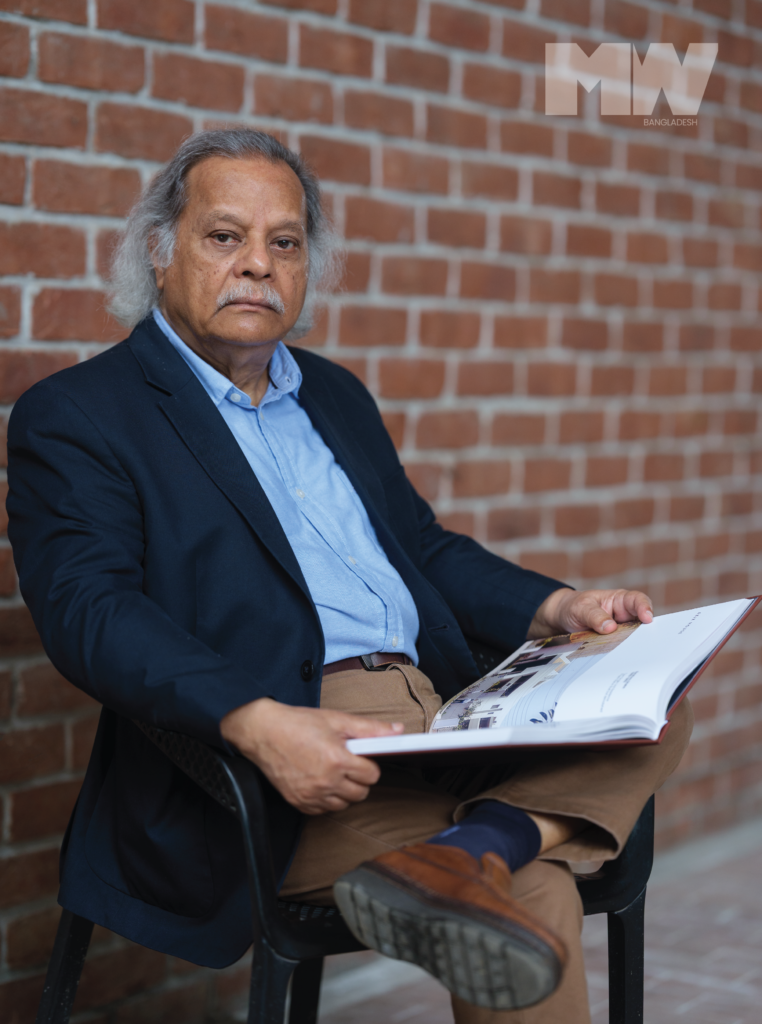
No doubt, it is a highly impressive resume. But a long view of his career is one thing. Getting more to the heart of the matter is another. What propels him towards the next piece of work? Truth is, Shamsul Wares relentlessly ponders on how the life and livelihood of people can be improved. What type of homes should people live in? What size should these homes be? How can we solve the many problems that plague our urban landscape? What needs to change at the policy level? Rules and regulation, taxation, car ownership, and most importantly, wealth inequality: these are concerns of overarching importance for Wares. From our lengthy conversation, time and again it became apparent to me that he believes that an unequal society can never be a fair and just society. A society where the upper 1% controls the lion’s share of resources is doomed to fail over and over again. But this gross inequality, unfortunately, is the reality we are living with at the moment. In that regard, his ideological view reminded me of Brazilian architect Oscar Niemeyer, who was a champion of the common people, and famously said: “architecture tends to benefit the rich, but the important thing is to make life better.” Throughout our discussion, Shamsul Wares made it very clear that the “value system” to him was paramount. As he succinctly put it: “Artists and architects should take a position against commercialization and consumerism in their work.” To Wares, architectural work then, goes far beyond the aesthetic and the functional, and has far-reaching ethical implications.
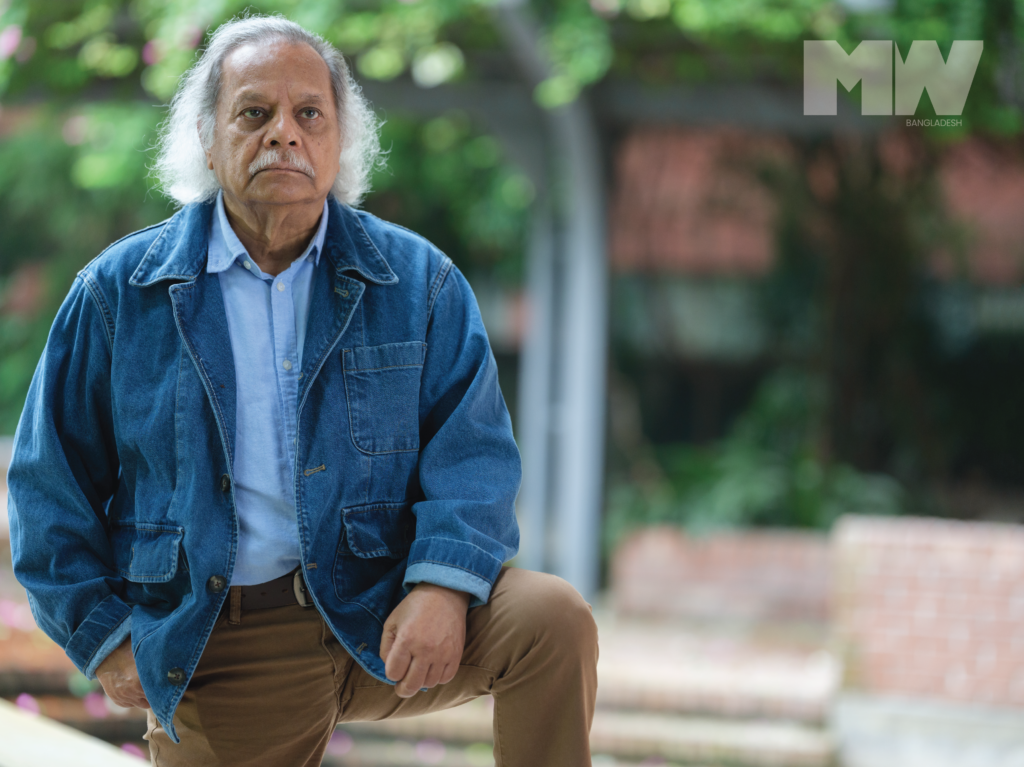
In a conversation with Shamsul Wares, the world of politics inevitably seeps into the architectural world, like sunlight flooding through an open window. For many, he became known through Nathaniel Kahn’s film My Architect (2003), which follows the son of the legendary architect Louis I Kahn, the virtuoso behind our parliament building. It is no small matter of pride for our nation that our parliament is a stunning work by any standard anywhere in the world. The building, flowing from the philosophy of “silence and light,” puts the occupants in a state of reverence and awe. For Louis I Kahn, a Philadelphia- based architect of immense repute, our very own Jatiya Sangsad Bhaban at Sher-e-Bangla Nagar was his magnum opus. In Nathaniel’s film, we see Wares appearing in the closing scene, talking about Kahn’s legacy. This documentary film has played all over the world, receiving much critical acclaim. It shows that the words and testimony of Shamsul Wares can serve as a bridge between the bygone era of the early days of the iconic parliament building along with all its hope and promises, and the architectural landscape in the present day.
Whether talking about the present or the past, Wares is outspoken and principled. He values the promise of an egalitarian, Left-leaning social system where the poor are provided for and the standard of life is elevated for all. He is drawn to existentialist philosophy and has a fondness for classic films, which perhaps affect his aesthetic and stylistic choices. Certainly, summarizing his world in a small space is no easy task. Here are some extracts from our dialogue.
On the subject of the parliament building, and Louis I Kahn, I want to ask you about the scene in My Architect where you appear, which strikes me as the emotional climax of that film. Can you take me back to that moment?
Jatiya Sangsad is considered by many art historians as one of the best buildings of the 20th century … its presence is monumental. What Louis I Kahn designed is “silence and light.” This is very interesting – he designed the building to create “silence.” Going inside, a person will be silenced by a sense of wonder. It creates a thoughtful atmosphere, a place of contemplation. The people who work inside the parliament, they decide the fate of the people of the country. This is an immense responsibility. Louis I Kahn, in that space, has taken light from the sky. The entire interior gets natural light. You see that light is coming from the top, and then you feel that you are being watched by God. This is something Kahn did to uphold democracy. A country gets only one assembly building, and this needs to be an awe-inspiring structure that reminds the people that we have our democratic rights.
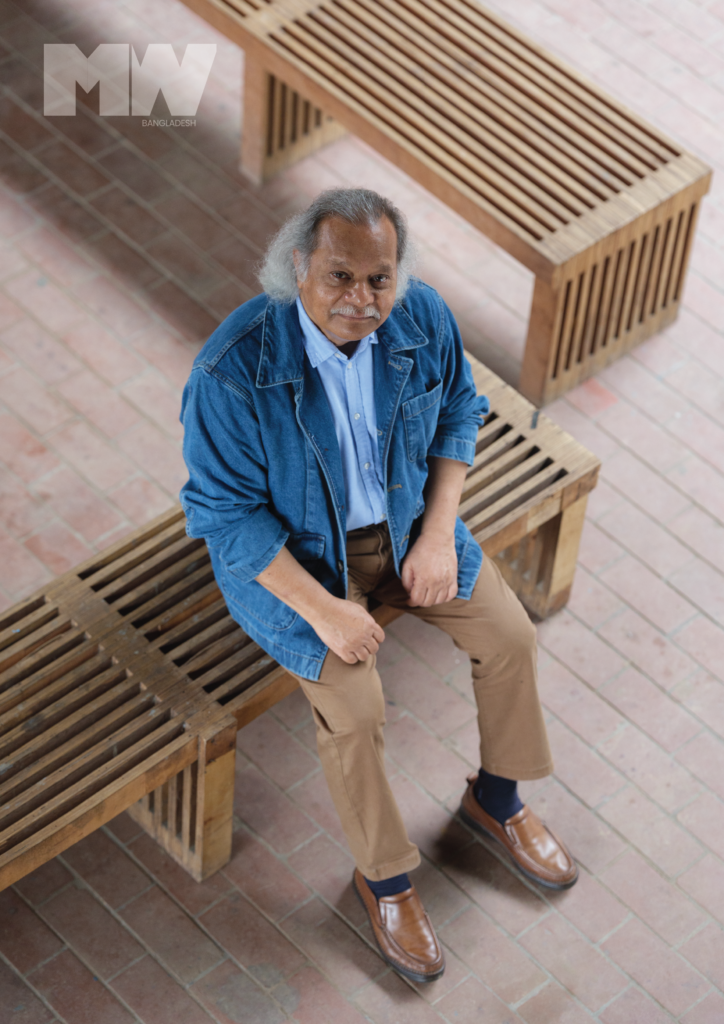
Nathaniel Kahn was only 11 when his father Louis passed away, so he came here to explore the life and work of his father. He wanted to find his father through the man’s work. He ended up in Dhaka as his last stop. When he came to Dhaka, Professor Nurur Rahman Khan recommended me as a contact, as someone who could talk to him about Kahn.
Going inside, a person will be silenced by a
sense of wonder. It creates a thoughtful
atmosphere, a place of contemplation
Inside the building when we met during the scene, it was a very emotional moment, and Nathaniel was almost in tears. I comforted him during that scene, and because of that climax, that segment has been highlighted and screened around the world.
Amazing. So from the grandest of projects, let’s move to something a bit smaller. This is one of your own. I actually spent much of my childhood in the walls of this place. The Udayan school campus in Fuller Road …
The Udayan building plan was originally four floors. There’s no lift, so it was assumed that youngsters would manage with the stairs. Afterwards they increased a couple of floors. Did they include lifts after that?
Not in my time at least.
They made a few things different afterwards. They changed the windows and grills from my initial design. But the basic design is mine. 75% was mine, they changed a few things. A different firm was brought in to add two floors to Udayan, they didn’t really bring me in during that change. Anyway, these things happen! But when you studied there, must have been a long time ago … how did you feel, did you like it?
Well I liked the building! It was really spacious, and at the time it seemed even bigger, maybe because we were smaller. But the education … well!
[Laughter] Well I don’t know what they teach there! My concern is if the classrooms were comfortable. There were a lot of divisions, for example the teachers’ area, department staff, library and so on, and then classrooms to one side. Initially I’d kept the ground floor empty, with no classrooms there. They hold the assembly and national anthem portion down there. There was also an open staircase with a tamarind tree adjoining the area, I made sure not to cut down that tree. Who knows if that is still there.
I’m always fascinated by the long view of a career. I’ve seen a lot of technological changes in my own field. You have been in architecture for over 50 years. What are some of the changes that you have seen?
Change is the only constant. Technology is changing every day, worldwide. And tools are getting better and better. In our day we did hand-drawings, with T-squares and set-squares. Now, technology has improved, and work can be done on computers. We can finish up the design much more easily. We have to welcome technology! If I can complete 10 hours of work now in only one hour, there is no reason not to welcome this advancement. So technology drives us forward. However, it is not the case that humanity improves along with technology. The problem is there in our social system. The pertinent question here is: are we doing the correct design? Whether the design is hand-drawn, or rendered with computers, or AI. These are just advanced tools. I welcome the tools.
When we talk about raising the
standard of life, there are two aspects we
are looking at: quantity and quality
The problems lie in consumerism and commercialization. Under our system of capitalism, right now we are all working for the upper 1%. This has taken us to a slave mentality, so in this environment, it’s not relevant whether the work is done with hands or machines. In a consumerist society where the resources are controlled by the 1%, no system can progress in a healthy way.
You have been speaking about social injustice quite a bit. One of my favorite architects, Oscar Niemeyer, has a quote along these lines. “Architecture tends to benefit the rich, but the important thing is to make life better.”
Yes! We believe in a better world, with equal rights and democracy for all. We want all the people of the country to be able to rise into the middle class, or at least there should be a large middle class in the population. But this is impossible to achieve for as long as the 1% controls the vast proportion of wealth in the country. After living so long under capitalism, people have become desensitized to it [the wealth inequality]. A long time ago, I was going down the Hazaribagh tannery, and the stench was quite awful. I was blocking the smell with my handkerchief while I was there. Then I witnessed some kids in the area: they were playing joyfully and having a lot of fun. Like the smell wasn’t bothering them at all! Later I understood that they have been experiencing this stench since their birth, so they do not even perceive the smell. They are completely desensitized to it. So, we could all become desensitized like that. There is exploitation in all sectors of society by the rich and powerful. But this was not supposed to happen in a highly democratized society. This is why personally I have always felt more aligned to the Left. Our over-commercialized society has negatively affected our sense of humanity itself, including the arts. There has been a degrading influence on music and poetry, for example.
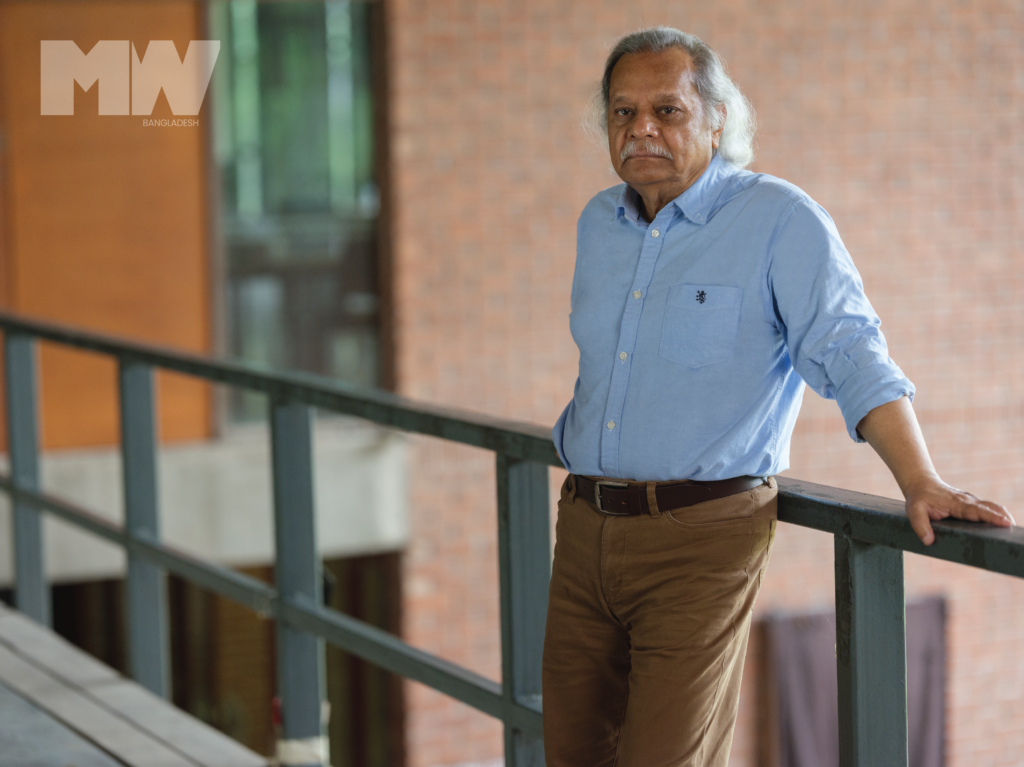
There was also an open staircase with a
tamarind tree adjoining the area, I made
sure not to cut down that tree. Who knows if
that is still there
Your remarks on Hazaribagh tannery made me think of the problem of environmental pollution. Dhaka is one of the most unlivable cities in the world, and I think the air pollution is a big culprit. Even in the film My Architect there is a shot of brick kilns belching dirty air. What do you think are the problems with Dhaka now? Can architects do something about these issues?
Dhaka has many problems, and these are regarding inadequate facilities. Dhaka is a megacity with a massive population, and for these reasons there are numerous complications. Regarding pollution, which you mentioned, there are ways to work step by step. We have to work against the things that cause pollution.
These issues are very difficult. For example, every household generates air pollution from the kitchen. Our use of detergent pollutes the water and is a danger to aquatic life. We use one-time-use tissue paper to clean things, but then the manufacturing process of tissue paper creates a lot of pollution. This is very hard to solve. Some other countries have been able to deal with it because of a much lower population density than ours. We are too congested. It is regrettable that our pollution levels are higher than what is acceptable. This is causing a lot of ailments, especially with respiratory functioning. Of course, this is not just a matter for architects. It is for the whole nation. It’s not right to blame architects though. For example, we architects don’t manufacture ACs. Regarding ACs, those who are scientists, they know that running an AC causes CFCs (chlorofluorocarbon) – and this causes air pollution. So then why did they put this product on the market? The government should have had a rule against this, that a product harmful to the environment will not get a license. If there was correct regulation, then we may have had pollution-free ACs by now.
The problem is there in our social
system. The pertinent question here
is: are we doing the correct design?
The Chinese government has managed to bring down the pollution levels of Beijing significantly in recent times through the right measures. So this is a question of government, of policy, and the work of scientists. Regarding things like bricks – it is the responsibility of manufacturers to make bricks in a clean way. Architects will probably use whatever brick is on the market, and if there is a more sustainable brick available, we will use that one. Ultimately, we won’t be able to get rid of pollution but maybe we can cut it down by 50% through a crash program within six years. The other 50% will take much more time, but by then we will be at a more tolerable stage.
I feel that there could be a city committee, or a “nogor committee” and on this committee, there could be poets, journalists, architects, planners, engineers, doctors – because we will need doctors to speak about the environment. If we could build a committee of about 20 people like that, we could solve a lot of the problems that vex us. This could give a clear direction or an “action plan” for the government. Both short-term and long-term.
Some final thoughts from Wares about the role of architecture:
Regarding what you’ve said about quality of life – of course architecture is there is to make life better. The thing about this field is, architecture is the only art that creates reality. No other art form creates a reality, but rather holds up a mirror. Let’s say we build a house, that house is a reality. Painting, literature, poetry … all of these uphold a mirror. But a home cannot be made without architecture. A workplace, a factory, all need architecture. It is an unavoidable reality that we create. Architects create the urban world. Architects will create a basic standard. We think about many aspects, light and space, and with architects, we achieve the minimum level. There is a much higher level as well of course. When we talk about raising the standard of life, there are two aspects we are looking at: quantity and quality.
We need to focus more on quality, and quality can be found in a very small home. I would declare that a 500sq-ft home, designed properly, can be functional. Japan and other countries have done this. We can make small homes like this which include all necessary facilities. People live in mobile homes, don’t they? In our country, people are more focused on the quantitative. They want more square footage. People compete with each other over who has a bigger flat. But the quality might tank. A 5,000sq-ft home could lack sunlight, air, good ventilation. In Bangladesh, we have a shortage of space, so should we not focus on more compact designs? We have fallen into quantitative thinking, where every bedroom needs an attached toilet or veranda. But why not have a common veranda for the whole family, which can be then decorated nicely? We could have bunk beds to stack the bed spaces vertically.
Here’s my personal tax policy suggestion: any home above 1,500sq-ft should be heavily taxed. The taxes should rise progressively for larger and larger homes. If you want to build a swimming pool, there should be a sizable tax for that too. The extra tax money which may be received by the government for these large houses, swimming pools, etc, can then be used for making the 500 sq-ft homes for common people, who would be able to pay the price in long-term instalments. There are many ways to reduce inequality, but for this, the government needs to have the correct intention, proper attitude, and commitment. Someone who builds a 10,000sq-ft home is taking up enough space for 20 small apartments. In a poor country like ours with a congestion crisis, this is downright immoral.
Fashion Direction & Styling: Mahmudul Hasan Mukul
Photographer: Kaushik Iqbal