

By Sumon Wahed
Rafiqun Nabi’s artistic practice is rooted in a profound understanding of the society of his time. He portrays people’s faces, gestures, professions, struggles and emotions with a diversity that remains deeply faithful to reality. Art is inseparable from human life, and it is therefore natural that everyday experience should find such a strong reflection in his work. His canvases depict the lives of fishermen and Bede communities, cowherds, families and street children. By giving prominence to people and subjects often neglected or pushed to the margins of society, Nabi does more than portray everyday life. He restores human dignity to those lives.
After completing his art education in the 1960s, Nabi joined the teaching profession. This was a fertile period for the Bengali nationalist movement, and he was not removed from the political and cultural currents of the time. This may explain why, rather than devoting himself primarily to experiments with various Western modernist styles, he became increasingly attentive to portraying the lives of ordinary people.
The art institution established in Dhaka in 1948 had already fostered efforts to connect students with the realities of everyday life. Continuing that tradition, Nabi frequently took his students to different places to practise art. He also travelled with his then colleague Hashem Khan for the same purpose. Towards the end of the decade, the two artists held a joint exhibition of watercolours that created considerable interest. Such realistic works centred on ordinary life also helped cultivate an appreciation of art among the wider public, extending beyond established connoisseurs.
Across an artistic career spanning nearly six decades, Nabi has perhaps shown his greatest interest in representing public life during the past two decades. Although many dimensions of society have appeared in his work during this period, four subjects have emerged as especially significant: fishermen, herdsmen, families and street children.
These subjects recur, but the artist’s skill and variety of presentation prevent them from becoming monotonous. His detailed compositions establish a convincing sense of place. One can almost travel through his paintings. Through his command of composition, Nabi opens spaces for the viewer to wander even within the limits of the picture plane. In a densely populated country, these people-centred works have become unmistakably Bangladeshi images.
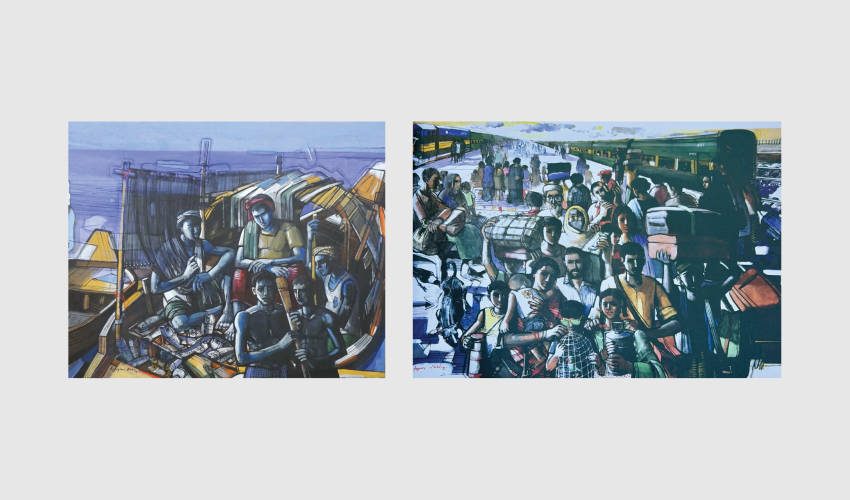
A large part of life in riverine Bangladesh is inseparable from fishing communities. The stories of fishermen have appeared in Bengali literature in many forms, while artists across generations have also portrayed their lives. Nabi’s paintings, however, reveal a distinct celebration of this world.
The artist approaches the subject in his own characteristic way. Instead of focusing on labour itself, he frequently depicts fishermen during moments of rest and leisure. In contrast to the forceful rhythm of working bodies, he presents the meditative stillness of people exhausted by labour. The beauty of work appeared powerfully in the art of Shilpacharya Zainul Abedin. In Nabi’s paintings, we encounter the beauty of rest.
This rest is never expressed through a single, repetitive posture. It changes from one individual to another. Nabi portrays fishermen reclining or sitting in various positions, with the movement of their hands and feet, and the bending and folding of their bodies, creating an aesthetically compelling geometry. This geometry is not an imitation of formulaic Western Cubism. It emerges from the physical structures and gestures of the people of this region. Saturated with a sense of place, it generates a pulse of life even within apparent stillness.
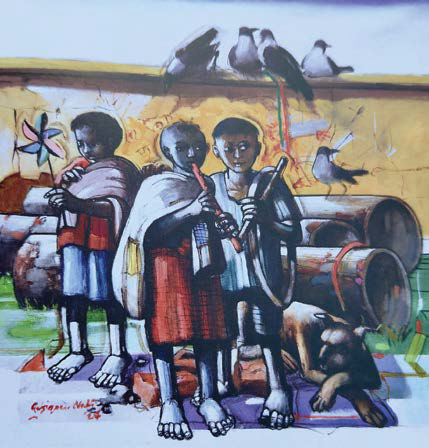
Street Boys | Acrylic on Canvas | 40 X 40 (inch) | 2024
Collector: Artist
To portray the dark, sunburnt skin of fishermen, Nabi often chooses blue. At times, the blue of the river and the blue of the fishermen’s bodies seem to merge, transforming them into a single entity.
The fishermen in Nabi’s paintings do not spend their leisure merely sitting or lying down. They gather for conversation and card games. Some play the flute for their own pleasure, while others draw on a hookah between stories. Many repair their fishing nets as they talk. After hours of hard labour, these intervals of leisure become moments of shared joy.
Bold, vigorous lines and firmly structured forms give this pleasure a sense of vitality. The formal stillness of the composition and the emotional pulse of the scene pull in opposite directions, inviting the viewer to travel through the artwork.
Nabi has also portrayed fishermen returning home with their catch after a period of rest and another expedition on the water. Their return resembles that of warriors arriving in triumph. The spontaneous presence of children and adolescents in the front row heightens the festive atmosphere.
Even the act of catching fish becomes a celebration in his paintings. Fishermen surrounding a net in a circle appear almost to be dancing, recalling Henri Matisse’s painting The Dance. Formally, Nabi’s work is in no way Matissean, but the underlying spirit is similar: a celebration of life. In other works, we see fishing boats being prepared for the journey ahead.
In Nabi’s Rakhal series, the affectionate relationship between herders and livestock comes into view. The inseparable presence of the cowherd and the buffalo, and their collective existence, remind us of the long relationship between human beings and domesticated animals throughout the history of civilisation.
The contribution of domesticated animals to the development of agricultural societies cannot be denied. In Nabi’s paintings, this coexistence reminds us that the world does not belong to humans alone. Human fulfilment lies in living alongside animals and the natural environment.
The cowherd carrying a stick is not portrayed as an oppressor. He appears instead as a guardian of life and nature. His happiness lies in this companionship. For this reason, we see him not only holding a stick, but also playing melodies on a flute.
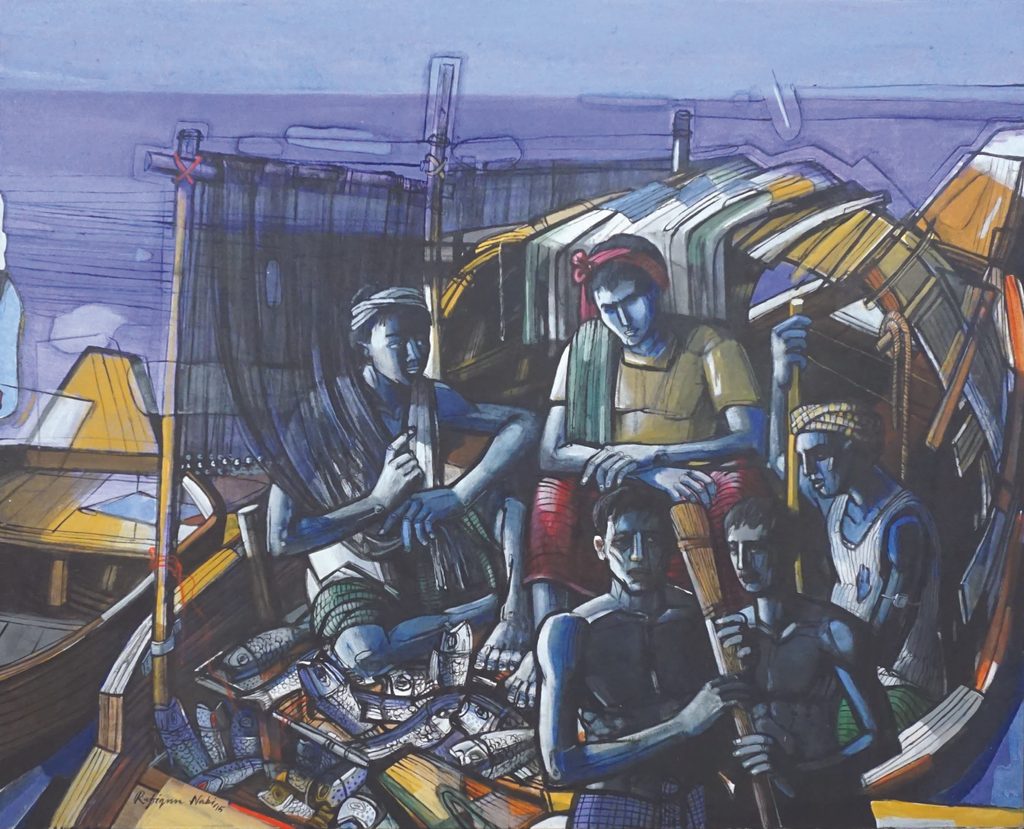
After The Catch | Acrylic on Canvas | 48 X 60 (inch) | 2015
Collector: Durjoy Bangladesh Foundation
Like the fishermen, the resting cowherd also attracts the artist’s attention. Memories of Nabi’s childhood in northern Bengal may have repeatedly inspired him to paint buffaloes. Goats, too, appear as companions to the cowherd. The suggestion of vast grasslands becomes a marker of Bangladesh’s particular landscape.
Family life and the atmosphere surrounding it occupy a considerable place in Nabi’s more recent work. Families appear in both urban and rural settings. Whether he portrays a mother and child, a father and child, or an entire household, he constructs arrangements in which people remain closely gathered. This togetherness reinforces the strength and depth of their relationships.
The child’s posture of dependence and the protective gestures of the parents intensify the sense of familial security and affection. The compositions of some paintings recall the group photographs of middle-class families from several decades ago.
The artist’s meticulous observation establishes the distinctive character and diversity of local life. His paintings also make it clear that, in rural households, livestock are often regarded as part of the family. The toys and food held by children of different ages, the clothing and adornment of family members, and various elements of domestic decoration help the viewer understand the specific time, place and people represented in these scenes.
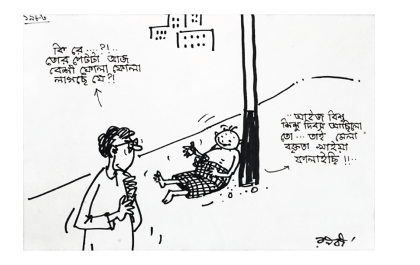
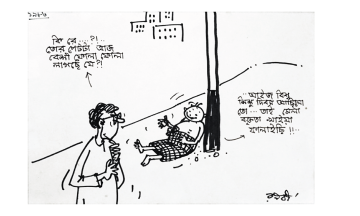
Rafiqun Nabi became “Ranabi” through Tokai, the street child he created as a cartoon character. As he often jokes, “Tokai is more famous than I am.”
Yet when Nabi took Tokai beyond the boundaries of cartoons and made him a subject of his paintings, the figure acquired an entirely different dimension. The solitary presence of Tokai within a harsh and unforgiving city draws us into existential reflection.
We see him standing against towering buildings, walking alone through dense fog, sitting between two closed doors, beside a wall or a dustbin, or facing the obstruction of a barricade. Elsewhere, he lies on a brick opposite the Parliament building or sits destitute and alone beneath a lamppost. In each of these scenes, his vulnerability compels us to think.
The artist, however, does not portray only the dangers and deprivation faced by street children. He also reveals their curious minds. We see this curiosity when Tokai peers over a wall or looks through the gap in a doorway. Images of him writing or scribbling on the pavement with whatever he can find suggest an indomitable desire to learn and express himself.
In recent years, the lives of street children have become one of Nabi’s principal subjects. Even amid their hardships and limitations, he portrays their enjoyment of life through symbolic objects such as flutes, colourful spinning wheels, toy cars made from bicycle wheels, kites and spools.
Nabi does not observe marginalised communities from the detached viewpoint of an NGO or donor organisation. He looks from within, guided by a sense of human responsibility and empathy. This is perhaps why he succeeds in portraying not only the suffering within these lives, but also their small yet immensely precious moments of happiness.
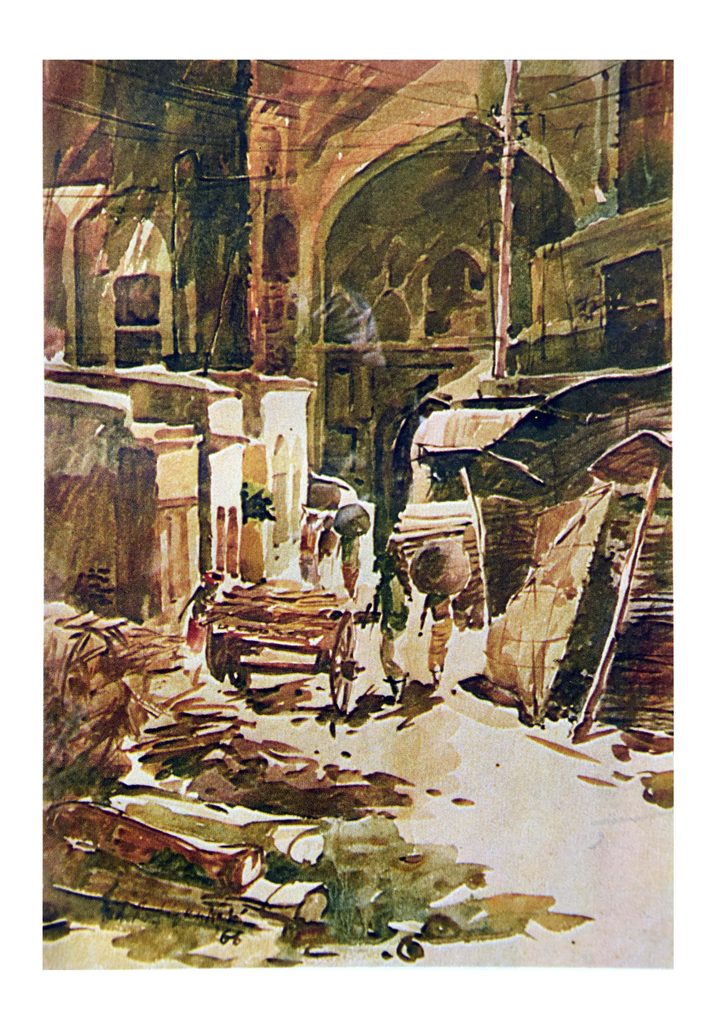
Barakatra | Watercolor | 20 X 30 (inch) | 1968
Collector: Bangladesh National Museum
Old Dhaka has long been another favourite subject in Nabi’s depictions of public life. His watercolour Bara Katra, painted in 1968, remains an important visual document of the everyday life surrounding this historic site at the time.
Drawing from memory, Nabi has also portrayed horse-drawn carriages in Old Dhaka and the Fulbaria Railway Station, capturing aspects of life in the city during the 1950s. His more recent paintings of railway stations and launch journeys reveal the remarkable diversity and coexistence of Bangladesh’s people.
At a railway station, people from vastly different backgrounds come together as they pass through. Their meeting offers a glimpse of extraordinary beauty and human connection.
A similarly detailed portrayal of collective life appears in Launch Passengers (acrylic, 2015). On the deck of the launch, people rest, play cards, read newspapers, engage in conversation and listen to the songs of a Baul musician. Within this gathering and harmony, one encounters the true Bangladesh, a country defined by coexistence rather than division and conflict.
Rafiqun Nabi’s art is an invaluable record of the diversity and realities of public life in Bangladesh. Through his brush, the lives, dreams, pain, hopes and struggles of ordinary people in villages and cities come vividly alive.
He uses colour and line not merely to create beauty, but also to communicate social awareness and a deeply human message. His art is therefore not simply something to be viewed. It becomes an inner narrative of people, society and a particular moment in history.
Just as Rafiqun Nabi’s work reflects our everyday lives, it also invites us to think more deeply about them.
Sumon Wahed
Assistant Professor
Department of Drawing and Painting
Faculty of Fine Art, University of Dhaka