

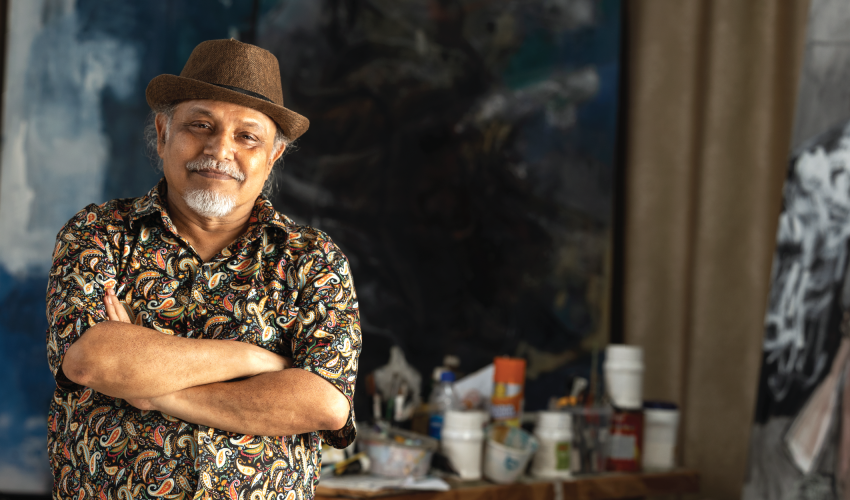
A conversation with Artist Sheikh Afzal Hossain
By Sumon Wahed
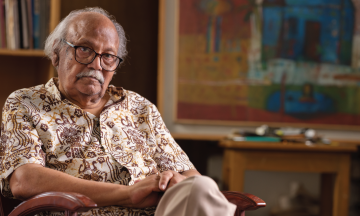
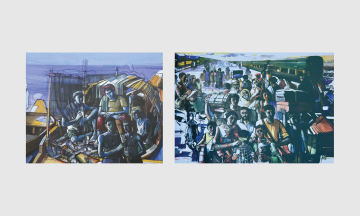
Abstraction has had a profound influence on the history of modern art in Bangladesh. Yet people return again and again to the canvases of artist Sheikh Afzal Hossain. Sometimes they appear as street children, sometimes as women, sometimes as familiar faces rendered in portraiture. Equally present throughout his artistic journey is his teacher and fellow artist Rafiqun Nabi.
What began as the respect of a student eventually developed into the relationship between two colleagues, strengthened over the years through working together, travelling, conversations and artistic guidance.
In this conversation, Sheikh Afzal Hossain looks back on his childhood, his first encounter with Dhaka, his years at the Institute of Fine Art, his training under Kazi Abdul Baset and Rafiqun Nabi, his studies in Japan, his attachment to figurative art, and his thoughts on contemporary art education and the art market in Bangladesh.
Modern art in Bangladesh has been strongly influenced by abstraction, yet much of your work is populated by figures. How did you arrive at this figurative language?
There are many figures in my work, that is true. Interestingly, I began working more consciously with figurative art after going to Japan.
Before that, when we began studying at the Institute of Fine Art, our training was largely academic. I was probably in my second or third year when Nabi Sir returned from abroad. We did not have him as a teacher when we first enrolled because he had gone to Greece for further studies.
After returning, he began taking our classes. Nabi Sir would give lectures and demonstrate things through his own work. Eventually Nabi Sir and Baset Sir became two of our main guides.
Once we entered the master’s programme, they began telling us, “Now work in your own way.”
That immediately raised a difficult question. What exactly was our own language? How much should we break down the form? What should remain and what should disappear?
Our seniors helped us too. Almost all of us went through that uncertainty.
At that stage, I began simplifying the figure. In many works there would be no eyes, nose or mouth. I would construct the figure using just a few basic shapes. I did many works like that during my master’s.
I paint people because I love people.
Before entering the Institute of Fine Art, had you heard of Rafiqun Nabi?
No, not at all. I did not know Nabi Sir before coming to the Institute.
How did drawing begin for you?
All children draw. Even before they learn to read and write, they make marks and scribbles. That is how I started too.
But there is one incident without which the story would remain incomplete.
I was in Class Four, around the time of the 1969 mass uprising. Sheikh Mujibur Rahman was travelling to different places and giving speeches.
I drew a little then: birds, cows and whatever I saw around me. Everyone at school knew that I could draw.
One day some older boys came to me and said, “You have to draw Sheikh Mujibur Rahman.”
He was coming to a school field in Harinarayanpur in Kushtia. A huge stage had been built, and an enormous crowd had gathered. Those older boys took me onto the stage.
Sheikh Mujibur Rahman came and spoke for perhaps ten minutes. Within those ten minutes, I finished his portrait.
After that, I suddenly became very well known!
He gave me 20 taka and told me, “You should come to Art College. Pass your matriculation, then come. I will arrange for you to be admitted.”
I think that was when the dream of becoming an artist truly began for me.
Then Sheikh Mujibur Rahman was assassinated in 1975. At the time, I felt as though everything was over because I had always carried this idea that he would help me enter Art College.
In the end, of course, I was able to gain admission on my own merit.
Even then I thought perhaps being an artist simply meant painting portraits. Later I discovered figures, composition and so many other possibilities.
Did you receive any formal drawing lessons as a child?
Not formally.
There was a teacher at our school named Osman Gani who could draw. He would ask me to make drawings and also show me how things should be drawn.
My greatest early influence, however, was my father. He loved music and drawing. He had never received formal training, but he seemed to have a natural understanding of these things.
He would tell me, “This is how you draw a cow,” or, “This is how you draw a bird.”
More than anyone else, my father encouraged me when I was young.
What was it like coming to Dhaka for the Art College admission test?
I knew no one.
After passing my matriculation examination, I came to Dhaka with my elder brother and my brother-in-law.
Travelling to Dhaka was not easy then. We had to cross at least three ferries. We left very early in the morning and by the time we reached Gulistan, it was dark.
I had grown up in a village. I had visited towns such as Kushtia and Jhenaidah, but Dhaka was completely different.
After getting off the bus at Gulistan, we were walking towards a nearby hotel. Along the road I saw homeless people, beggars and small children. Some were begging by the roadside. Some appeared to live there.
I had never seen anything like it.
I asked my brother-in-law, “Where do they live?”
He said, “They live here.”
My younger brother Zohur was very small then. Looking at those children, I kept thinking of him. I thought, these children should have homes too.
Looking back now, I realise that image stayed very deeply within me.
Did that memory later influence your paintings of street children and neglected people?
Absolutely.
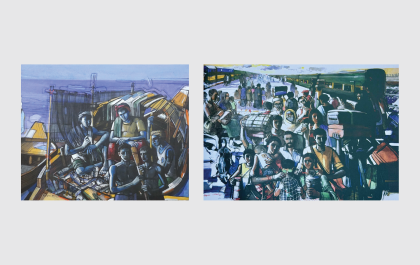
I have always painted neglected children, disadvantaged families and street children.
This is also one of the places where I see a connection between my work and Nabi Sir’s. Nabi Sir used ordinary people, Tokai and street children to speak about social crises, human emotion, deprivation and different realities of life.
Perhaps that first shock of seeing street children in Dhaka remained somewhere inside me and later found its way into my paintings.
Is there a particular memory of Nabi Sir from your student years that has stayed with you?
At one point I became very ill. I had a fever for a long time, could not sleep properly and became increasingly anxious.
One day Nabi Sir came to class. My classmates told him that I had been very ill and could not attend classes properly.
He told me, “If you keep worrying all the time, it will harm your body. Attend your classes, study and concentrate on your work. Once you become occupied with those things, these anxieties will begin to disappear.”
I still remember those words.
Did you also spend time with him outside the classroom?
Yes, and that was another important opportunity.
One of our seniors, Syed Lutful Haque, worked at Dainik Bangla. I would often go to his office after class. When his work was finished, he would sometimes say, “Come on, let’s go to Nabi Sir’s house.”
Going to Nabi Sir’s house also meant getting good food! Bhabi would prepare wonderful things for us.
But more importantly, we listened to Sir’s stories. He had so many stories to tell.
Did you work with him on the large paintings and banners produced around February 21?
Yes.
Before February 21, large banners, paintings and protest works would be displayed from Shahbagh to TSC and towards Shaheed Minar.
Nabi Sir would paint and we would work beside him. Sometimes we passed him colours or brushes.
At times he would make a small layout and tell me, “Afzal, enlarge this and copy it.”
He must have trusted me to reproduce the layout accurately at a much larger scale.
Those experiences helped me tremendously later in life.
You also painted a portrait of Shilpacharya Zainul Abedin. How did that happen?
During the Ershad period, the political situation was very difficult. There were curfews, violence and clashes. I had to move around and stay in different places for a while.
Nabi Sir’s younger brother Reza Bhai was one year senior to us. Nabi Sir told him, “Afzal probably has nowhere to stay. Bring him with you.”
They were living near Tannery Mor in Jigatola, and I stayed there for some time.
Around that period, I was given the responsibility of painting a portrait of Zainul Abedin. The painting is now in the Dean office at the Faculty of Fine Art.
Abdur Razzaque Sir was the director at the time.
I painted the portrait while staying at Nabi Sir’s home. When it was almost complete, Nabi Sir looked at it and said, “All right, don’t work on it anymore. Now show it to Director Razzaque Sir.”
I took it to Razzaque Sir the following day. He looked at it and immediately said, “Don’t touch this anymore.”
You never met Zainul Abedin. How did you try to understand him while painting his portrait?
We never saw Abedin Sir in person.
But I heard so many stories about him from Nabi Sir that I sometimes felt as though I knew him.
While I was painting the portrait, Nabi Sir would sit beside me and tell stories. He would tell me how Abedin Sir spoke, what he did, what he ate, how he worked and how he interacted with students.
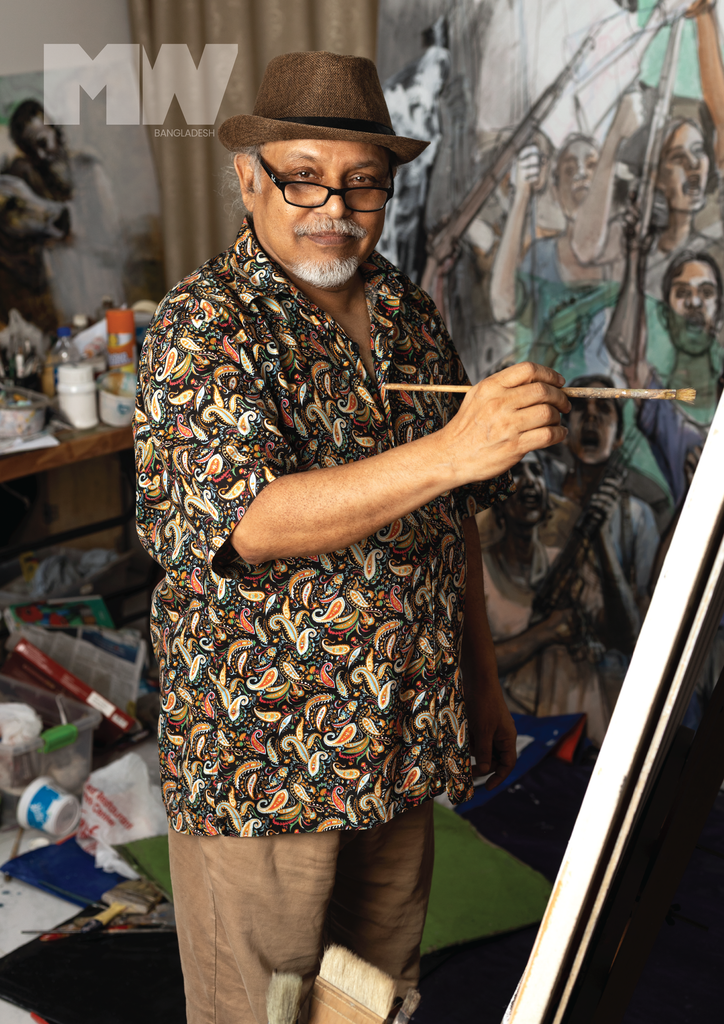
I felt that if I listened carefully enough to those stories, perhaps I could bring not just his face but something of his character into the painting.
Does seeing Nabi Sir’s work still make you want to paint?
Very much.
Whenever I visit Nabi Sir’s house, I look at his paintings, especially works I have not seen before. Then I come home and immediately feel like starting another painting.
It gives me new energy.
His compositions, his figures, the dynamism of those figures and his command of form are extraordinary to me.
How did studying in Japan affect your practice?
At first, I was extremely busy learning the language.
At the University of Tsukuba, there was a large common study area containing replicas of famous sculptures, including Michelangelo’s David and Laocoön. Between language classes, I would study there, often late into the night.
My first professor was Tanaka Sensei. He worked in a somewhat Expressionist manner.
He asked me to produce four or five large paintings. Later he came to my apartment, looked at the realist works I had produced and demonstrated another way of working.
Sometime later, because of his health, my supervision passed to Professor Fumihiko Yamamoto.
Yamamoto Sensei looked at my earlier paintings and said, “Leave these. What Tanaka Sensei has asked you to do does not suit your character. I have seen your portfolio. Study more.”
Then he gave me a new routine.
Every Sunday I had to go to Ginza, visit galleries, see international exhibitions and, when possible, go to exhibitions in Ueno. Afterwards I had to report back to him about what I had seen, what I liked and why.
Seeing those exhibitions week after week gradually opened my eyes.
Was Yamamoto Sensei himself a figurative painter?
Completely figurative.
He painted female figures and his work was extremely realistic, almost super-realist. That suited me very well because I already liked that kind of work.
There was a connection between his practice and my own interests.
He also took a great interest in my work.
I would enter the studio in the morning and often continue working until midnight.
One night I suddenly sensed someone behind me. I turned around and saw Yamamoto Sensei. He had probably been standing there for some time, silently watching me work.
He would sometimes notice that the studio lights were still on at night and come to see whether I was working.
That kind of attention from a teacher meant a lot.
Why do you keep returning to people in your work?
I wrote about this in my thesis too.
Ultimately, love for people is the most important thing.
I paint people because I love people. Their happiness, sadness, joy, pain and relationships naturally enter my paintings.
When you look at a human figure, you recognise it because you see people every day. The information already exists in your mind. The same is true of a landscape.
But an abstract form may feel unfamiliar because perhaps you have never seen that particular fragment before.
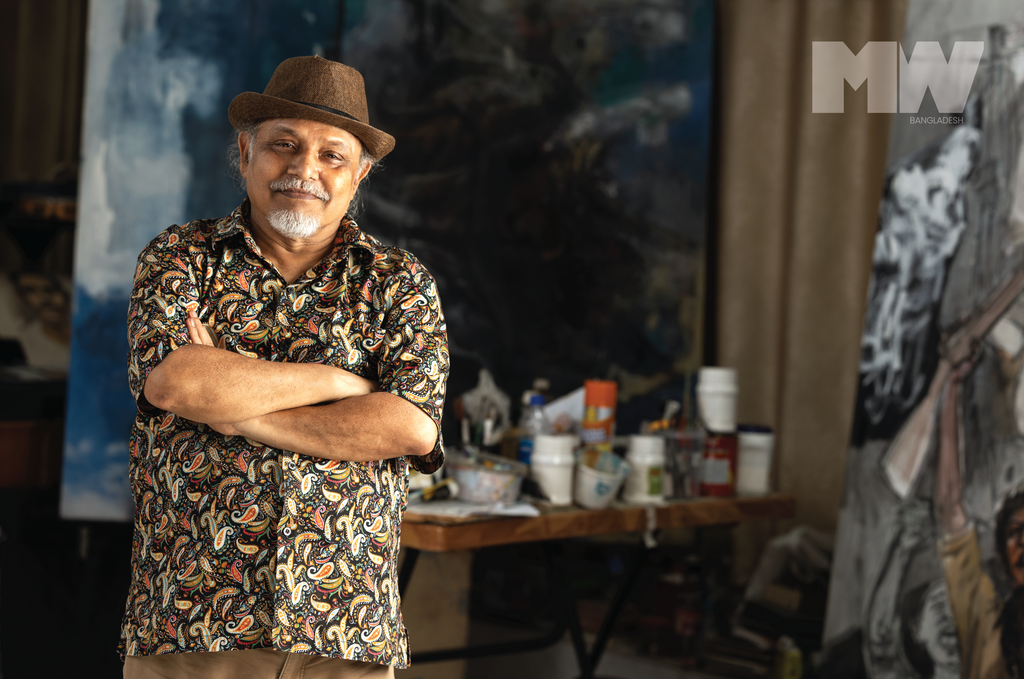
Suppose you paint a tiny section of a wall exactly as it appears, with all its texture and surface. Technically, it may be extremely realistic. But if the viewer does not know it is part of a wall, it may look abstract.
So, a great deal of abstraction can also come from fragments of reality. It feels unfamiliar because we do not recognise it.
You eventually became Nabi Sir’s colleague. Did that change your relationship?
A teacher remains a teacher.
We became colleagues and I can discuss almost anything with him, but somewhere inside me that deep respect remains.
That part of the relationship will never disappear.
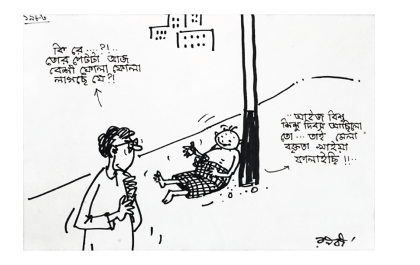
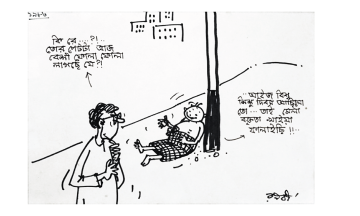
You also make cartoons. Did Nabi Sir influence that side of your practice?
Certainly.
I had been making portraits since I was young. Before digital printing, portraits of political figures and large banners had to be painted by hand.
I could often paint a face from memory once I had painted the person before.
During the Ershad period, I would see Nabi Sir exaggerate or distort faces while keeping the person completely recognisable.
That fascinated me. How do you exaggerate a face while preserving its essential character?
We learned a great deal simply by watching him.
But I did not make the kind of social and political cartoons he did. I mostly drew friends, acquaintances and people within my own close circle.
You have also travelled extensively with Nabi Sir.
It has been one of the great privileges of my life.
When I was a student, I heard Nabi Sir tell stories about travelling with Abedin Sir.
Around twenty years ago, perhaps even earlier, I had a dream in which Sir, I and several other artists were travelling together.
Later, in real life, I had the opportunity to travel with him many times.
On one trip to the United States, Nabi Sir and I travelled separately from the larger group and went to Detroit, St Louis and other places.
Nazvi Bhai, who was one year senior to us and had also been Nabi Sir’s student, sent the tickets.
Nabi Sir told him, “There are two of us.”
Nazvi Bhai replied, “Sir, I am sending one for Afzal too. Bring him with you.”
These journeys created another dimension to our relationship.
Do you follow Nabi Sir’s approach in your own teaching?
I do.
I still remember how Nabi Sir spoke to us, when he was firm and when he chose to be gentle.
In many situations, I consciously follow his example when talking to students.
His manner, his way of speaking and the way he explained things have influenced me greatly.
And Nabi Sir is tremendously witty. He has this wonderful ability to say something very serious through humour.
How do you view the way younger artists in Bangladesh are practising today?
There are both advantages and disadvantages.
The kind of study we used to do has diminished considerably.
There is a Japanese term, fuke jisshu, which means outdoor study.
Japan is one of the most technologically advanced countries in the world, yet students are still taken outside to study directly from life.
Why?
Because there is no substitute for sitting in front of reality, observing it, understanding it and drawing from it.
Here, even when teachers want students to do that, many students no longer want to. One reason is the mobile phone.
Images are now so easily available that students do not want to stand for hours in the heat, in old areas or crowded places, sketching from life.
But technology also has a great advantage.
Students today can sit at home and see what artists are doing all over the world. We never had that opportunity.
So, I do think our young artists are progressing well. They are experimenting, working at larger scales and producing many variations.
The techniques and systems have changed.
My only regret is that direct observation and study from life have diminished.
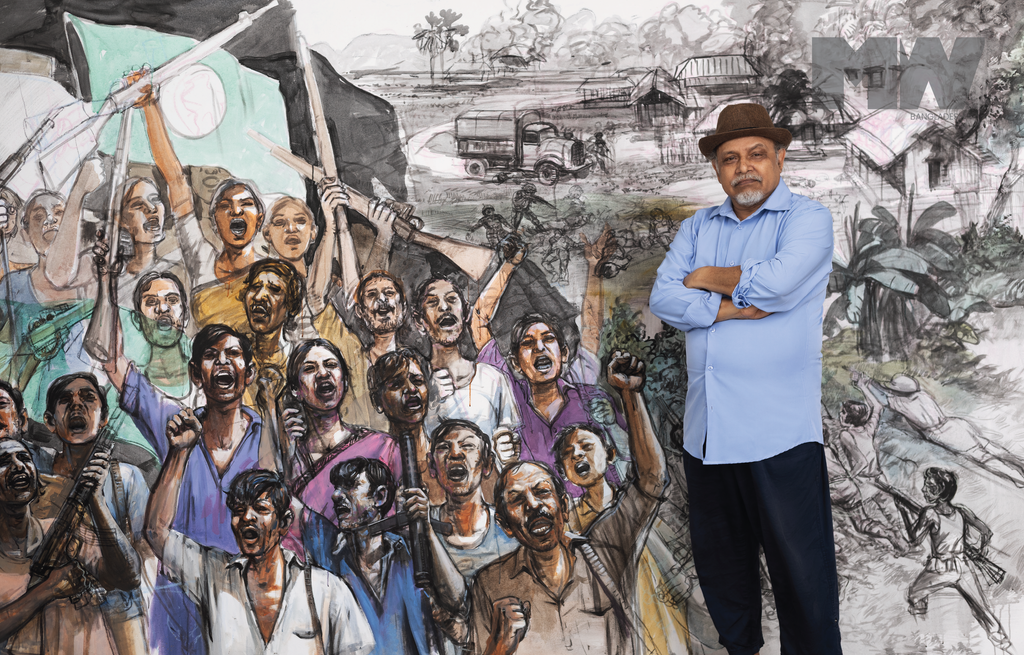
How do you view the current art market in Bangladesh?
The character of our art market has changed.
Previously, the market was largely centred around foreign buyers. Those foreign buyers still exist, but the number of Bangladeshi collectors has increased significantly.
The prices of our artworks have also risen.
Nabi Sir’s works now command very high prices and, importantly, many of his major collectors are Bangladeshi.
That is extremely encouraging.
Collectors are also interested in younger artists. Many ask us about them, and we always say they should collect their works too.
There are many young artists in Bangladesh producing very good work, and quite a few have already established themselves.
There is no substitute for sitting in front of reality, observing it, understanding it and drawing from it.
Do you believe there is a healthy market for figurative art as well?
Absolutely.
Collectors buy Nabi Sir’s paintings. They buy my work too.
Young artists should feel encouraged by that.
It is not right to approach art with the idea that figures cannot be painted or that figures should somehow be avoided.
After knowing Nabi Sir for so long as a teacher, artist, colleague and travelling companion, what is the greatest lesson you have received from him?
There is not just one lesson.
There is so much to learn from him.
His way of looking at people, his command over the human figure, his compositions, his dedication to work, the energy with which he still tackles enormous canvases, his way of teaching students to think instead of simply telling them what to do, his ability to maintain relationships with people and his sense of humour are all lessons in themselves.
There is no way I can deny his influence on my own artistic life.
We are very fortunate that we can still show him our work and continue learning from him.
I hope Sir remains healthy and continues working for many more years, because every new work he creates becomes another lesson for us.
What matters is what the artist wants to say and how successfully the artist can say it.
Photographed by: Salek Bin Taher