


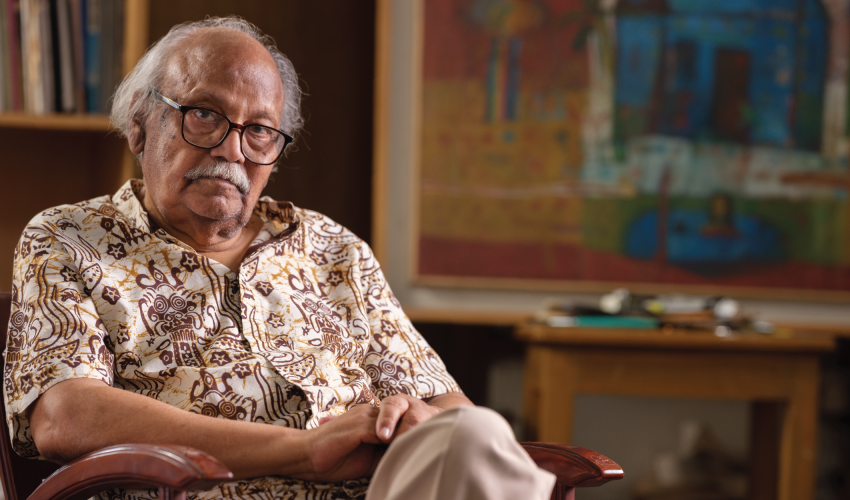
By Sumon Wahed
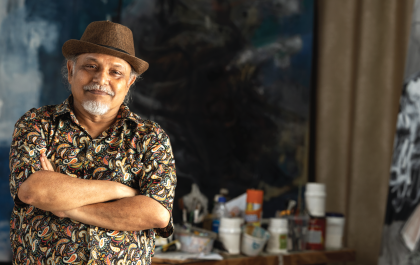
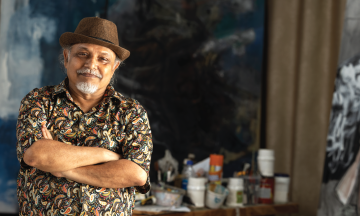
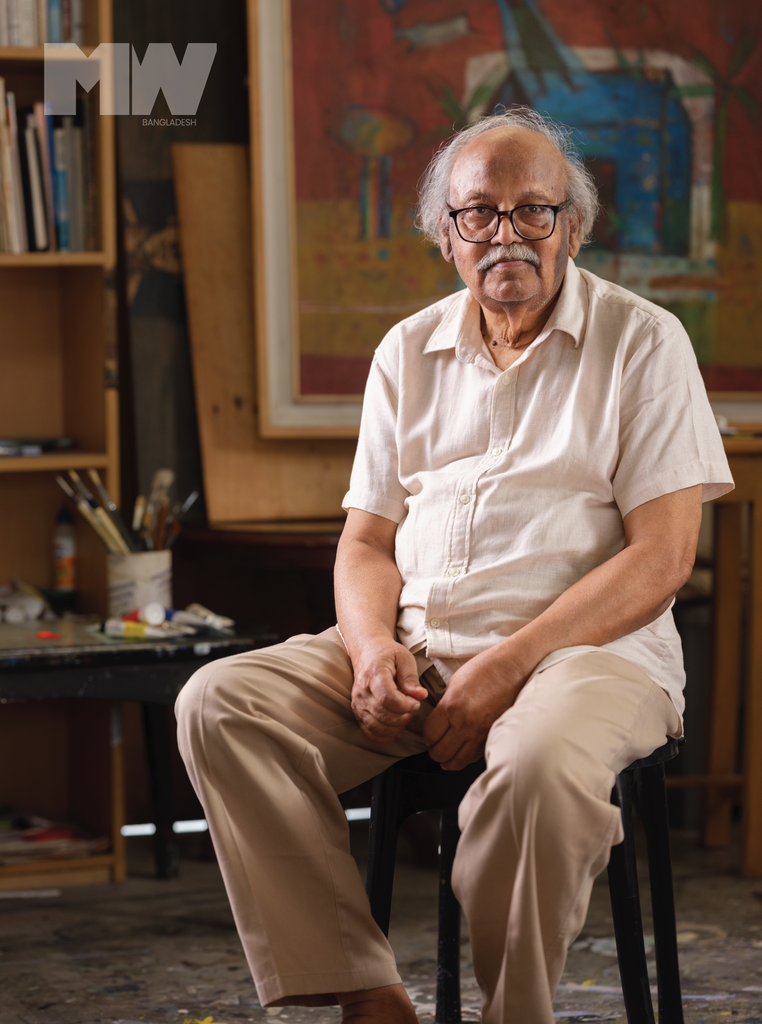
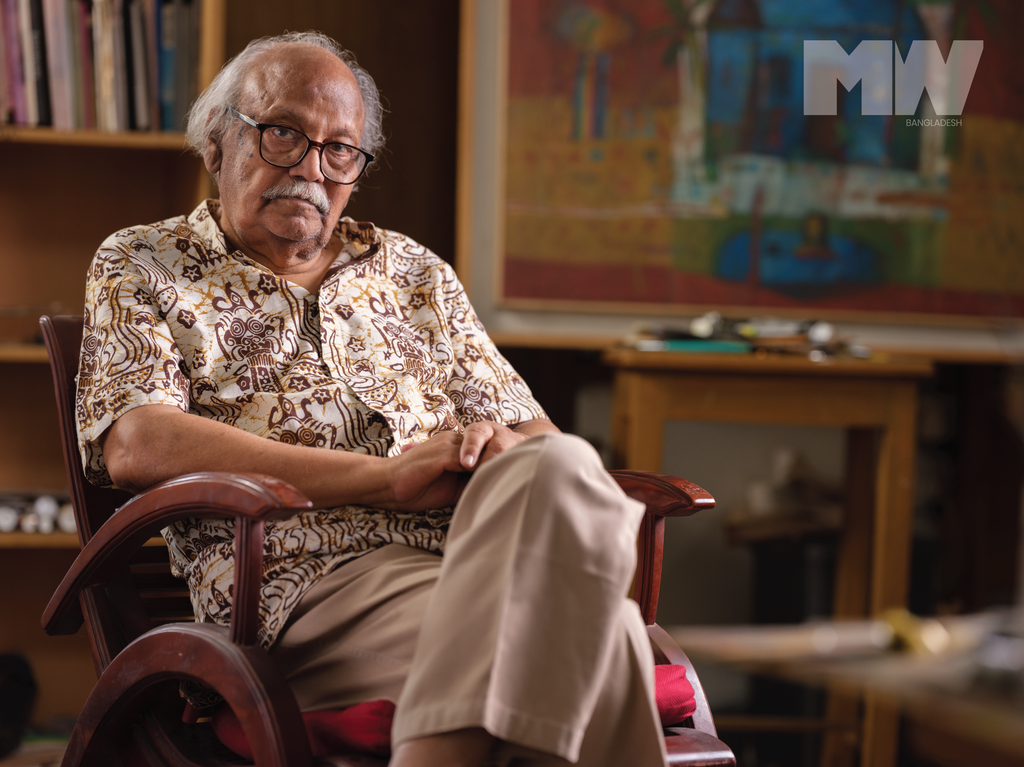
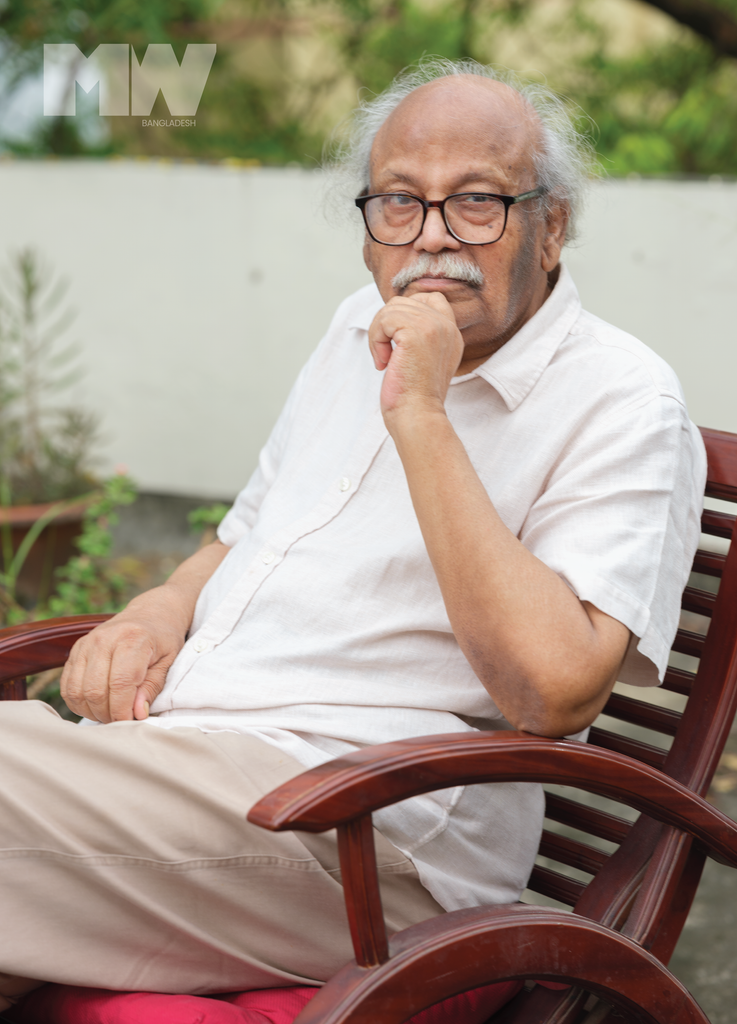
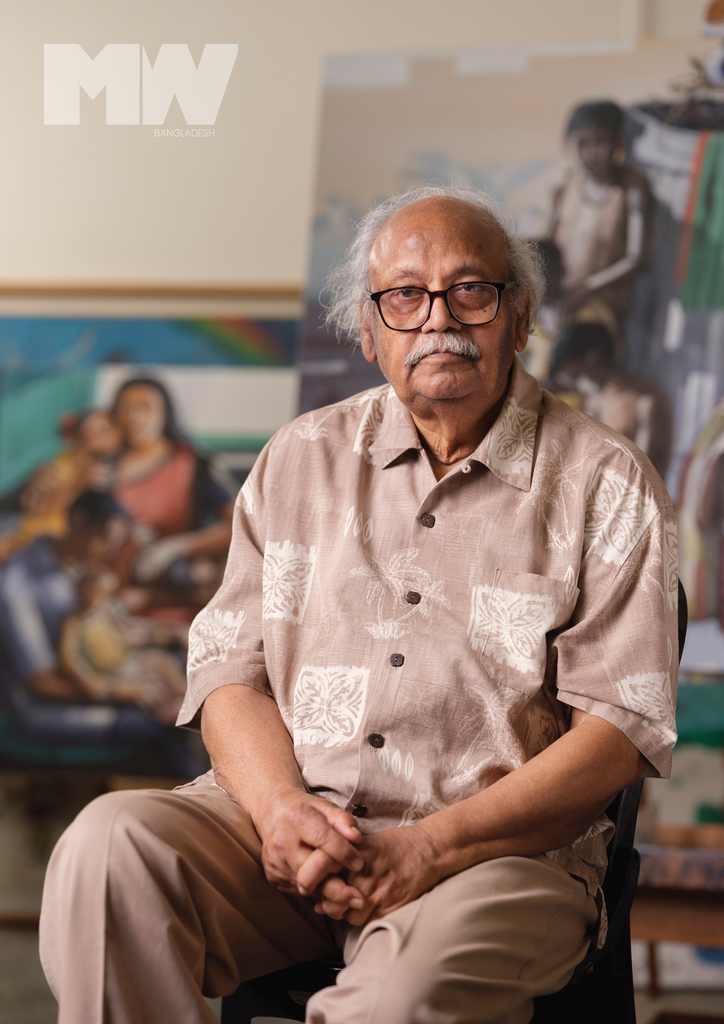
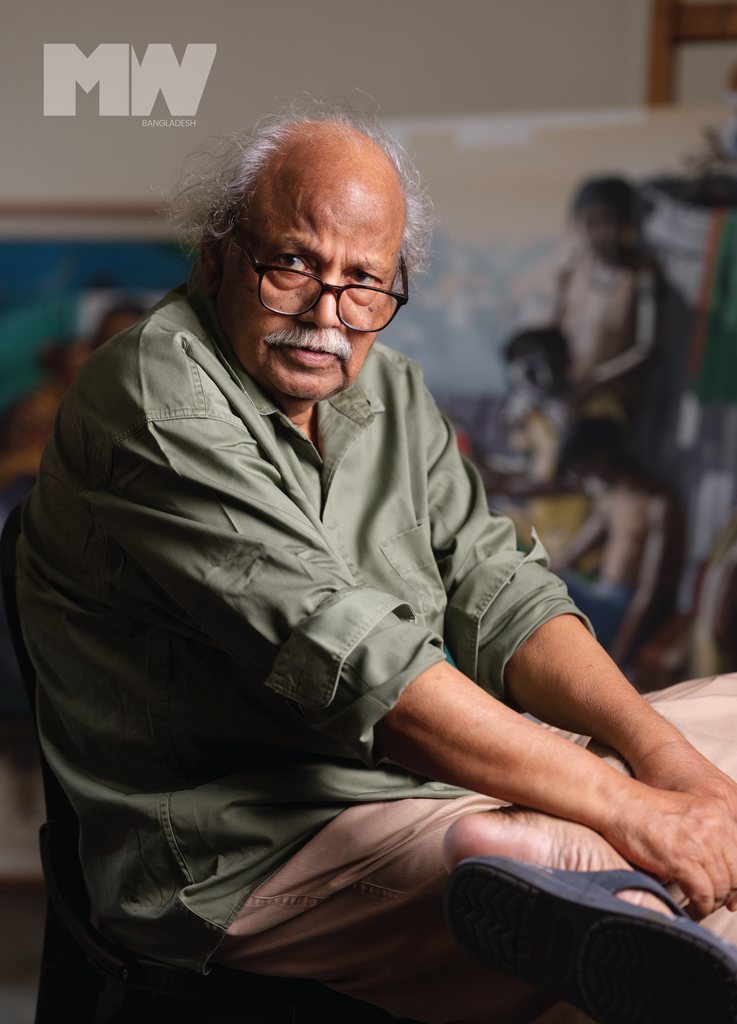
Rafiqun Nabi, born in 1943, is one of the defining figures of Bangladesh’s contemporary art world. His artistic journey has been as long as it has been multifaceted. He is not simply a painter, but an observer, social commentator and chronicler of human life. Faces, social inequality, political realities, and the sights and rhythms of rural and urban life recur throughout his work. Through his brush and pen, the lives of ordinary people and the realities of Bangladesh seem to acquire a vivid presence.
For more than six decades, Nabi has enriched the country’s visual culture through painting, printmaking, illustration and cartooning. In search of the memories behind this extraordinary creative life, we visited his home in South Monipur. There, on a late afternoon, he opened a vast storehouse of memories.
A large part of your work revolves around ordinary people and everyday life. What drew you towards public life as a subject?
From the very beginning, I have tried to remain close to people and nature. There is no grand reason or thought behind it. I observe people, their gestures, presence, and the scenes created when many people gather together. Those things fascinate me.
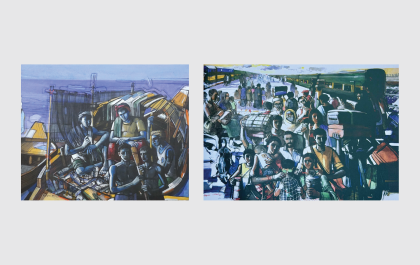
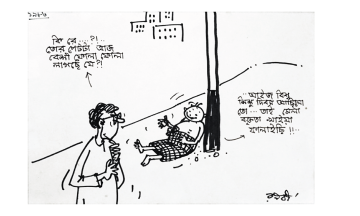
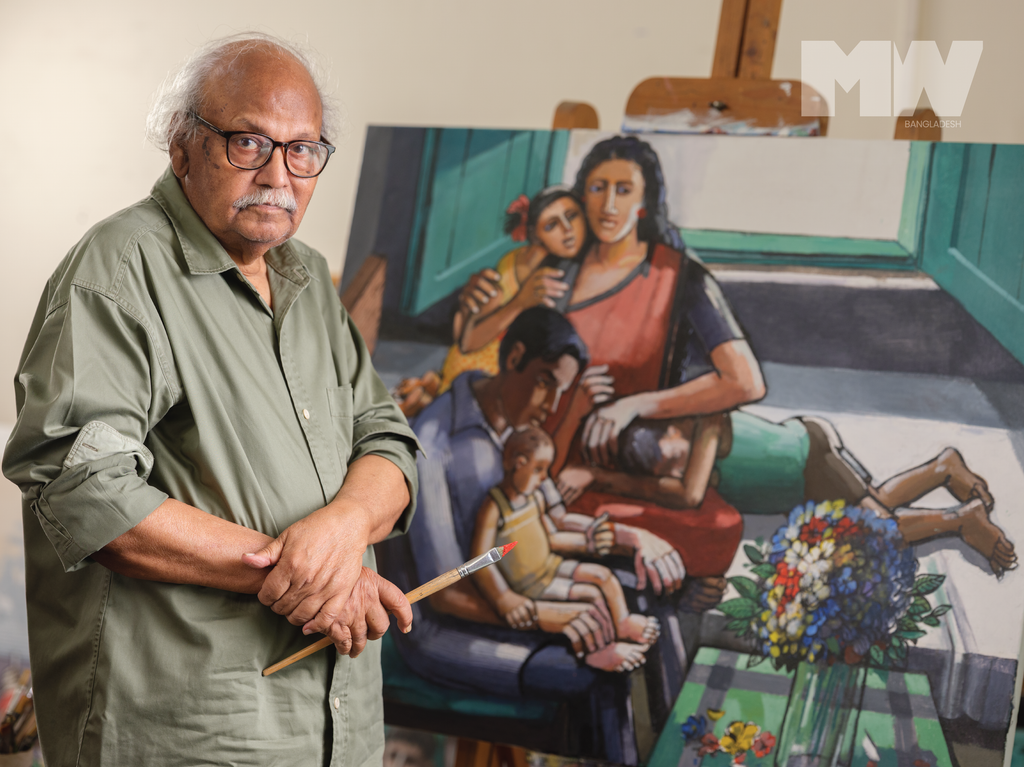
When I paint people, I usually paint very ordinary people, working people and labourers. Then there is my Tokai, or you could say my entire “Tokai brigade”. I create different kinds of compositions around them.
People also give you endless possibilities. There are different gestures, clothes, personalities and ways of occupying space.
If I work with fishermen, for example, there is the vast river, its own world of colour, the sky, the land, the fishermen, fish and nets. I enjoy bringing all of these elements together into a composition.
You spent the first few years of your childhood in Rajshahi. Where did you go afterwards?
After Rajshahi, we moved to Singra in Natore, within the Chalan Beel region. I lived there from around the age of three until I was about four, so some memories remain.
After that, we came to Fatullah, and later moved to Louhajong.
Do memories of the long train and steamer journeys from that period return in your work?
Yes, certainly. We would travel from Amnura by train to Goalanda. It took the whole day. From Goalanda, we took a steamer through the night to Narayanganj, and then came to Dhaka by train.
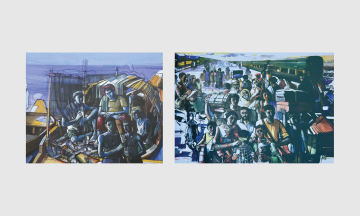
Those memories still find their way into my work. Trains in particular are a favourite subject. I have painted compartments and train roofs packed with people.
I first experienced that overwhelming kind of crowd at Goalanda Ghat. Partition had already happened. India and East Pakistan had become separate territories. I saw people leaving their homes for India, with trains packed inside and on the roofs. As a child, the crowd felt so suffocating that sometimes I thought I could not breathe.
On the return journey, I would see trains full of people coming from India. So, I witnessed movement in both directions. Those memories still return and sometimes find their way into my paintings.
Your family settled permanently in Dhaka in 1952. Where did you live when you first arrived?
We came to Dhaka in June 1952. At first, we lived in Tejgaon. Indira Road did not even exist then, and the area had mostly tin houses. We rented one for two or three months. Tejgaon Airport was very close, so I could watch the planes take off and land.
Then we moved to Rokonpur in Old Dhaka, around Patla Khan Lane and Panch Bhai Ghat Lane.
It was a culturally rich neighbourhood. Famous actress Rowshan Jamil lived there. Musician Samar Das had his home nearby, as did dancer Gauhar Jamil. I spent my childhood among many such people.
How did that cultural environment shape you?
I gained a great deal from the cultural circle around Panch Bhai Ghat Lane. Some people were involved in music, some in acting, others in different cultural activities. Growing up among them gradually developed a certain sensibility in me.
Then, in 1956, we moved to Narinda. Tofazzal Hossain Manik Miah’s family lived nearby. Mohammad Nasiruddin, editor of Saogat, was there, along with his daughter Nurjahan Begum, editor of Begum, and her husband Rokonuzzaman Khan, popularly known as Dadabhai.
Renowned journalist Abed Khan’s family also lived there. His elder brother Toaha Khan was a journalist. Another elder brother, Montu Khan, was a veteran communist leader. Abdullah Al Muti Sharafuddin was also part of that circle. His house was opposite my house.
A major reason we interacted with many of these people was a library called Abhijatrik. Cultural activities revolved around it. There would be sessions of mass songs, protest plays and musical programmes. Altaf Mahmud, Abdul Latif, Sukhen Chakraborty used to come and sing. The library also had books by major Bengali writers, which I read at a very young age.
By spending time around these people, I gradually developed an understanding of politics, culture and society.
I still believe that Panch Bhai Ghat Lane and Narinda together created an awakening in me.
This was also the period after the Language Movement. Political movements intensified through the latter half of the 1950s and into the 1960s. We learned about these developments through the people around us and sometimes became involved ourselves.
I think all of that contributed to a broader awareness within me.
I still believe that Panch Bhai Ghat Lane and Narinda together created a kind of awakening within me.
I learned and understood many things there, including how to look at politics, culture and society.
Were there already signs in childhood that you might become an artist?
While I was still in school, people in the neighbourhood had begun to think of me as something of an artist.
That’s why a wall magazine was published from the Abhijatrik library, and I was involved in it. I drew all the pictures, wrote out the texts neatly and handled the visual presentation.
So, I developed a reputation in the neighbourhood as an artist. But even then, I had no plan to actually become one.
Some of your schoolmates at Pogose School later became well known. What do you remember about them?
ATM Shamsuzzaman and Prabir Mitra later became actors. Subal Dutta was a violinist and Osman Gani was a tabla player. Subal Dutta was one class above me, while the others were my classmates.
The funny thing is that we had school programmes, but I do not remember seeing them act at the time. Yet later they went into acting.
We did watch an enormous number of films. We would skip classes to catch morning shows. There were many cinemas in Old Dhaka then.
Perhaps all that film-watching proved more directly useful to them. In my case, even though it didn’t directly affect me, it helped develop a certain taste and sensibility.
Your father, Rashidun Nabi, was a police officer who also painted. Did watching him inspire you?
I would see him return from duty, light a hurricane lamp in the evening and sit down to paint. I watched him in amazement. At that time, there was a major flood in Dhaka. USAID provided the school students with books, cheese, chocolates, and a box of 12 watercolour cakes. My father used to take over my box and painted all sorts of beautiful paintings.
He collected small reproductions by different artists. There were works by Rabindranath Tagore, Picasso and other European artists. He looked at art journals and traditional Chinese and Japanese watercolours and collected them.
But when he painted himself, he painted in his own way.
Was it also through your father that you first experienced an art exhibition?
Yes. In 1954, my father took me to my first art exhibition. He said, “Come on, let’s go see an art exhibition.”
I did not even know what an art exhibition was.
We went to Burdwan House, which is now Bangla Academy. Later I learned that the exhibition had been organised by the Pakistan Council.
There were works by artists from both wings of Pakistan, including Abdur Rahman Chughtai, Shakir Ali, Zubeida Agha and Allah Bakhsh.
But I liked the works of our own artists more. There were works by students of the Art Institution, including Aminul Islam, Qayyum Chowdhury and Murtaja Baseer.
I was most astonished by Zainul Abedin Sir’s work. His Goon Tana was in the exhibition, and that image remained in my mind for a long time. There was also a work depicting a Santal couple that affected me deeply.
What amazed me most was simply that someone could make a painting, hang it on a wall, and countless people would come to see it.
Yet even then, it did not occur to me that I should become an artist.
Had you ever visited the Art Institution before enrolling?
No. When we lived in Panch Bhai Ghat Lane, the Government Institution of Arts operated out of a few rooms of the National Medical Institute, but I did not even know it was an art institution.
I would see people carrying large boards but had no idea what they were doing. After enrolling in art institution, I found common ground while carrying all of that on my own.
I did not know that a new building was being constructed in Shahbagh either. I first saw it when I went there to collect the admission form after passing my matriculation examination.
What was it like attending classes in the new building at Shahbagh?
Everything was new, polished and beautifully arranged. There were vast jamun, mango and jackfruit groves behind it. There were hardly any houses around.
Because I had grown up in Old Dhaka, I was accustomed to older architecture including our school. This was the first time I had encountered such modern architecture up close. I found the building extraordinarily beautiful.
I felt proud to be able to come there every day.
Who were your teachers?
I was extremely fortunate. Almost all of Bangladesh’s greatest artists were my teachers.
Zainul Abedin Sir, Anwarul Haque, Safiuddin Ahmed, Quamrul Hassan, Aminul Islam, Mohammad Kibria, Rashid Choudhury, Abdur Razzak, Kazi Abdul Baset, Mustafa Monwar were among them. Khwaja Shafiq Ahmed also taught us. All the teachers took classes.
Murtaja Baseer was the only one I did not have as a teacher.
You often tell a memorable story about being asked to draw cows by Zainul Abedin. What happened?
Abedin Sir did not regularly teach a particular class, but whenever another teacher was absent, he would come in.
One day our class teacher was absent. We were making some noise, and Sir came in and said, “Why are you making so much noise? You are being given seven days of outdoor classes, and for those seven days, you will draw nothing but cows.”
We were delighted because we thought we had been given a holiday from class.
Sir specifically told us not to draw a cow merely walking along the road. We had to really observe it and draw a tethered cow carefully in the cow yard. Remember, the cow won’t pose for you. You’ll have to go around drawing it yourself.
There were hardly any cows in the city, so eventually we crossed the river and found them in the fields and markets.
There were about seven of us. Keramat Mowla and Shamsul Islam Nantu were among them. I selected one cow and spent seven days drawing it from different angles.
When Sir came to inspect the work, he praised another student’s drawing. I was certain he would praise mine even more because, in my mind, I had drawn an absolutely “correct” cow.
Instead, he looked at it and said, “What is this? This has become a cow of essay. It has everything a cow is supposed to have, but was this cow really so plump? Where are its bones? Where is the teste?”
I was terribly disappointed.
He told me to go back and observe the cow again. When I did, I realised it really was extremely thin.
After I redrew it, he said, “Our farmers themselves do not have enough to eat. Their bodies are thin and bony. How is their cow supposed to get enough food? Naturally, the cow is bony too. Pay attention to what lies behind these things. One thing is connected to another.”
I do not know how much of it I understood then, but those words stayed with me.
Then he looked again and said, “Just because I told you to look for the bones, you have put in all these bones from your imagination! Bones have anatomy too.”
He explained where the bones joined and how the joints worked. He even told us to watch butchers because they knew exactly where to strike to separate a joint.
I still paint cows. Although these days I do not always obey anatomy. Sometimes I put the bones wherever I like!
What were the Art College picnics like?
Very lively. Once we went to Mirpur, which was almost like wilderness then. The picnic was being held on a place like high hill by the lake.
There would be drawing competitions. Students would stand together and someone would shout, “One, two, three, start!” Everyone would run off to draw.
At one point, Abedin Sir sat down to draw an extremely ordinary scene: cooking pots, a nearly dead jackfruit tree, bags hanging from its branches and a few crows attracted by the smell of food.
He drew it with a reed pen in black and white. It was extraordinary.
What struck me was that I had never imagined such an ordinary scene could become the subject of a drawing.
You joined the Art College as a teacher in 1964. Had teaching been part of your plan?
Not at all. I wanted to work in newspapers.
I had been doing occasional work for newspapers and magazines as a student. The Purbodesh-Observer group asked me to work part-time and said that after graduation they would make the position full-time.
I was delighted. Kalam Mahmood was also working at the Observer then.
That office became another turning point. Poets, writers, actors, filmmakers and directors were constantly coming and going. There was adda, discussion and laughter.
To illustrate stories and poems, I had to read them, so I learned a great deal there.
So how did you become a teacher?
About three months after our final examination, my classmate Ranjit Niyogi called and told me the results were out and that I had done very well.
That evening, Hannan, who was Abedin Sir’s peon and lived in my neighbourhood, arrived with a note saying Sir wanted to see me urgently.
I went to his house at 73 Shantinagar.
The moment he saw me, he said, “You’ll start taking classes from Monday.”
I nearly collapsed.
I said, “Sir, I have never imagined becoming a teacher. I don’t know everything myself. What am I going to teach other people? I’m happy at Purbodesh.”
Sir asked for my father’s telephone number and called him immediately.
When I returned home, my father said, “Such a great artist is personally offering you an opportunity. That is a matter of fortune. Go.”
Then I spoke to Kazi Idris at Purbodesh. He also said, “Of course you’ll join. Do that job and do this one too.”
That is how I began doing both jobs.
Among my early students were Shahid Kabir, Monjurul Hai, Khushi Kabir and Biren Shome.
You were also involved with the political movements of the 1960s. How did that begin?
It began in my first year.
My classmate Hasan Ahmed came to me early one morning and said, “Come on, we’re going somewhere.”
We went towards the Ahsanullah Engineering College, which later became BUET. In a small closed room, we met Alamgir Kabir, who became a famous architect later. He was not the famous filmmaker, but another person with the same name.
Inside were piles of paper, ink and poster colours.
They told us to make posters.
When I began writing, I realised all the slogans were anti-government. I had never done anything like that before and was terrified. Moreover, my father was police!
They said, “Nothing will happen. Just keep quiet and work.”
That was how it began. Throughout the 1960s I remained involved in one way or another.
Even after becoming a teacher and holding a government job, I continued. Qayyum Chowdhury, Aminul Islam, Murtaja Baseer and many others were involved too.
I was good at cartoon drawing, so gradually I began using that ability for protest posters. I drew cartoons while others wrote slogans.
How did Unoshottore Chhora emerge during the 1969 Mass Uprising?
It grew out of an idea Shahadat Chowdhury and I had.
Many poets were writing political rhymes, so we thought something could be done with them. Shahadat came up with the title Unoshottore Chhora.
I did the drawings. We went from poet to poet asking for contributions.
It was a small book, but it became quite significant.
At one point, we thought the government had confiscated it. Later, we realised that it had probably not been officially seized. People associated with the government may simply have bought up all the copies.
We had no idea. We were delighted that the book was selling so quickly!
You also worked on large banners around the Shaheed Minar during the 1969 movement.
Yes. We painted enormous banners and displayed them at the Shaheed Minar.
There were open fields between the university buildings, and that was where we worked.
Mostafa Monwar, Rashid Choudhury, Nitun Kundu, Pranesh Mandal and many others worked on large canvases. I also made huge cartoons.
There was tremendous excitement. We felt we were doing something for the country.
One incident surprised us. Government officials understood the protest message embedded in one of Rashid Choudhury’s modern works and demanded that it be removed.
So, it was not true that they did not understand modern art. They understood exactly what the work was saying.
You went to Greece in 1973. Had you planned to go abroad?
Not at all. I had just married and had a small child.
One day, Principal Syed Shafiqul Hossain called a meeting and said a scholarship for teachers had come from Greece and someone had to be selected immediately.
First, they asked Qayyum Sir. He declined. Then they asked Hashem Bhai, who was planning to go elsewhere.
Then everyone pointed at me.
I said, “No, I can’t. I’ve just started a family. I don’t even know the language.”
But everyone decided I had to go. They said, “If you don’t like it, come back.”
Later I realised that the experience opened an entirely new chapter in my life.
You went to Greece to study painting but turned towards printmaking. Why?
One day I walked into the printmaking department and saw enormous woodcuts being made.
In Bangladesh, we had seen much smaller woodcuts. The scale and quality fascinated me. I was also attracted to the painterly quality of colour woodcuts.
I told the professor I wanted to work with him.
He said I would have to change my scholarship from painting to printmaking.
I completed the formalities and moved into printmaking.
My scholarship was at postgraduate level, so there was no fixed routine. I had a separate workspace and the freedom to work independently.
Gradually I became completely immersed in printmaking.
Which teachers in Greece influenced you?
Kostas Grammatopoulos was very important. He was a renowned artist in Greece.
Another was Nikos Stavroulakis, a printmaker associated with the Doxiadis Institute.
He was a friend of Dr Kamal Hossain, who was the foreign minister of Bangladesh at that time.
Mr. Kamal Hossain gave me a letter and told me to contact him if I ran into trouble.
I went to his house only to discover that he was in prison on charges of treason!
About three months later, the government changed and he was released. I met him afterwards.
His woodcuts and etchings were extraordinary, and later I had the opportunity to work with him.
How did you begin drawing cartoons?
As a student, I first made cartoon-like drawings for banners and posters.
I began regularly producing cartoons for publications later. In 1969, I started drawing for Forum and continued until March 25, 1971.
My cartoons appeared on the cover and were all political.
With a banner, you can make a political statement on a huge scale. On a magazine cover, you have to break that statement into a smaller, more focused idea.
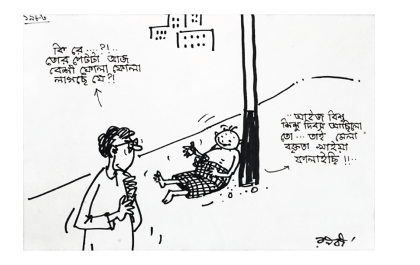
Tokai emerged in Bichitra in the late 1970s. In your recollection, the character was created in 1978. How was he born?
Tokai emerged unexpectedly.
After returning from Greece, I had decided not to work in cartoons or illustration anymore. I wanted to focus on woodcut and painting.
But I faced problems returning to my job. Someone else had been appointed to my position and administrative complications followed. I also began facing financial difficulties.
My friend Shahadat Chowdhury, editor of Bichitra, said, “Do some work. You’ll get some financial support from here.”
I initially resisted, but then thought about doing something in the form of a semi-strip.
I had already drawn a small child figure in the late 1960s. He was not called Tokai then.
I decided to turn that kind of child into a recurring character.
Then I spent almost an entire week thinking about the name. It was like a family trying to name a new born baby.
Suddenly, the name “Tokai” came to me from the word Tokaina (the person who collects trashes).
I began working under that name, and the character became regular through pen drawings.
Tokai became enormously popular. Did that make it difficult to stop?
Yes. His popularity kept growing, and that was one reason I could never really leave him.
From time to time I thought, this is the end, I won’t do it anymore. But I could not stop.
There were also so many political, social and cultural issues that offered material.
My cartoons were not conventional cartoons either. They were dialogue-driven, almost like semi-strips, with issues emerging through questions and answers.
In 1996, Tokai also led you to an international mock tribunal on child labour in Mexico.
Yes. You could say I went there because of Tokai.
Tokai had attracted some international attention. I was selected as one of seven judges at the tribunal.
As I remember it, the French Workers’ Party and Mexican Workers’ Party were involved in organising the event. From Bangladesh, a committee involving people from different political views selected me.
The whole setting was arranged like a real courtroom, with judges’ bench, arguments, counterarguments and hearings.
A verdict was delivered at the end, with allegations concerning the use of child labour in several countries, including Brazil and the United States.
I also took cartoons about child labour in Bangladesh and Tokai. They were exhibited outside the courtroom and translated so international visitors could understand them.
You have also worked extensively in book illustration. Do you still illustrate?
Yes. In fact, I completed a recent piece just this week.
My hands shake now, so I cannot work as easily as before. Even so, I recently designed the cover of a children’s storybook by Mostafa Monwar Sir.
The book is based on stories featuring his puppets and will contain 22 stories.
Where did your interest in illustration begin?
I really discovered the pleasure of illustration while working at Purbodesh.
From there, assignments started coming from other publications. I probably began illustrating books around 1965 or 1966, mostly children’s books.
I enjoyed those very much.
There was not much money in illustration. It was not something you could really treat as a livelihood then. I simply loved doing it.
I would read the story and then illustrate it.
Later, I also worked on posters, banners and international projects.
You also designed Adommo, the SAF Games mascot. What is the story behind it?
Major General Amin Ahmed Chowdhury was very keen that I should design the mascot.
I made the original drawing. Mostafa Monwar Sir created the sculpture and was also involved with the puppet version.
I drew the tiger cub and later created different poses for different events.
Was Tokai an influence on Adommo?
A little.
It was a tiger cub wearing a lungi. You could jokingly say it looked like a tiger version of Tokai.
I designed it with a sense of fun, but everyone liked it. Later, it was developed in many forms, including animation.
Tokai will complete 50 years in 2028 according to the 1978 chronology you recall. Are you planning anything?
Nothing concrete yet.
I no longer draw Tokai regularly. Sometimes Prothom Alo asks me to do a full-page cartoon, and one or two Tokais may appear there.
I used to have tremendous fun drawing him. Now, when I do it, it is more out of a sense of responsibility.
Perhaps when the 50th anniversary gets closer, some idea will emerge.
You also created many theme-based calendars in the 1990s.
Yes. I did most of my calendar work for the British Tobacco Company.
The subjects had to suit their requirements, but I also interpreted them in my own way.
One calendar focused on archaeological sites, another on the lives of indigenous communities, and another on life in Dhaka. Under the management of the organizers, I would travel far and wide to sketch the subject. This allowed me to see the country.
Printing standards in Bangladesh were not very advanced then. Sometimes the works were scanned in Bangkok and printed at Padma Printers in Dhaka.
Good paper, printing and binding made the whole process exciting.
You have also written books and essays. Where did your interest in writing begin?
I think it came from reading.
Later, when I illustrated books, I would read entire stories, novels and manuscripts. Sometimes that made me want to write something myself.
My earliest writing probably began with the Abhijatrik wall magazine. Sometimes there was empty space because we had not received enough material, so I would write a rhyme or something else to fill it.
When was your first published piece?
When I was in Class Ten, Ittefaq published my first piece.
At the time, the world was fascinated by space exploration and Yuri Gagarin had gone into space. I wrote a short allegorical piece centred on that excitement.
Ittefaq gave it quite a prominent treatment.
Later, I wrote humorous pieces for a magazine called Barnali. At one point, I even wrote a full-length novel.
My book Pterodactyl was published in 1992 and was well received. Encouraged by that, I wrote another book the following year. Three books of my rhymes have also been published.
As a reader, what do you enjoy most?
It depends on my mood. I cannot specify one particular form.
But I have always enjoyed reading literature from Bangladesh and abroad.
Watercolour has remained one of your favourite mediums. Why?
I developed an attachment to watercolour as a student.
My teachers praised my work and I also won prizes for watercolour, so I developed a special affection for it.
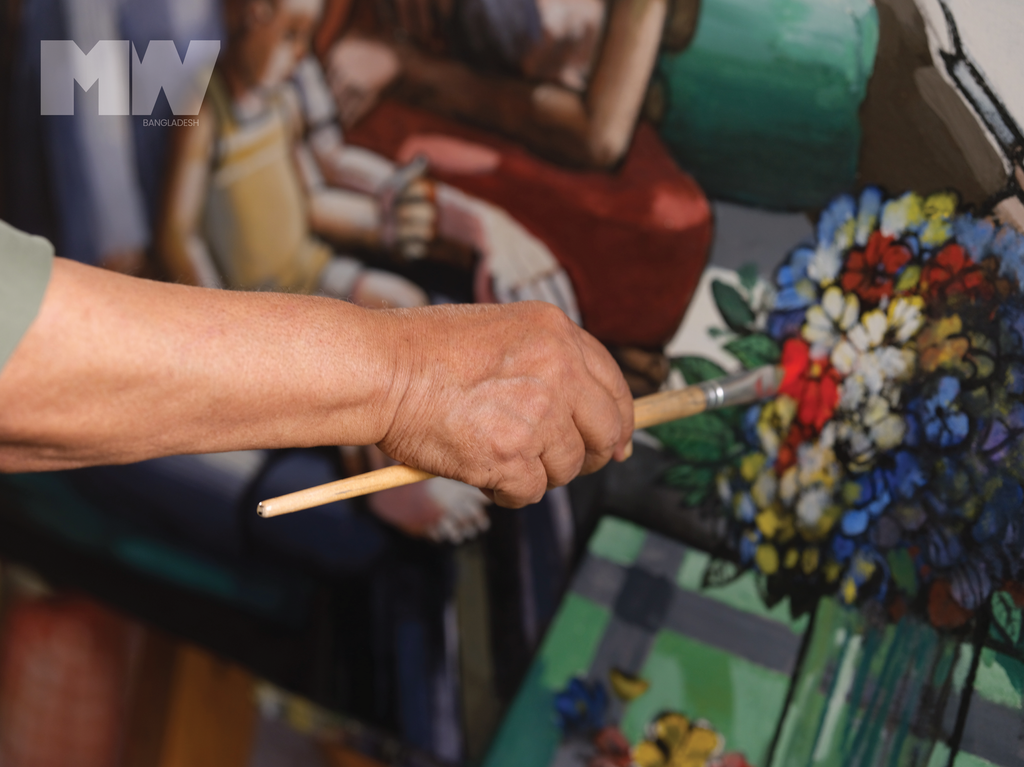
Anyone who works in watercolour knows the medium has a pleasure of its own.
At one point, I studied how watercolour was being used around the world. Eventually, through experimentation, the work became my own.
I also believe watercolour gives you a certain command over colour, and that experience helps when working in other mediums.
Drawing became increasingly prominent in your work, particularly after 2000. Was that a conscious shift?
The tendency to retain drawing within my work goes back to my student days.
It was not something I consciously planned later.
I think my long experience in printmaking and illustration naturally strengthened the role of line.
There is a difference between defining a form purely through colour and defining it through drawing. Drawing allows for far more variation.
Which artists influenced the way you think about line?
Zainul Abedin Sir retained drawing in his work.
Nandalal Bose also worked with drawing in that way. I am not talking about imitating their styles, but learning how line can function.
I look at Matisse’s drawings and Picasso’s drawings too.
Gradually, the use of drawing became habitual for me. Eventually, the nature of the line itself can create an identity.
Crows repeatedly appear in your work. Why?
To me, the crow is a very clever creature.
I do not use crows in every composition. Sometimes a single crow can bring an entire composition together.
I like its gestures and presence.
There is not always a profound explanation. Sometimes I simply do it for fun.
Were Zainul Abedin’s crows an inspiration?
Not directly.
Abedin Sir’s crows are very famous, but my crows are different.
There is one coincidence. Tokai is often accompanied by a dustbin, and dustbins appeared in Abedin Sir’s work too.
In my case, the dustbin naturally belongs to Tokai’s environment. And where there is a dustbin, crows naturally appear.
So, the crow came from the environment itself.
Buffaloes are another recurring motif. Does that come from childhood memories?
Certainly. I have my own story involving a buffalo.
At my maternal uncles’ home there were many cows and buffaloes. When we arrived at Amnura Station, a buffalo cart or bullock cart would come to collect us.
Once, during the intense heat of Chaitra, I was travelling home in a buffalo cart. The buffalo was sweating and panting.
As we crossed a bridge near the village, it saw the water below and jumped straight into it, taking the entire cart and me along with it!
Some people think that accident explains why I paint buffaloes, but I don’t think so.
What actually attracts you to them?
I love the deep grey colour of the buffalo’s body, its volume, strength and at the same time its calm appearance.
Sometimes I look at it from a bird’s-eye view. From behind, the enormous expanse of its back is very interesting.
So, there is an attraction of colour and also of drawing.
Cows, buffaloes and goats each have distinct bodies and gestures. They offer many possibilities.
Many of your recent works use crowded compositions. Is that linked to Old Dhaka?
To some extent.
But over time, I have also become increasingly attracted to crowds, noise and the presence of many people in one place.
I enjoy watching many people sitting together, each with a different posture, each doing something different.
If I am already working with figures, I often feel like using many rather than stopping at one.
It is also a compositional choice. Sometimes I minimise, sometimes work horizontally or vertically, and sometimes combine the two.
Sir, we would like to know your thoughts on painting.
Painting is actually an object of expression. When an idea arises in the mind about something, the artist tries to embody that idea through painting. That world of ideas can occur in both real and unreal fields. Sometimes it takes the form of an object filled with emotions, sometimes it is drawn from reality and comes in the form of a special style.
However, the field of painting is endless. Unlimited. Special styles are created through experiments. New dimensions are added. Special styles of subjects conceived by artists can be obtained, and the world seen can also be expressed in a certain way by arranging it. Reality and hyper-reality are two different aspects. In one, there is a direct expression of imitation in some way or the other, in the other, a different dimension is added through the quality of extreme detail. Perfection can be given to the painting even by creating a pattern of using few elements, and again, a painting can be created by combining many things (Guernica as an example). A complete painting can be made with just a sketch, on the other hand, a painting can be made with the purity of the drawing. Language can be added to the painting. There may be a tendency to make the painting difficult to understand by using abstract captions. Again, the painting can be made meaningful even by not having a caption. All these are the types of paintings. The real thing that I believe is whether the painting retains the essence or not. The talent of the artist may not match the talent of the art connoisseur. I think this because two people have different sensory antennae.
You have witnessed enormous changes in contemporary art. How do you respond to installation, performance and video art?
I like them.
Artists are experimenting and trying to open up new directions.
Installation has a certain immediacy. A work may be created after enormous thought, but when the exhibition ends, it is dismantled. It exists for a period and then disappears.
Do you remember an experience that shaped your understanding of installation art?
A Japanese installation artist came to the first Asian Art Biennale.
Installation was completely new to us then. We asked him, “What’s the fun in making an installation?”
He said that who else enjoys it is not the most important thing. What matters is the pleasure the artist experiences while creating it.
He gave an example. Imagine you are stranded in a desert with nothing but sand. You are an artist and want to make something, so you create something out of sand.
When you leave, you simply leave it there.
I thought that explained the temporary nature of installation beautifully.
What do you think of installation and performance art today?
Installation has moved into much deeper conceptual territory. There are video installations and all kinds of concept-based work.
You also do not necessarily need to be an institutionally trained artist to make an installation. Anyone can have a strong idea and find a way to realise it.
Performance art can also be immediate but meaningful.
I enjoy these forms.
Where do you see the biggest changes in contemporary art?
Art has changed enormously.
People are no longer preoccupied with a particular “ism” the way they once were. Artists work according to their own ideas and approaches.
Technically and conceptually, a great deal is happening across painting, sculpture, installation and other forms.
I enjoy seeing these things. They make me think about what the artist is trying to say and how the work was made.
Sometimes even something ugly can become beautiful within art.
What do you mean when you say the ugly can become beautiful?
There is a history of the grotesque in art.
There was once an idea that artists should paint beautiful aristocratic faces and conventionally beautiful subjects. Artists moved away from that and began working with grotesque, uncomfortable and unconventional subjects too.
People still collected those works.
To me, when someone chooses to keep a work in their collection, they are respecting it as art. Whether the subject is conventionally beautiful or ugly is no longer the only consideration.
There is also a spontaneous sense of humour in your paintings, cartoons, writing and speech. Where does it come from?
We’ve been talking all this time. Perhaps there has been some humour in this conversation too!
It happens naturally. I do not really understand it myself.
People often talk about the sense of humour associated with Old Dhaka or Chapainawabganj. There was also a strong culture of humour within my family.
My father had a wonderful sense of humour. My grandmother could make people laugh enormously. My younger brothers and sisters have that sense of humour too.
Perhaps some of it came to me from there.
People also enjoy listening to your speeches. Is that something you consciously cultivate?
No.
Very formal, heavy language does not come naturally to me.
I say what I want to say in my own way. I try to become a little closer to the audience. I do not want the conversation to happen from a distance. I want it to feel intimate.
Perhaps humour slips into it from time to time. I do not notice it myself, but other people tell me that apparently, I speak humorously.
Were there already signs in childhood that you might become an artist?
While I was still in school, people in the neighbourhood had begun to think of me as something of an artist.
That’s why a wall magazine was published from the Abhijatrik library, and I was involved in it. I drew all the pictures, wrote out the texts neatly and handled the visual presentation.
So, I developed a reputation in the neighbourhood as an artist. But even then, I had no plan to actually become one.
Some of your schoolmates at Pogose School later became well known. What do you remember about them?
ATM Shamsuzzaman and Prabir Mitra later became actors. Subal Dutta was a violinist and Osman Gani was a tabla player. Subal Dutta was one class above me, while the others were my classmates.
The funny thing is that we had school programmes, but I do not remember seeing them act at the time. Yet later they went into acting.
We did watch an enormous number of films. We would skip classes to catch morning shows. There were many cinemas in Old Dhaka then.
Perhaps all that film-watching proved more directly useful to them. In my case, even though it didn’t directly affect me, it helped develop a certain taste and sensibility.
Your father, Rashidun Nabi, was a police officer who also painted. Did watching him inspire you?
I would see him return from duty, light a hurricane lamp in the evening and sit down to paint. I watched him in amazement. At that time, there was a major flood in Dhaka. USAID provided the school students with books, cheese, chocolates, and a box of 12 watercolour cakes. My father used to take over my box and painted all sorts of beautiful paintings.
He collected small reproductions by different artists. There were works by Rabindranath Tagore, Picasso and other European artists. He looked at art journals and traditional Chinese and Japanese watercolours and collected them.
But when he painted himself, he painted in his own way.
Was it also through your father that you first experienced an art exhibition?
Yes. In 1954, my father took me to my first art exhibition. He said, “Come on, let’s go see an art exhibition.”
I did not even know what an art exhibition was.
We went to Burdwan House, which is now Bangla Academy. Later I learned that the exhibition had been organised by the Pakistan Council.
There were works by artists from both wings of Pakistan, including Abdur Rahman Chughtai, Shakir Ali, Zubeida Agha and Allah Bakhsh.
But I liked the works of our own artists more. There were works by students of the Art Institution, including Aminul Islam, Qayyum Chowdhury and Murtaja Baseer.
I was most astonished by Zainul Abedin Sir’s work. His Goon Tana was in the exhibition, and that image remained in my mind for a long time. There was also a work depicting a Santal couple that affected me deeply.
What amazed me most was simply that someone could make a painting, hang it on a wall, and countless people would come to see it.
Yet even then, it did not occur to me that I should become an artist.
Had you ever visited the Art Institution before enrolling?
No. When we lived in Panch Bhai Ghat Lane, the Government Institution of Arts operated out of a few rooms of the National Medical Institute, but I did not even know it was an art institution.
I would see people carrying large boards but had no idea what they were doing. After enrolling in art institution, I found common ground while carrying all of that on my own.
I did not know that a new building was being constructed in Shahbagh either. I first saw it when I went there to collect the admission form after passing my matriculation examination.
What was it like attending classes in the new building at Shahbagh?
Everything was new, polished and beautifully arranged. There were vast jamun, mango and jackfruit groves behind it. There were hardly any houses around.
Because I had grown up in Old Dhaka, I was accustomed to older architecture including our school. This was the first time I had encountered such modern architecture up close. I found the building extraordinarily beautiful.
I felt proud to be able to come there every day.
Who were your teachers?
I was extremely fortunate. Almost all of Bangladesh’s greatest artists were my teachers.
Zainul Abedin Sir, Anwarul Haque, Safiuddin Ahmed, Quamrul Hassan, Aminul Islam, Mohammad Kibria, Rashid Choudhury, Abdur Razzak, Kazi Abdul Baset, Mustafa Monwar were among them. Khwaja Shafiq Ahmed also taught us. All the teachers took classes.
Murtaja Baseer was the only one I did not have as a teacher.
You often tell a memorable story about being asked to draw cows by Zainul Abedin. What happened?
Abedin Sir did not regularly teach a particular class, but whenever another teacher was absent, he would come in.
One day our class teacher was absent. We were making some noise, and Sir came in and said, “Why are you making so much noise? You are being given seven days of outdoor classes, and for those seven days, you will draw nothing but cows.”
We were delighted because we thought we had been given a holiday from class.
Sir specifically told us not to draw a cow merely walking along the road. We had to really observe it and draw a tethered cow carefully in the cow yard. Remember, the cow won’t pose for you. You’ll have to go around drawing it yourself.
There were hardly any cows in the city, so eventually we crossed the river and found them in the fields and markets.
There were about seven of us. Keramat Mowla and Shamsul Islam Nantu were among them. I selected one cow and spent seven days drawing it from different angles.
When Sir came to inspect the work, he praised another student’s drawing. I was certain he would praise mine even more because, in my mind, I had drawn an absolutely “correct” cow.
Instead, he looked at it and said, “What is this? This has become a cow of essay. It has everything a cow is supposed to have, but was this cow really so plump? Where are its bones? Where is the teste?”
I was terribly disappointed.
He told me to go back and observe the cow again. When I did, I realised it really was extremely thin.
After I redrew it, he said, “Our farmers themselves do not have enough to eat. Their bodies are thin and bony. How is their cow supposed to get enough food? Naturally, the cow is bony too. Pay attention to what lies behind these things. One thing is connected to another.”
I do not know how much of it I understood then, but those words stayed with me.
Then he looked again and said, “Just because I told you to look for the bones, you have put in all these bones from your imagination! Bones have anatomy too.”
He explained where the bones joined and how the joints worked. He even told us to watch butchers because they knew exactly where to strike to separate a joint.
I still paint cows. Although these days I do not always obey anatomy. Sometimes I put the bones wherever I like!
What were the Art College picnics like?
Very lively. Once we went to Mirpur, which was almost like wilderness then. The picnic was being held on a place like high hill by the lake.
There would be drawing competitions. Students would stand together and someone would shout, “One, two, three, start!” Everyone would run off to draw.
At one point, Abedin Sir sat down to draw an extremely ordinary scene: cooking pots, a nearly dead jackfruit tree, bags hanging from its branches and a few crows attracted by the smell of food.
He drew it with a reed pen in black and white. It was extraordinary.
What struck me was that I had never imagined such an ordinary scene could become the subject of a drawing.
You joined the Art College as a teacher in 1964. Had teaching been part of your plan?
Not at all. I wanted to work in newspapers.
I had been doing occasional work for newspapers and magazines as a student. The Purbodesh-Observer group asked me to work part-time and said that after graduation they would make the position full-time.
I was delighted. Kalam Mahmood was also working at the Observer then.
That office became another turning point. Poets, writers, actors, filmmakers and directors were constantly coming and going. There was adda, discussion and laughter.
To illustrate stories and poems, I had to read them, so I learned a great deal there.
So how did you become a teacher?
About three months after our final examination, my classmate Ranjit Niyogi called and told me the results were out and that I had done very well.
That evening, Hannan, who was Abedin Sir’s peon and lived in my neighbourhood, arrived with a note saying Sir wanted to see me urgently.
I went to his house at 73 Shantinagar.
The moment he saw me, he said, “You’ll start taking classes from Monday.”
I nearly collapsed.
I said, “Sir, I have never imagined becoming a teacher. I don’t know everything myself. What am I going to teach other people? I’m happy at Purbodesh.”
Sir asked for my father’s telephone number and called him immediately.
When I returned home, my father said, “Such a great artist is personally offering you an opportunity. That is a matter of fortune. Go.”
Then I spoke to Kazi Idris at Purbodesh. He also said, “Of course you’ll join. Do that job and do this one too.”
That is how I began doing both jobs.
Among my early students were Shahid Kabir, Monjurul Hai, Khushi Kabir and Biren Shome.
You were also involved with the political movements of the 1960s. How did that begin?
It began in my first year.
My classmate Hasan Ahmed came to me early one morning and said, “Come on, we’re going somewhere.”
We went towards the Ahsanullah Engineering College, which later became BUET. In a small closed room, we met Alamgir Kabir, who became a famous architect later. He was not the famous filmmaker, but another person with the same name.
Inside were piles of paper, ink and poster colours.
They told us to make posters.
When I began writing, I realised all the slogans were anti-government. I had never done anything like that before and was terrified. Moreover, my father was police!
They said, “Nothing will happen. Just keep quiet and work.”
That was how it began. Throughout the 1960s I remained involved in one way or another.
Even after becoming a teacher and holding a government job, I continued. Qayyum Chowdhury, Aminul Islam, Murtaja Baseer and many others were involved too.
I was good at cartoon drawing, so gradually I began using that ability for protest posters. I drew cartoons while others wrote slogans.
How did Unoshottore Chhora emerge during the 1969 Mass Uprising?
It grew out of an idea Shahadat Chowdhury and I had.
Many poets were writing political rhymes, so we thought something could be done with them. Shahadat came up with the title Unoshottore Chhora.
I did the drawings. We went from poet to poet asking for contributions.
It was a small book, but it became quite significant.
At one point, we thought the government had confiscated it. Later, we realised that it had probably not been officially seized. People associated with the government may simply have bought up all the copies.
We had no idea. We were delighted that the book was selling so quickly!
You also worked on large banners around the Shaheed Minar during the 1969 movement.
Yes. We painted enormous banners and displayed them at the Shaheed Minar.
There were open fields between the university buildings, and that was where we worked.
Mostafa Monwar, Rashid Choudhury, Nitun Kundu, Pranesh Mandal and many others worked on large canvases. I also made huge cartoons.
There was tremendous excitement. We felt we were doing something for the country.
One incident surprised us. Government officials understood the protest message embedded in one of Rashid Choudhury’s modern works and demanded that it be removed.
So, it was not true that they did not understand modern art. They understood exactly what the work was saying.
You went to Greece in 1973. Had you planned to go abroad?
Not at all. I had just married and had a small child.
One day, Principal Syed Shafiqul Hossain called a meeting and said a scholarship for teachers had come from Greece and someone had to be selected immediately.
First, they asked Qayyum Sir. He declined. Then they asked Hashem Bhai, who was planning to go elsewhere.
Then everyone pointed at me.
I said, “No, I can’t. I’ve just started a family. I don’t even know the language.”
But everyone decided I had to go. They said, “If you don’t like it, come back.”
Later I realised that the experience opened an entirely new chapter in my life.
You went to Greece to study painting but turned towards printmaking. Why?
One day I walked into the printmaking department and saw enormous woodcuts being made.
In Bangladesh, we had seen much smaller woodcuts. The scale and quality fascinated me. I was also attracted to the painterly quality of colour woodcuts.
I told the professor I wanted to work with him.
He said I would have to change my scholarship from painting to printmaking.
I completed the formalities and moved into printmaking.
My scholarship was at postgraduate level, so there was no fixed routine. I had a separate workspace and the freedom to work independently.
Gradually I became completely immersed in printmaking.
Which teachers in Greece influenced you?
Kostas Grammatopoulos was very important. He was a renowned artist in Greece.
Another was Nikos Stavroulakis, a printmaker associated with the Doxiadis Institute.
He was a friend of Dr Kamal Hossain, who was the foreign minister of Bangladesh at that time.
Mr. Kamal Hossain gave me a letter and told me to contact him if I ran into trouble.
I went to his house only to discover that he was in prison on charges of treason!
About three months later, the government changed and he was released. I met him afterwards.
His woodcuts and etchings were extraordinary, and later I had the opportunity to work with him.
How did you begin drawing cartoons?
As a student, I first made cartoon-like drawings for banners and posters.
I began regularly producing cartoons for publications later. In 1969, I started drawing for Forum and continued until March 25, 1971.
My cartoons appeared on the cover and were all political.
With a banner, you can make a political statement on a huge scale. On a magazine cover, you have to break that statement into a smaller, more focused idea.
Tokai emerged in Bichitra in the late 1970s. In your recollection, the character was created in 1978. How was he born?
Tokai emerged unexpectedly.
After returning from Greece, I had decided not to work in cartoons or illustration anymore. I wanted to focus on woodcut and painting.
But I faced problems returning to my job. Someone else had been appointed to my position and administrative complications followed. I also began facing financial difficulties.
My friend Shahadat Chowdhury, editor of Bichitra, said, “Do some work. You’ll get some financial support from here.”
I initially resisted, but then thought about doing something in the form of a semi-strip.
I had already drawn a small child figure in the late 1960s. He was not called Tokai then.
I decided to turn that kind of child into a recurring character.
Then I spent almost an entire week thinking about the name. It was like a family trying to name a new born baby.
Suddenly, the name “Tokai” came to me from the word Tokaina (the person who collects trashes).
I began working under that name, and the character became regular through pen drawings.
Tokai became enormously popular. Did that make it difficult to stop?
Yes. His popularity kept growing, and that was one reason I could never really leave him.
From time to time I thought, this is the end, I won’t do it anymore. But I could not stop.
There were also so many political, social and cultural issues that offered material.
My cartoons were not conventional cartoons either. They were dialogue-driven, almost like semi-strips, with issues emerging through questions and answers.
In 1996, Tokai also led you to an international mock tribunal on child labour in Mexico.
Yes. You could say I went there because of Tokai.
Tokai had attracted some international attention. I was selected as one of seven judges at the tribunal.
As I remember it, the French Workers’ Party and Mexican Workers’ Party were involved in organising the event. From Bangladesh, a committee involving people from different political views selected me.
The whole setting was arranged like a real courtroom, with judges’ bench, arguments, counterarguments and hearings.
A verdict was delivered at the end, with allegations concerning the use of child labour in several countries, including Brazil and the United States.
I also took cartoons about child labour in Bangladesh and Tokai. They were exhibited outside the courtroom and translated so international visitors could understand them.
You have also worked extensively in book illustration. Do you still illustrate?
Yes. In fact, I completed a recent piece just this week.
My hands shake now, so I cannot work as easily as before. Even so, I recently designed the cover of a children’s storybook by Mostafa Monwar Sir.
The book is based on stories featuring his puppets and will contain 22 stories.
Where did your interest in illustration begin?
I really discovered the pleasure of illustration while working at Purbodesh.
From there, assignments started coming from other publications. I probably began illustrating books around 1965 or 1966, mostly children’s books.
I enjoyed those very much.
There was not much money in illustration. It was not something you could really treat as a livelihood then. I simply loved doing it.
I would read the story and then illustrate it.
Later, I also worked on posters, banners and international projects.
You also designed Adommo, the SAF Games mascot. What is the story behind it?
Major General Amin Ahmed Chowdhury was very keen that I should design the mascot.
I made the original drawing. Mostafa Monwar Sir created the sculpture and was also involved with the puppet version.
I drew the tiger cub and later created different poses for different events.
Was Tokai an influence on Adommo?
A little.
It was a tiger cub wearing a lungi. You could jokingly say it looked like a tiger version of Tokai.
I designed it with a sense of fun, but everyone liked it. Later, it was developed in many forms, including animation.
Tokai will complete 50 years in 2028 according to the 1978 chronology you recall. Are you planning anything?
Nothing concrete yet.
I no longer draw Tokai regularly. Sometimes Prothom Alo asks me to do a full-page cartoon, and one or two Tokais may appear there.
I used to have tremendous fun drawing him. Now, when I do it, it is more out of a sense of responsibility.
Perhaps when the 50th anniversary gets closer, some idea will emerge.
You also created many theme-based calendars in the 1990s.
Yes. I did most of my calendar work for the British Tobacco Company.
The subjects had to suit their requirements, but I also interpreted them in my own way.
One calendar focused on archaeological sites, another on the lives of indigenous communities, and another on life in Dhaka. Under the management of the organizers, I would travel far and wide to sketch the subject. This allowed me to see the country.
Printing standards in Bangladesh were not very advanced then. Sometimes the works were scanned in Bangkok and printed at Padma Printers in Dhaka.
Good paper, printing and binding made the whole process exciting.
You have also written books and essays. Where did your interest in writing begin?
I think it came from reading.
Later, when I illustrated books, I would read entire stories, novels and manuscripts. Sometimes that made me want to write something myself.
My earliest writing probably began with the Abhijatrik wall magazine. Sometimes there was empty space because we had not received enough material, so I would write a rhyme or something else to fill it.
When was your first published piece?
When I was in Class Ten, Ittefaq published my first piece.
At the time, the world was fascinated by space exploration and Yuri Gagarin had gone into space. I wrote a short allegorical piece centred on that excitement.
Ittefaq gave it quite a prominent treatment.
Later, I wrote humorous pieces for a magazine called Barnali. At one point, I even wrote a full-length novel.
My book Pterodactyl was published in 1992 and was well received. Encouraged by that, I wrote another book the following year. Three books of my rhymes have also been published.
As a reader, what do you enjoy most?
It depends on my mood. I cannot specify one particular form.
But I have always enjoyed reading literature from Bangladesh and abroad.
Watercolour has remained one of your favourite mediums. Why?
I developed an attachment to watercolour as a student.
My teachers praised my work and I also won prizes for watercolour, so I developed a special affection for it.
Anyone who works in watercolour knows the medium has a pleasure of its own.
At one point, I studied how watercolour was being used around the world. Eventually, through experimentation, the work became my own.
I also believe watercolour gives you a certain command over colour, and that experience helps when working in other mediums.
Drawing became increasingly prominent in your work, particularly after 2000. Was that a conscious shift?
The tendency to retain drawing within my work goes back to my student days.
It was not something I consciously planned later.
I think my long experience in printmaking and illustration naturally strengthened the role of line.
There is a difference between defining a form purely through colour and defining it through drawing. Drawing allows for far more variation.
Which artists influenced the way you think about line?
Zainul Abedin Sir retained drawing in his work.
Nandalal Bose also worked with drawing in that way. I am not talking about imitating their styles, but learning how line can function.
I look at Matisse’s drawings and Picasso’s drawings too.
Gradually, the use of drawing became habitual for me. Eventually, the nature of the line itself can create an identity.
Crows repeatedly appear in your work. Why?
To me, the crow is a very clever creature.
I do not use crows in every composition. Sometimes a single crow can bring an entire composition together.
I like its gestures and presence.
There is not always a profound explanation. Sometimes I simply do it for fun.
Were Zainul Abedin’s crows an inspiration?
Not directly.
Abedin Sir’s crows are very famous, but my crows are different.
There is one coincidence. Tokai is often accompanied by a dustbin, and dustbins appeared in Abedin Sir’s work too.
In my case, the dustbin naturally belongs to Tokai’s environment. And where there is a dustbin, crows naturally appear.
So, the crow came from the environment itself.
Buffaloes are another recurring motif. Does that come from childhood memories?
Certainly. I have my own story involving a buffalo.
At my maternal uncles’ home there were many cows and buffaloes. When we arrived at Amnura Station, a buffalo cart or bullock cart would come to collect us.
Once, during the intense heat of Chaitra, I was travelling home in a buffalo cart. The buffalo was sweating and panting.
As we crossed a bridge near the village, it saw the water below and jumped straight into it, taking the entire cart and me along with it!
Some people think that accident explains why I paint buffaloes, but I don’t think so.
What actually attracts you to them?
I love the deep grey colour of the buffalo’s body, its volume, strength and at the same time its calm appearance.
Sometimes I look at it from a bird’s-eye view. From behind, the enormous expanse of its back is very interesting.
So, there is an attraction of colour and also of drawing.
Cows, buffaloes and goats each have distinct bodies and gestures. They offer many possibilities.
Many of your recent works use crowded compositions. Is that linked to Old Dhaka?
To some extent.
But over time, I have also become increasingly attracted to crowds, noise and the presence of many people in one place.
I enjoy watching many people sitting together, each with a different posture, each doing something different.
If I am already working with figures, I often feel like using many rather than stopping at one.
It is also a compositional choice. Sometimes I minimise, sometimes work horizontally or vertically, and sometimes combine the two.
Sir, we would like to know your thoughts on painting.
Painting is actually an object of expression. When an idea arises in the mind about something, the artist tries to embody that idea through painting. That world of ideas can occur in both real and unreal fields. Sometimes it takes the form of an object filled with emotions, sometimes it is drawn from reality and comes in the form of a special style.
However, the field of painting is endless. Unlimited. Special styles are created through experiments. New dimensions are added. Special styles of subjects conceived by artists can be obtained, and the world seen can also be expressed in a certain way by arranging it. Reality and hyper-reality are two different aspects. In one, there is a direct expression of imitation in some way or the other, in the other, a different dimension is added through the quality of extreme detail. Perfection can be given to the painting even by creating a pattern of using few elements, and again, a painting can be created by combining many things (Guernica as an example). A complete painting can be made with just a sketch, on the other hand, a painting can be made with the purity of the drawing. Language can be added to the painting. There may be a tendency to make the painting difficult to understand by using abstract captions. Again, the painting can be made meaningful even by not having a caption. All these are the types of paintings. The real thing that I believe is whether the painting retains the essence or not. The talent of the artist may not match the talent of the art connoisseur. I think this because two people have different sensory antennae.
You have witnessed enormous changes in contemporary art. How do you respond to installation, performance and video art?
I like them.
Artists are experimenting and trying to open up new directions.
Installation has a certain immediacy. A work may be created after enormous thought, but when the exhibition ends, it is dismantled. It exists for a period and then disappears.
Do you remember an experience that shaped your understanding of installation art?
A Japanese installation artist came to the first Asian Art Biennale.
Installation was completely new to us then. We asked him, “What’s the fun in making an installation?”
He said that who else enjoys it is not the most important thing. What matters is the pleasure the artist experiences while creating it.
He gave an example. Imagine you are stranded in a desert with nothing but sand. You are an artist and want to make something, so you create something out of sand.
When you leave, you simply leave it there.
I thought that explained the temporary nature of installation beautifully.
What do you think of installation and performance art today?
Installation has moved into much deeper conceptual territory. There are video installations and all kinds of concept-based work.
You also do not necessarily need to be an institutionally trained artist to make an installation. Anyone can have a strong idea and find a way to realise it.
Performance art can also be immediate but meaningful.
I enjoy these forms.
Where do you see the biggest changes in contemporary art?
Art has changed enormously.
People are no longer preoccupied with a particular “ism” the way they once were. Artists work according to their own ideas and approaches.
Technically and conceptually, a great deal is happening across painting, sculpture, installation and other forms.
I enjoy seeing these things. They make me think about what the artist is trying to say and how the work was made.
Sometimes even something ugly can become beautiful within art.
What do you mean when you say the ugly can become beautiful?
There is a history of the grotesque in art.
There was once an idea that artists should paint beautiful aristocratic faces and conventionally beautiful subjects. Artists moved away from that and began working with grotesque, uncomfortable and unconventional subjects too.
People still collected those works.
To me, when someone chooses to keep a work in their collection, they are respecting it as art. Whether the subject is conventionally beautiful or ugly is no longer the only consideration.
There is also a spontaneous sense of humour in your paintings, cartoons, writing and speech. Where does it come from?
We’ve been talking all this time. Perhaps there has been some humour in this conversation too!
It happens naturally. I do not really understand it myself.
People often talk about the sense of humour associated with Old Dhaka or Chapainawabganj. There was also a strong culture of humour within my family.
My father had a wonderful sense of humour. My grandmother could make people laugh enormously. My younger brothers and sisters have that sense of humour too.
Perhaps some of it came to me from there.
People also enjoy listening to your speeches. Is that something you consciously cultivate?
No.
Very formal, heavy language does not come naturally to me.
I say what I want to say in my own way. I try to become a little closer to the audience. I do not want the conversation to happen from a distance. I want it to feel intimate.
Perhaps humour slips into it from time to time. I do not notice it myself, but other people tell me that apparently, I speak humorously.
Tokai has been your companion for decades. Can audiences expect something special when the character turns 50?
I cannot say anything with certainty yet.
But when the 50th anniversary arrives, a new idea may certainly emerge.
Tokai has been my companion for such a long time that I cannot completely rule out doing something around him.
I had never planned to create a character like Tokai.
He emerged almost unexpectedly, and then became a companion I could never quite leave behind.
We wish you a long and active life ahead. Thank you for sharing the stories of your extraordinary creative journey with us.
Thank you as well.
Sometimes even something ugly can become beautiful within art.
Once someone chooses to keep a work in their collection, beauty is no longer the only consideration.
Fashion Direction & Styling: Mahmudul Hasan Mukul
Photographer: Kaushik Iqbal