



By Ayman Anika
Before Miles became part of Bangladesh’s musical memory, Hamin Ahmed had already lived several musical lives. He grew up in the home of renowned composer Kamal Dasgupta and Nazrul Sangeet legend Firoza Begum, sang as a child artiste, performed Rabindranath Tagore at school, played English acoustic covers with his brother Shafin Ahmed, formed bands with friends, and pursued cricket seriously enough to represent Bangladesh internationally.
By the time Miles became his defining identity, discipline, performance and music were already deeply connected in his life. What followed was not simply the rise of a successful band. Miles helped reshape how Bangladeshi audiences understood band music.
Ahmed’s role in music has also extended beyond performance. Through the Bangladesh Lyricists, Composers and Performers Society and the Bangladesh Musical Bands Association, he has worked on copyright, royalties, professional standards and the future of musicians’ rights. He has seen the industry move from cassettes and physical albums to YouTube, streaming and global tours, and he remains deeply interested in what has been gained, what has been lost, and what still needs to be built.
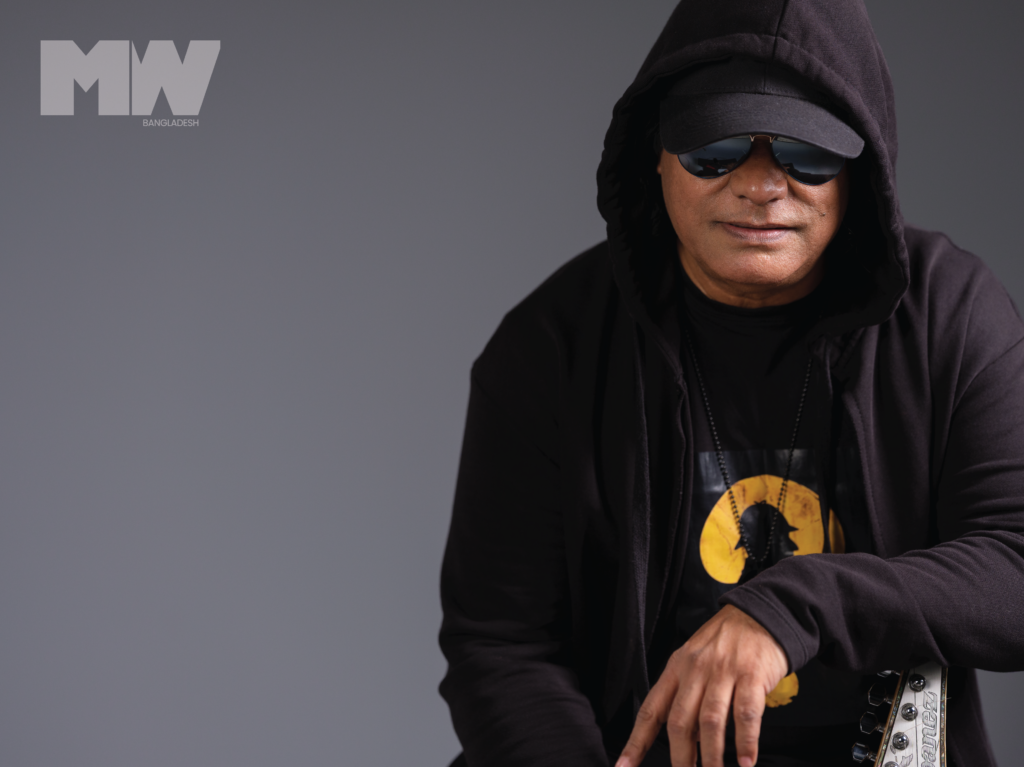
In conversation with MWB, Hamin Ahmed looks back on the formation of Miles, the discipline behind its endurance, the cultural choices that shaped its sound, and the responsibility of passing a stronger music industry to the next generation.
You grew up as the son of renowned composer Kamal Dasgupta and legendary Nazrul Sangeet exponent Firoza Begum, in a household where music was almost a way of life. What made you gravitate towards band music and rock instead of following a more classical or semi-classical path?
I was born into a home where music was always present. When I was too young to understand it, music was playing around me, and when I gradually began to understand it, the music was still there. That was simply the environment in which we grew up.
From around the age of seven, I performed Nazrul Sangeet as a child artiste at different programmes for children. I also learned music during that period. My father taught me certain things, so my earliest exposure was very much connected to Bengali music and the musical traditions of my family.
Both my father, Kamal Dasgupta, and my mother, Firoza Begum, were among the most important figures in Bengali music in the subcontinent. Despite their stature, they were extremely open-minded. That was a significant factor in how Shafin and I were allowed to develop our own musical interests.
They were more interested in music itself than in telling their children, “You must follow this particular path.” My mother was actually somewhat sceptical about whether music should be taken up as a profession. Her condition was that we had to finish our education first. But neither of our parents ever restricted our interest in music.
I understood much later that they could give us that freedom because they were secure in their own knowledge and understanding of music. They knew that music flows and evolves. It cannot remain fixed in one place. Instead of preventing our natural interests, they encouraged us and gave us advice that became very useful throughout our lives. They would tell us, “Know what you are doing, and whatever you do, do it well.”

My mother bought my first guitar, my second guitar and my amplifier. She supported us even though Shafin and I created an unbelievable amount of noise at home. At one point, I became obsessed with drums. You can imagine what it was like to have an entire drum kit set up and being played in the living room.
Our elder brother, Tahsin, also loved music and had a beautiful voice, although he did not pursue it professionally in the way we did. Shafin and I, however, were completely consumed by music. By the time we were approaching our teenage years, music had become the centre of our lives.
For some reason, our interest naturally moved towards Western music. We began listening closely to artists and bands such as Deep Purple, Jimi Hendrix and Santana. The guitar, the arrangements, the energy and the possibilities within that music fascinated us. So, moving towards band music was not a rejection of the musical tradition we inherited. It was our own way of exploring music.
Our parents gave us the foundation, the discipline and the freedom to discover our individual direction. That freedom ultimately allowed us to find rock and band music without losing respect for where we came from.
Music was playing around me before I could understand it, and it was still playing when I began to understand the world. My parents never forced us into one tradition because they knew that music must be allowed to flow
Before joining Miles, were you involved with other bands? How did those early experiences shape you as a musician?
Although Shafin and I had been interested in music from a very early age, my first experience of forming a band came during my college years. Like many young musicians, I started a band with friends. It was called Purple Ocean.
We used to perform at a restaurant called Dimple. Through Purple Ocean, we became closely associated with several other musicians who would later become well known, including Foad Nasser Babu from Feedback, Nayan Munshi, and Pearo Khan.
We played music together, spent time together and were part of the same circle. Some of those musicians later became associated with Feedback. At that stage, we were all learning, performing and developing our musical interests together.
Purple Ocean was one of the first important steps in my journey. A little later, we formed another band called Baroque. It was also formed mainly by college friends. By that time, some of us had completed college and were beginning to move in different directions in life.
With Baroque, we started performing at different places. It was still in its early stages, but it gave us experience working as a group and performing in front of audiences. Those bands helped us understand rehearsal, coordination and live performance before music became a serious professional commitment.
At the same time, Shafin and I were already becoming known among friends and musicians in Dhaka for singing Western songs together. We had a collection of perhaps 20 to 30 English songs that we could perform using acoustic guitars. We covered songs by The Beatles, Crosby, Stills, Nash & Young, John Denver, John Lennon and the band America.
We were often invited to parties and gatherings where the two of us would perform live with only acoustic guitars. Those performances helped us develop our vocal harmony, timing and confidence. They also created a musical identity for us before we formally became part of Miles.
When the other members of Baroque eventually went abroad or followed their own paths, Shafin and I received an invitation to join Miles. That became the beginning of a completely different phase in our lives.

You and Shafin Ahmed had already performed as child artistes and were known for your acoustic covers before joining Miles. Why do you consider Miles the true beginning of your musical identity?
Our relationship with music began long before Miles. As children, Shafin and I recorded the Nazrul Sangeet song “Projapoti Projapoti.” I was around eight, and Shafin was around seven at the time.
We also performed regularly at school. I still remember that the first song I sang at school was Rabindranath Tagore’s “Gram Chara Oi Ranga Matir Poth.” From around Class six onwards, whenever the school organised a programme, our music teacher would tell us that Hamin and Shafin had to sing. So, performing was already a regular part of our lives.
Later, we formed and performed with Baroque, while also becoming known for our acoustic performances. By the period between Baroque and Miles, many people within Dhaka’s music circle already knew that there were two brothers, Hamin and Shafin, who sang together. People appreciated our singing and often invited us to perform.
However, I still consider Miles the real beginning of my musical identity. Before Miles, we were child artistes, school performers and young musicians playing cover songs. We were certainly serious about music, but it was with Miles that music became a disciplined and professional commitment.

With Miles, we began practising for six to eight hours a day. That level of preparation changed everything. It was no longer only about enjoying music or performing occasionally. We were working on our instruments, voices, arrangements and live presentation with complete dedication.
Miles taught us what it meant to function as professional musicians and as members of a band. It gave us the environment in which our skills, discipline and musical identities could properly develop. So, while Purple Ocean, Baroque, our childhood recordings and our acoustic performances were all important parts of the journey, the identity people know as Hamin Ahmed was truly formed through Miles.
You once spoke about Miles rehearsing without fans or air-conditioning for years to prepare for live stage conditions. What did that practice teach you about discipline?
We followed that practice for at least 36 years. We rehearsed without fans or air-conditioning because, at that time, rehearsal spaces were not as developed or comfortable as the practice pads musicians have today. We simply worked in the conditions available to us.
Eventually, however, those conditions became part of our preparation. An air-conditioned rehearsal room cannot reproduce what happens during a live concert. On stage, you may be performing in front of eight to ten thousand people. It may be summer or even early winter, but the stage lights are extremely powerful, with each light producing a great deal of heat. Then there is the nervous energy and tension that naturally come before a performance. When all those factors come together, the environment becomes physically demanding.

Because we had spent years rehearsing in difficult conditions, that stage environment never felt unfamiliar to us. We already knew that we would sweat and that the heat would be intense. Instead of being distracted by discomfort, we could concentrate on the music and move through the performance naturally.
That practice taught us that discipline is not only about rehearsing songs correctly. It is also about preparing your body and mind for the actual conditions in which you will have to perform. You cannot expect everything to be comfortable. A professional musician has to be ready to deliver the same standard of performance despite the heat, exhaustion, pressure or technical difficulties.
For us, this was part of taking live performance seriously. When we stepped onto the stage, we did not want the environment to become an excuse. We had already trained ourselves to know what was coming and to continue performing without allowing the discomfort to affect the audience’s experience.
You also had a serious cricket background and represented Bangladesh. Did cricket shape your sense of discipline as a musician?
I was not involved in a wide range of sports at school. I took part in the high jump and ran the 800 metres, but cricket was the sport that truly introduced me to discipline because I pursued it very seriously.
I played as an opening batsman and represented Bangladesh, including in the 1986 ICC Trophy. I also played domestic cricket for about ten years. During that period, I represented several major clubs, including Abahani, Mohammedan and Azad Boys Club. I played for Azad Boys Club the longest, and at the time, it was one of the most sought-after clubs to play for.

The structure of cricket was different then. The Premier Division included established clubs such as Abahani, Mohammedan, Victoria Sporting Club, National Sporting Club, Wari Club, Agrani Bank, Biman and Azad Boys Cricket Club. Agrani Bank and Biman had their own competitive teams, while clubs such as Abahani, Mohammedan and Azad Boys were major centres of cricket. The competition was serious, and being part of that system required regular practice, fitness, patience and commitment.
As an opening batsman, you also had a particular responsibility. You had to face the new ball, handle pressure from the beginning and build the foundation of the innings. That required concentration, preparation and the ability to remain composed. You could not depend only on natural ability. You had to practise consistently and be mentally ready every time you went out to bat.
Those habits naturally became part of my life as a musician. Cricket taught me to respect preparation, teamwork and routine. A band also depends on every member doing their job properly. Just as one player cannot carry an entire cricket team, one musician cannot create the complete sound of a band alone.
Playing cricket for ten years taught me that discipline means showing up regularly, practising even when you do not feel like it and performing responsibly under pressure. That same approach later became essential to the way I worked with Miles. The field and the stage are very different places, but both demand concentration, teamwork and the ability to deliver when people are depending on you.
Cricket taught me that discipline means showing up regularly, practising even when you do not feel like it and performing responsibly under pressure. I carried the same approach from the field into Miles
Before “Protisruti,” Miles was primarily known for performing English cover songs. How important was that phase in building the band’s identity and audience?
Protisruti was our first Bengali album, but a large part of Miles’ early journey is unknown to many younger listeners today. Before that album, we were performing almost entirely in English. A typical Miles show could run for two to three hours and consist only of English cover songs.

That phase was extremely important because it built our discipline, our stage confidence and our audience. We performed these songs all over Bangladesh from 1979 until around 1990. The number of shows we did during that period was remarkable, especially considering that band music was still developing and the concert infrastructure was very limited.
Our first tour in India also began with English music. We performed in Bangalore, Chandigarh, Kolkata and Delhi. Because the songs were in English, we were able to connect with audiences beyond Bengali-speaking listeners, and over time, Miles developed a following among many non-Bengali Indian fans as well.
Concerts at that time were very different from what people see today. Large open-air stadium shows were not common because the necessary sound systems, lighting and technical support were not widely available. Most performances took place indoors, in auditoriums that could accommodate perhaps 700 or 800 people.
However, when Miles performed, 1,000 to 1,500 people would often arrive. The halls would become completely packed, many people would be unable to enter, and there were occasions when doors or entrances were damaged because of the crowd pressure. It happened so often that the name Miles became associated with overcrowded venues. Eventually, some venue authorities became reluctant to host our shows because they expected that the audience would exceed capacity.
So, although Pratishruti marked the beginning of our Bengali album journey, the years of performing English cover songs had already established Miles as a serious live band. That period trained us to perform long sets, respond to different audiences and maintain a strong stage standard. It created the foundation on which the later Bengali identity of Miles was built.

You began in the cassette era, when buying music meant physically owning it. What do you think was lost when music became mostly digital?
I think one of the main things we have lost is a certain degree of creative freedom. In the cassette and CD era, both music and the music industry were perhaps more open to experimentation.
If an artist wanted to release an album, a record company would often be willing to distribute it and see how listeners responded. There was more room for an artist to present something new without having to prove in advance that it matched an existing commercial formula. This was not limited to Bangladesh. It was part of the music industry worldwide.
As the industry expanded and became more corporate, decision-making also became more calculated. Today, when an artist presents an album, people may listen to the songs and suggest changing one or two of them to resemble something that has already succeeded in the market. That is where commercial considerations can begin to influence the artist’s creative process.
The problem is not that people offer advice. The problem arises when success is judged mainly through what has already worked. Instead of asking what is distinctive about a new artist, the tendency can be to ask whether the music sounds similar to something that is already popular. That can restrict experimentation.
If you look at the music of the 1970s and 1980s, there was an enormous range of artistic exploration. Much of that music is still widely heard today. Contemporary artists may draw inspiration from those decades, which shows how influential that period remains. Different branches of rock and metal also developed because bands had the space to experiment and create their own identities.
In Bangladesh, bands such as Miles and LRB had the opportunity to develop during a relatively open period. Later bands, including Warfaze, Artcell and Nemesis, entered a different industry. They were highly talented, but the commercial environment had changed. There was often greater uncertainty from record companies about whether a particular sound would succeed.
The arrival of YouTube and streaming platforms made it easier for musicians to release their work independently. That has clearly created opportunities. Artists no longer have to depend entirely on a record company to make their music available. At the same time, digital access has changed the listener’s relationship with music.
Previously, when you bought an album, you saved money, went to a shop and brought home something physical. You held the cassette or CD, studied the cover, read the lyrics and listened to the album repeatedly. That process created a sense of value and personal connection. You felt that you owned the music.
Today, a listener can hear a song instantly on YouTube or Spotify, press the like button and move on to something else. The access is easier, but the level of commitment can be different. The listener appreciates the song, but there may not be the same physical or emotional relationship with the album as an object.

This does not mean that digital platforms have no value. They have made music available to listeners across the world and have given artists new ways to reach an audience. But they are also businesses, and their systems are largely shaped by algorithms, engagement and commercial priorities. Their main role is to make music available. They do not necessarily build a close relationship with an artist in the way some record companies once did.
Earlier, a record company might sign an artist for several albums and remain actively involved in how the music developed, how it was promoted and how audiences responded. There was a longer-term relationship. Now, music can simply be uploaded to a platform and left there to find its audience.
As a result, longevity has become more difficult. Songs are released and replaced very quickly. I believe the artists who maintain a clear identity and are willing to work against short-term trends are more likely to remain relevant. Digital platforms have expanded access, but artists still need the freedom, patience and support required to create music that lasts.
Several classic Miles songs, including “Neela,” “Phiriye Dao” and “Dhiki Dhiki,” continue to attract new listeners. How do you approach requests to remix or re-record these songs while also making space for new music?
We have received many requests over the years to remix or re-record some of our best-known songs. My preference has generally been to focus on creating new music.
For a band like Miles, one of our greatest strengths has always been our ability to write and compose original songs. We still have new material waiting to be released. However, our approach to releasing music is perhaps different from simply producing a song, uploading it to YouTube and moving on. We want a release to have the right context, presentation and connection with the audience.
That does not mean that I am completely against remixes. A reinterpretation can work when it suits the character of the original song and brings something meaningful to it. Habib Wahid’s work on the album Krishno is one example of how traditional material can be presented in a contemporary form while retaining its musical character.
My concern is mainly about repeatedly returning to a familiar hit simply because it has already been successful.
We once prepared a club mix of “Priyotoma Megh,” but we chose not to release that version at the time. We felt the original song needed the space to establish its own identity. When you introduce another version too quickly, attention can shift away from the original recording.
There is also a strong sense of nostalgia attached to Miles’ recordings from the 1990s. People remember not only the compositions, but also the sound, arrangements and recording character of that period. A more polished contemporary version may sound technically cleaner, but listeners may not necessarily connect with it in the same way.
Remastering an original recording is different. It can improve the sound quality while preserving the original performance and arrangement. Re-recording a song creates a new interpretation, and that needs to be approached more carefully.
Ultimately, I believe both preservation and experimentation have a place. But any new version should have a clear musical reason behind it. At the same time, I would rather use our creative energy to introduce new songs than depend only on the success of the past.
I would rather use our creative energy to make new songs than depend entirely on past successes. A classic song should only be reinterpreted when there is a clear musical reason for doing so
Through the Bangladesh Lyricist Composers & Performers Society (BLCPS), you have worked to create a structured royalty system for lyricists, composers and performers. Why has it taken Bangladesh so long to recognise music as intellectual property?
Bangladesh has a strong legal framework for copyright protection. The main challenge is ensuring that the law is implemented consistently and that people understand how it applies to music.
A song is intellectual property. Its lyrics, composition, sound recording and performance may involve different rights and rights holders. When music is used publicly or commercially, the appropriate authorisation or licence should be obtained, depending on the nature of that use. This allows the people who created and own the music to receive their rightful share.
In Bangladesh, songs are frequently performed at concerts and used by broadcasters, businesses and other organisations. Covering a well-known song can certainly be a way of appreciating the original artist, and it can also introduce the work to a new audience. However, when that performance is part of a commercial activity, the relevant copyright and licensing requirements should also be respected.

The law already provides protection, but effective implementation requires awareness, monitoring and timely action when rights are violated. It is also important to establish clear procedures so that broadcasters, venues, event organisers and other music users know how to obtain licences and pay royalties.
I have been working on this issue for many years because Bangladesh needed an organisation capable of managing these rights collectively. That is the role of the Bangladesh Lyricists, Composers and Performers Society, or BLCPS. It is Bangladesh’s first government-licensed Collective Management Organisation for music rights.
Collective management organisations operate in many countries. Organisations such as ASCAP and BMI in the United States license the use of music, collect royalties and distribute those royalties to their members and aliated rights holders. BLCPS is working to establish a similar structured system suited to Bangladesh.
An individual lyricist, composer or rights holder cannot personally monitor every radio station, television channel, venue or business where a song may be used. A collective organisation can manage that process on behalf of its members by documenting works, issuing licences, collecting royalties and distributing the money to the appropriate rights holders.
At the time of this conversation, BLCPS had become operational and had begun developing its royalty collection and distribution process. The larger objective is to create a permanent and transparent system rather than a one-time initiative.
Once that system functions properly, creators will not have to depend only on concerts or new releases for income. Their existing work can continue to generate royalties whenever it is licensed and used. That is important not only for established musicians, but also for lyricists, composers and performers whose contribution is often less visible.
The legal protection already exists. What Bangladesh now needs is consistent implementation, greater public awareness and a reliable system through which music users can obtain licences and creators can receive what they are entitled to.
You have spoken about bringing younger musicians into the Bangladesh Musical Bands Association’s (BAMBA) leadership. Why is generational inclusion important for an organisation like this?
Generational inclusion is important, but leadership should not be based on age alone. In every generation, a few people step forward, understand what needs to be done and create a path for others.
Before taking leadership, young musicians need to understand their profession properly. They should know their rights, copyright, ownership and how the music industry works. A hip-hop or rock artist, for example, should also have some understanding of Bengali music, Nazrul Sangeet, Rabindra Sangeet and the basic elements of classical music.
Inspiration may be the starting point, but knowledge and preparation allow someone to contribute meaningfully. Once young musicians understand both their craft and the industry, they can identify problems, propose solutions and eventually lead organisations such as BAMBA.
Miles toured the United States and Australia in 2025, with a Canadian tour in preparation. How does performing for diaspora audiences differ from performing at home?
The experience is largely similar, but Bangladeshi audiences abroad often hold on to Bengali music with particular affection. They sometimes request songs that are not commonly requested at home because those songs are connected to memory, identity and nostalgia.
Miles also has listeners from India and other South Asian communities, partly because of our long history of performing across the region. This often creates a mixed audience at our international concerts.
Touring abroad also taught us the importance of professional planning. During our first US tour in 1996, we paid close attention to the venue, sound, scheduling and overall concert experience. We wanted each event to be presented as a proper live show. That approach helped Miles build a lasting relationship with audiences outside Bangladesh.
What do you want young musicians to inherit from your generation?
I would want them to understand that music is a subject that needs to be studied seriously. Miles could experiment with different styles because we tried to understand melody, rhythm, arrangement and the cultural context of the music we were creating.
Young musicians should not simply copy what an earlier generation did. They should study why certain choices worked. Miles performed rock music in English, but when we began creating Bengali songs, we adapted our sound to the character and natural melody of the language.
A song can use influences from rock, Latin music or other traditions, but its melody must still connect with the listener. “Neela,” for example, uses a Latin-influenced rhythm, but the tune remains recognisably Bengali. That combination helped the song reach a wide audience.
Bands and artists such as Miles, LRB, James, Winning, Feedback, Warfaze and Artcell created songs that travelled beyond a limited group of listeners. Their music reached people across urban and rural Bangladesh. That is an important achievement.
I hope young musicians inherit the discipline to study music, the confidence to experiment and the awareness that lasting music must connect with its language, culture and audience.
The artists who last are usually the ones who develop a clear identity rather than simply following the market. Trends may create immediate attention, but knowledge, discipline and originality create longevity
Fashion Direction & Styling: Mahmudul Hasan Mukul
Photographer: Kaushik Iqbal
Make-up & Hair Style: Shamim Makeover
Assistant Stylist: Arbin Topu