



Kishwar Chowdhury first captured hearts as a standout contestant on MasterChef Australia, where her deeply personal cooking rooted in Bengali heritage told stories far beyond the plate. What followed wasn’t a fleeting moment of fame, but the beginning of a thoughtful evolution: from home cook in the spotlight to celebrated chef and food writer, and now, a cookbook author with a distinct voice. In this frank conversation, Kishwar traces her poignant journey to her debut cookbook, Smoke, Rice, Water
By Samai Haider
Long before the television appearances, the restaurant kitchens and the cookbook deal, Kishwar Chowdhury was carrying around a stubborn little idea: one day, she would write a cookbook. Not open a restaurant. Not launch a hospitality empire. A book.
Which is why one piece of early advice stuck with her so clearly. “Someone told me very bluntly: ‘There’s no money in books, Kishwar. What are you doing?’” she says, laughing. Oddly enough, the warning only sharpened her resolve. “That sorted out the reason why I wanted to do it,” Chowdhury says. “If you’re writing a book, you have to be deeply driven by it.”
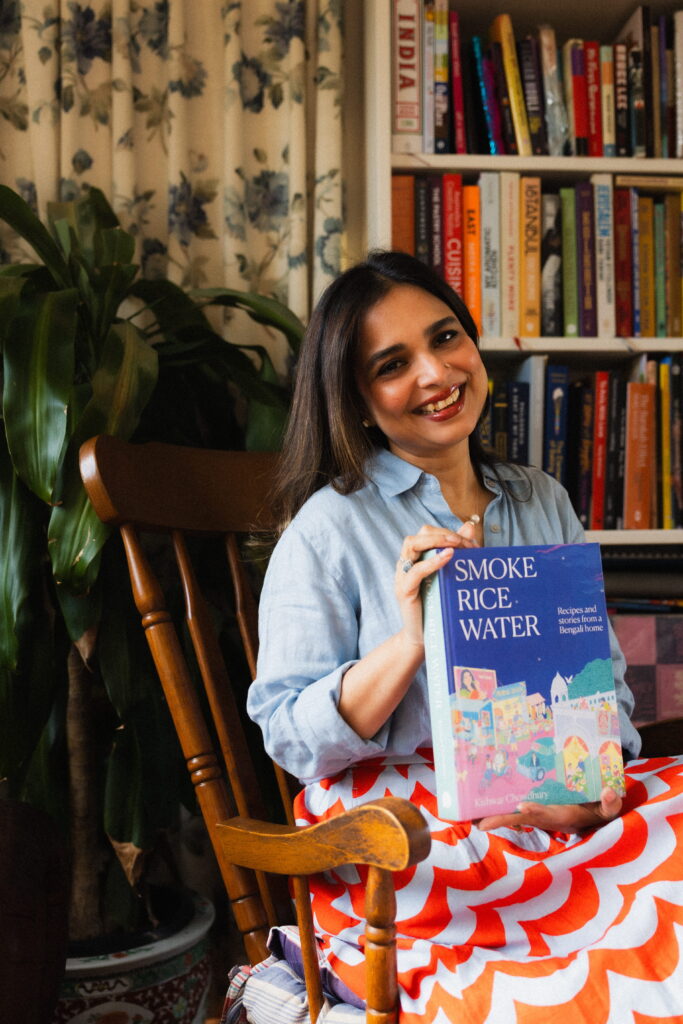
That drive eventually became Smoke, Rice, Water, her debut cookbook: a collection of Bengali recipes, rooted in family memories that feels as much about identity and migration as it does cooking.
The book arrives several years after Chowdhury became a finalist on MasterChef Australia in 2021, but she insists it couldn’t have happened any earlier. “I don’t think I could have written this straight after MasterChef,” she says. “The universe kind of guides you to things when you’re ready for them.”
In the years after the show, opportunities arrived quickly. Chowdhury worked in professional kitchens, staged under acclaimed chefs, hosted events and became a global food personality. But underneath the momentum, the book remained unfinished business. “Every year that passed, I kept thinking: when can I finally slow down enough to do this properly?”
Learning from the bottom up
That willingness to keep building slowly, and start from the bottom repeatedly, seems to define much of Chowdhury’s career. Before MasterChef, she had already lived several versions of herself: moving between Australia, Bangladesh and the UK, opening a business overseas, raising children and constantly adapting to unfamiliar environments. “We do a lot of things we’re probably not qualified for,” she says. “We walk into situations blind.”
Professional kitchens were no exception. Going from home cook to chef, she says, was physically punishing but creatively exhilarating. After MasterChef, she spent months doing long shifts, internships and staging roles — often unpaid — simply to learn. “I was exhausted. Completely exhausted,” she says. “I was on my feet for 12 or 13 hours a day. But I was so deeply satisfied.”
That hunger for growth still shapes the way she thinks about food and work. Chowdhury speaks passionately about the value of mentorship and apprenticeships in hospitality, lamenting what she sees as the decline of traditional kitchen staging. “Everyone once dreamed of staging at places like Noma or The Fat Duck,” she says. “That was your education.”
While unpaid kitchen work has increasingly come under scrutiny internationally, Chowdhury says the experience of learning alongside great chefs was transformative for her own development. “If you can find a chef or mentor who believes in you, that’s worth more than money can buy.”
Writing wherever she could
Writing Smoke, Rice, Water required a similar humility. Despite years of recipe writing for publications and contributing to other books, creating her own cookbook proved overwhelming in ways she hadn’t anticipated. “There’s the recipes, but then there’s also the storytelling, the history, the research,” she says. “It’s a mountain of work.”
A friend offered her advice that became something of a mantra during the process: “The only way to eat an elephant is one bite at a time.” So that’s what she did.
Writing happened everywhere — on planes, in hotel rooms after cooking demonstrations, before sunrise while the rest of the household slept. Sometimes after school runs and her children’s basketball practice. Often in less-than-ideal conditions. “I’ve written parts of the manuscript in hospital with an IV drip in my arm,” she says. She quickly clarifies she would not recommend this approach to aspiring authors.
The warmth of home cooking
Still, Smoke, Rice, Water never feels laboured. Instead, it carries the warmth and pliancy of the food traditions it documents. Chowdhury writes about Bengali cooking not as rigid authenticity, but as something instinctive, adaptable and deeply tied to place.
For all the technical precision she learned in restaurant kitchens, she draws a clear distinction between chef food and home food. “You can be an incredible chef and not necessarily know how to be a good home cook,” she says. “Restaurant cooking is rigid systems and pressure; making sure that each element comes out perfectly every single time. There’s a real science behind it. That’s not how home cooking works. It is hard to bring a lot of warmth and heart into a mostly clinical environment,” she elaborates, referring to the differences between a restaurant kitchen and home.
At home, she leaves much of the restaurant mentality behind. “My kids eat lasagna,” she says, laughing. “I definitely leave work at work.”
Cooking with meaning
That philosophy runs throughout the book. Smoke, Rice, Water celebrates food that is seasonal, practical and emotionally resonant rather than overly complicated. Chowdhury wants readers to think differently about how they shop and cook — starting not with elaborate recipes, but with what fills their fridge. “What goes into your grocery basket really dictates how you eat,” she says. “That’s more important than a gym membership.”
Many of the recipes in the book embrace simplicity: pumpkin bhaji scented with nigella seeds and garlic; local Australian fish adapted into Bengali curries and steamed dishes. The emphasis is on technique and intuition rather than perfection. “Delicious food can come from a few simple ingredients,” she says.
That flexibility, she believes, is central to preserving culture through food. Bengali cooking, as she learned it, was always deeply local — shaped as much by Australian barramundi and Murray cod as it once was by Bangladeshi river fish. “You learn the techniques so you can adapt them wherever you are in the world,” she says.
Which perhaps explains why Smoke, Rice, Water resonates beyond the recipes themselves. It isn’t simply a cookbook about Bengali food. It’s a story about migration, ambition, reinvention and learning to trust your instincts — even when the practical advice says otherwise.
After all, there may be no money in books. But sometimes, there’s something much more important.
Photo Credit: Yaameen Al-Muttaqi