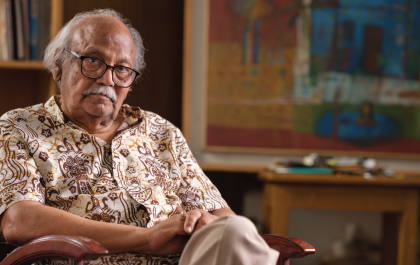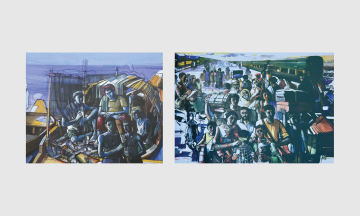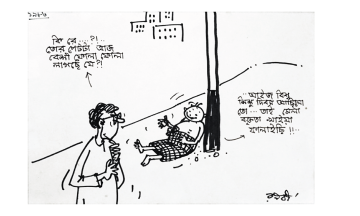




Tanvir Mokammel’s place in Bangladeshi cinema has always been slightly off to the side of the mainstream, not by accident, but by choice. Born in Khulna and educated in English literature at Dhaka University, Mokammel’s formation wasn’t based on glamor or star power; it was grounded in books, political awareness, and a firm belief in cinema as a medium of truth-telling. Over decades, he’s created a body of work that refuses easy entertainment. His films, from the war-era drama Nodir Naam Modhumoti (1996) and the partition-era story Chitra Nodir Pare (1999), to the hard-hitting rural critique Lalsalu (2001) and the poetic biopic Lalon (2004), examine identity, memory, displacement, and social justice.
By MWB Desk
Mokammel doesn’t chase box-office numbers. He works with modest budgets, often through informal financing or crowd-support, rejecting commercial formula and the compromises mainstream cinema demands. Despite financial and institutional obstacles, including censorship and funding challenges, he has remained committed to making films that matter.
In his films and his career, Mokammel shows that cinema doesn’t have to be loud to be powerful; sometimes the quiet insistence of memory, conscience, and social commentary speaks far louder.
In this conversation with MWB, he reflects on how his upbringing, political awakening, and decades of struggle shaped his vision and what drives him forward even now.
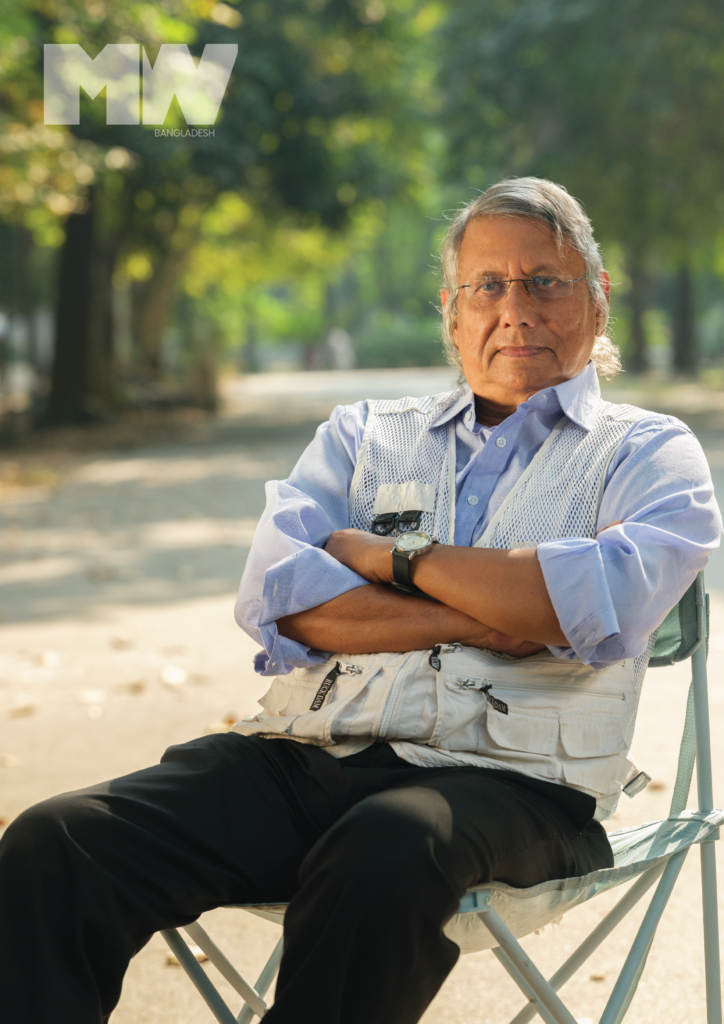
You grew up in Khulna and studied literature at Dhaka University. Could you reflect on how those early environments shaped your cinematic vision?
I grew up in our ancestral home, “Mokammel Manzil” in Khulna. My mother was a teacher of Bengali literature, and my father was a student of English literature. So, the house was filled with books of both Bengali and English literature. Since my childhood, I was a voracious reader. I think this indulgence in literature from early years later impacted my desire to tell the stories of human beings in my films. Ours was a family steeped in cultural activities. My sisters would sing and dance. One of my brothers was a musician. My mother herself, during her youth, was a skilled Esraj player. In our Khulna house, she even established a musical school called “Jhankar”.
When I grew up during the 1960s, even in a mofussil town like Khulna, two cine halls would regularly show quality English films. In my boyhood, I watched such good films as For Whom the Bell Tolls, Thomas Becket, Spartacus and Fall of the Roman Empire. My mother used to take me with her to see Bengali films. Those were the heydays of Uttam-Suchitra. But to be honest, I was not particularly fond of those popular Bengali films. They seemed to me a bit slow and artificial. Rather, I used to enjoy the English movies more, which my father used to take me along.
During my student days at Dhaka University, with some of my friends, we formed a film club known as “Dhaka University Cine Circle”. We used to write about cinema, organize seminars and workshops on classic films and on serious filmmakers. My yearning for better cinema seemed to have developed during those days. At one stage, I thought making films by myself would be more interesting. So, after graduating from university, I made my first film Hooliya, an experimental short film on a poem by poet Nirmalendu Goon.
What made you first pick up a camera, not as a hobby, but as a tool to say something?
Being a film society activist, I saw an large number of old classics and quality films from all over the world. I became aware of the power of cinema. In those days I was also in creative writing poem, short story, article or travelogue. But I realized that by vernacular literature one could reach only the readers of one’s own language. But the language of cinema being a universal one can reach out to a much wider audience, even all over the globe. Perhaps that was the reason why I picked up camera to tell what I wanted to say.
You have noticed that I do not make so-called “commercial” films. For me to be commercially successful was never any aim. I would rather wanted to have full freedom in my cinematic endeavours. So, I began to make my films in the alternative genre, out of FDC’s mainstream cinema, without the filmstars and my films were also shown outside the commercial cine-halls. During our days of film society activism we knew about the Latin American political filmmakers who used to make and exhibit their films in the alternative genre. I was definitely influenced by them. Instead of being caught in the corporate imbroglio or money-shark intermediaries, I wanted to reach directly to the people with my films. That’s why I made and showed my films totally in an alternative way of filmmaking and showing my films in alternative outlets. And I am still doing that.
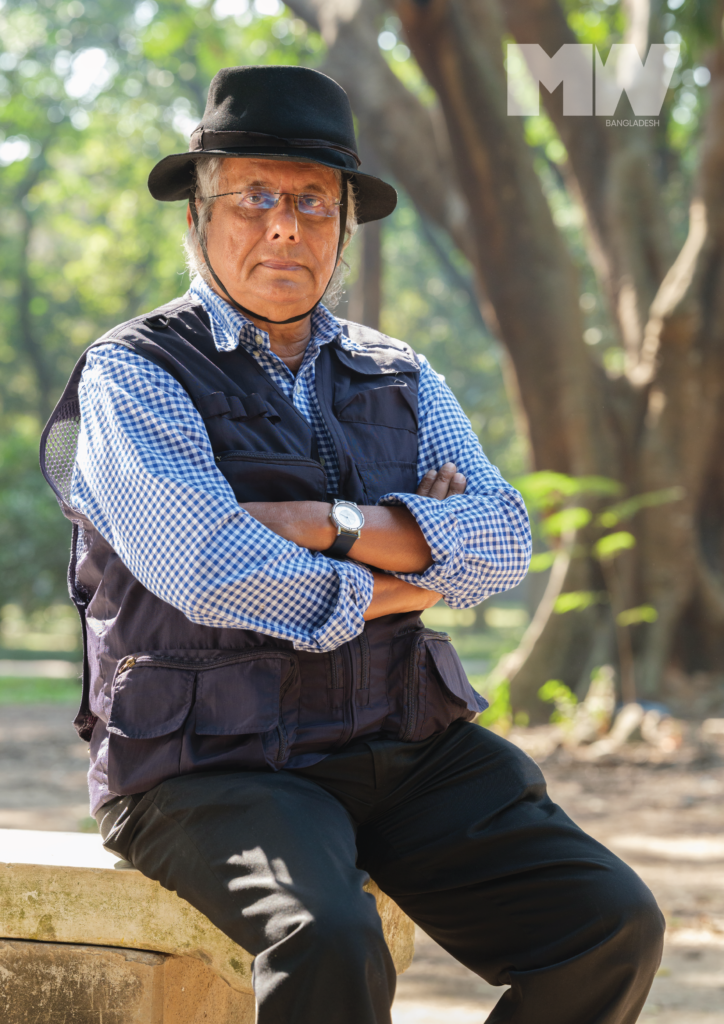
Your films repeatedly revisit 1971 and Partition. What keeps drawing you back to those themes?
I did experience the 1971 war. Look at our age then. I was just a teenager, an age, when a person’s sensibilities remain most sharp. Then I witnessed the horrible events of genocide and rape by the marauding Pakistan Army and their retainer Islamist forces, the Razakars and Al-Badr. I also saw the sufferings of the religious minorities and the refugees. Ten million refugees had migrated from East Pakistan to India in 1971. Never in history such a mammoth number of population had migrated from one country to another. Imagine the sheer number, ten millions. Almost a Biblical figure! I also then witnessed the heroics of our freedom fighters. With so little weapons and training they showed resilience and courage to confront the ruthless and professional Pakistan Army. All these perhaps made such an impact on my young impressionable mind that when I later came to filmmaking, whenever I thought of any theme or subject for my films, some incidents which I saw or heard in 1971 would come up to my mind. I believe the events of 1971 made a huge impact on my creative self.
And regarding 1947 Partition, well, as I told before, I was born and brought up in Khulna town. Khulna, when I was growing up, had a huge Hindu population. Lot of my classmates, or the boys I used to play in out neighborhood, were from the Hindu community. After the 1964 riot, which took place in Khulna in a very violent form, they began to leave Khulna and migrate to India. It would happen that one-day Subhas or Binod will come with a pale face and would say “We are going tomorrow?” In answer to my query “Where?” they would say “Kolkata”. I was almost a child then. So, I didn’t understand what “going to Kolkata” really meant. To me that time Kolkata seemed like a black hole where one after another my childhood friends had disappeared. Some of whom I never saw any more in life! You will be surprised to know that when I was a student of class VI, a boy of mere twelve years old only, I decided to make a film on the tragedy of the Hindus in East Bengal and the title of the film would be Chitra Nodir Pare. Later on, I made Seemantorekha, Swapnabhumi and Rupsa Nodir Banke. Both these three films dealt with Partition. Yes, the Partition of 1947 still haunts me.
In Bangladesh, funding and censorship can be major obstacles. How do you work around them without diluting your message?
Funding is an endemic problem for our kind of cinema. Though my films are very low-budget, made almost in shoe-string budgets, yet to organize that small amount of money itself is an uphill task in Bangladesh. We have a rich bourgeois class now in Dhaka, but mostly being first generation, they are not enlightened enough to come forward to contribute to a worthy cultural project. In Bangladesh there is no provision of bank loans for films.
So to shoot a film I have to collect money mainly through personal loans from family members, friends and acquaintances. If you notice the title card of any of my film you will see a rather long list of acknowledgements. So many people contribute or help my films and I have to express my gratitude to such a big member of people that the acknowledging scroll at the end of the film goes on and on and seems never ending! Actually, most of my films were made by some kind of informal crowd funding. But these days, as crowd funding has become more an established and institutionalized process, my film unit is now using the system more effectively. At least two of my last films were made by crowd funding. But the process is not easy and funding is still a big hurdle in my cinematic endeavours.
And regarding censor, well, I have a long history of struggle with the Bangladesh film censor board. Censor Board stopped my first liberation war film Nodir Nam Modhumoti and asked me to cut at ten places of the film. I remember, a journalist jocularly wrote it as the “Ten Commandments!” But I won’t cut any part of any of my films for a insensitive censor board. So I went to the High Court. The film was later released. For another of my film Teardrops of Karnaphuli [Karnaphulir Kanna] I also had to go to the High Court. After I got the writ in my favour from the High Court the film could be released. After these two incidents the censor board have not opposed my films any more. While making a film I never think at all about censor board or their outmoded rules. I believe censor rules in Bangladesh are anti-art, outdated and far from the real life of our people.
Do you write with an audience in mind, or are your scripts more personal reflections?
There are two kinds of filmmakers in the world. One for whom cinema is their vocation. They live on it. So, audience is very important to them. Then there is another kind of filmmakers who make films because they have something to say and they want to express their ideas through cinematic art form. I perhaps belong to the second category. In the world of cinema this kind of filmmakers are known as “Auteur” filmmakers. Being an Auteur, the reflections of my personal traits or experiences, remain omnipresent in my works. Films after films, sometimes consciously, often sub-consciously, my own personal beliefs and ideas may get expressed in my films. These beliefs include my political ideology, my attitude towards religion, and above all, my views about the human condition.
In Lalsalu, you showed how religion can be used to control people. Did you face any risk or backlash for that?
Not during shooting. But I faced problem during exhibition of the film Lalsalu. It first happened in Sylhet. The bigots of Sylhet protested against the screening of the film. Their point was that Sylhet being a mazar-town they won’t allow an anti-mazar film like Lalsalu to be shown in Sylhet. They created such a commotion that the local police administration refused to give permission to show the film. So, the screening of Lalsalu was cancelled in Sylhet.
A similar incident happened in Khulna too. The journalists of Khulna organized the show of Lalsalu there. The show was supposed to take place at the Khulna Press Club. But religious fanatics in Khulna began to protest. They even threatrened that bombs would be hurled if Lalsalu was shown and the Khulna police authority finally stopped the show of the film.
It is interesting that the novel Lalsalu was published in 1948. The Bengalee Muslim society then had accepted the novel and it even became popular. But fifty years later when I made the film Lalsalu, the conservative section of the same community, not only disliked Lalsalu, but even opposed its screenings. This shows how much our society has moved backward and has become anti-art these days.
Did making Lalon (2004) change your own understanding of spirituality?
Before making Lalon I made a documentary film on Lalon Fakir and his philosophy, titled as Achin Pakhi (1996). So, there was quite a few years of research before I came to shoot Lalon. I personally knew well and worked with the major prominent Lalonpanthi Gurus of that time, like Fakir Mohin Shah, Fakir Bader Shah or Fakir Anwar Shah. From them, and by my own research, I came to know a lot about the philosophy and musicology of Lalon Fakir.
Baul songs have a long history of almost five hundred years in Bengal. In the mediational mystical practices in Bengal there is a difference between the Bauls and the Fakirs. Lalon Fakir never called himself a “Baul”, rather called himself “Lalon Fakir”. Anyway, this Fakir-Baul tradition of Bengal has been influenced by three spiritual sources: Buddhist Tantricism, Hindu Vaisnabism, and Islamic Sufism. All these three traits are present in Lalon’s songs. He is a master of all these three distinct spiritual ideas. For centuries, hundreds of Baul Gurus had composed songs on these spiritual themes but none could excel better than Lalon Fakir. Among all the Baul-Fakirs of Bengal, Lalon seems to be the most creative, most philosophically oriented and most musicologically gifted.
Regarding the spirituality of Lalon, well, the more I did research on Lalon’s persona and his songs, I found that Lalon’s meditational philosophy was more physical than spiritual. The philosophy of Baul-Fakirs centres around the doctrine of sperm and menstrual blood (rojo-bijer dorshon), a physio-sexual meditational practice, that had existed in Bengal since the Buddhist Tantric era. They try to find the creator through body-centric physio-Tantric meditation that had very little to do with spirituality. But as these practices were not socially sanctioned their songs have to be esoteric and had dual meanings. Apparently, they are love songs or devotional songs.
But underneath remain the expression of their sexo-tantric practices which a Guru teaches to his disciples and can be understood only by the initiated ones. It is a complex and heuristic learning process and only after initiated by a proper Guru or Murshid one can learn the secrets of these practices.
Lalon believes human beings are not only “Manus” (Man), they are potential “Manabroton” (Human Gem) as well. When the creator (Achin Manush) and the creation, (the human body) are reconciled, an individual transcends his physical limitations and becomes a Manabroton (Human Gem). In Lalon’s vocabulary.

“In the bi-petal Lotus The golden man shines With compassion of human Guru You will come to know If you meditate man You will become a golden man.”
In fact Lalon and the Bauls of Bengal are heterodox mystics, ever searching for the “Sohoj Manus” or “Achin Pakhi” (The Unknown Bird) in human body. Though there is a discernible influence of Sufism on Lalon Fakir, the Sufi’s love for God is mostly an ephemeral romantic love. But Lalon’s idea of reunion with the creator (to catch the Achin Manus) was essentially a physical act, an Yogic-Tantrik sexual practice. So Lalon and his followers were never the “ethereal bauls” as the Bengalee middle class intelligentsia have constructed them.
As a nation we Bengalees have some contribution in literature and creative art. But unfortunately, we have not much contribution in philosophy per se. Lalon Fakir and his followers are a rare community of Bengal who did ask some fundamental questions of the philosophic quest i.e, who is God? Where does he live? How was the universe created? Who am I? What is man’s relationship with his creator? These cosmological and existentialist queries, and the way Lalon Fakir had tried to answer those issues, were rooted in the Baul-Fakir meditational tradition of pre-modern Bengal, steeped with Buddhist Tantric cosmology of human body, Nath-Vaisnab-Sahajiya body-centric practices and incorporealism of Islamic Sufism. Lalon Fakir’s era was an era when syncretism of Islamization was taking place in the caste-ridden rural Bengal. And Lalon Fakir was the most conspicuous example of that syncretic assimilation.
But to the mainstream religious establishments, both to the Bahmanic Hindu religious establishment or Sunni religious leaders, Lalon Fakir, and the Baul-Fakirs community as a whole, seemed a dangerously subversive community, active to sabotage the belief system of the dominating religions by posing enigmatic questions with their double-meaning songs.
“The man who worships
Human beings in this world
All his meditations get fulfilled
In rivers, fens or in canals
The water is same
The same Lord
Moves alone
Mingled with humans
He expresses himself
Without a form
He is luminous
The incorporeal takes an appearance
You have to be divinely wise to know
In this infernal age
Man is the incarnation of God.”
In Lalon’s cosmology, God did not have a place to reside. Hence God created human beings with utmost love and chose human body as his abode and resides within it in an incorporeal form as “Achin Manus”, “Moner Manus” or “Sohoj Manus”. So according to Lalon if one worships human beings one worships God as well. Lalon sings.
It is interesting to note that this body-centric humanism of Lalon Fakir, placing man at the epicentre of all meditations, did not arrive from the Renaissance Europe, but was an indigenous breed of humanism, created, held and propagated by the mystic Baul-Fakirs of Bengal like Lalon Fakir. And as an artist this humanism of Lalon was the main reason which attracted me towards him. So much so that I made two films on Lalon Fakir and his philosophy, the documentary Achin Pakhi and the fiction Lalon. Lot of my understanding of Lalon Fakir and his philosophy evolved during my research of these two films and I understood that Lalon’s doctrines had very little to do with the airy spirituality as imagined by the urban and middle class Bengalees. It is very much a body-centric materialist philosophy.
Do you think young people today still connect with Lalon’s ideas?
To some extent, they do.
But I told you before that Lalon’s songs have dual meanings. On the surface they are love songs or devotional songs. The sheer beauty of those songs charms all, old and young. But beneath the surface of these songs remain the sexo-tantric doctrines of Lalon Fakir. Very few people do understand that. And unless initiated by a Guru or a Murshid, it is almost impossible for anyone to understand the meaning of the esoteric philosophy of Lalon’s songs. So I am not sure whether the young people can connect with the inner meanings of Lalon’s songs. But that is not be very important. If they can connect and love Lalon’s songs per se, as understood popularly, that is fair enough. And I see no problem in that.

As Director of the Bangladesh Film Institute, what is your message to young filmmakers today?
There is very little opportunity to learn filmmaking in this country. So many years ago I decided within myself that when I was not making film, during that spare time, I would try to make filmmakers. Hence we established the Bangladesh Film Institute (BFI) way back in 2005. Myself and my film unit members, who are also very adept in this profession, do spend a lot of our quality time to teach the craft of filmmaking to the young generation. My message for them always remains the same. That filmmaking is a serious business. So leave all casual approaches. Be serious and have hundred percent dedication. Only then any chance that a good cinematic work may emerge. It is also very important in this vocation to avoid greed for money, fame or other worldly possessions. If you can do these only then you may create any art. And also it is important to avoid the corporate world. Because corporate greed can spoil any sincere effort in the world of art. And above all, be hard working. There is no short cut in life. Same is in cinema. There is no short cut here to succeed.
What are you working on now? Is there a story or issue you’ve been waiting to tell but haven’t yet?
There are lot of stories I haven’t told yet. A lot of issues I haven’t dealt with. If situation permits, I would definitely like to make films on those.
At present, myself and my film unit, are preparing to make the feature film Sojon Badiar Ghat, on the well-known love story by folk poet Jasimuddin Ahmad. We will shoot the film in this winter.
Besides, I am making a documentary film on the Dhaleswari river titled as Dhaleswari Kotha. The Dhaleswari, once a beautiful river, even mentioned by Rabindranath Tagore, is now in a dismal condition. I want to make a film on this river to make people aware about the moribund condition of the river at present.
I also have a few more film projects in mind. But better not talk about those now as that would be too early. And as Lalon Fakir had said, “Apon sadhan kotha/ Na kohibe jotha totha”. You’ve to wait!
Fashion Direction & Styling: Mahmudul Hasan Mukul
Photographer: Kaushik Iqbal