


By Abak Hussain
Back in our school days, if a child ever made the mistake of referring to Zainul Abedin as “shilpi” or simply artist, they would quickly be rectified. Because of course, Zainul Abedin, in terms of his scope and power and place in our cultural consciousness, has never been seen as just a “shilpi.” He is the Shilpacharya, the master of art; the one and only holder of this moniker.
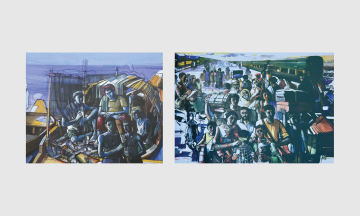
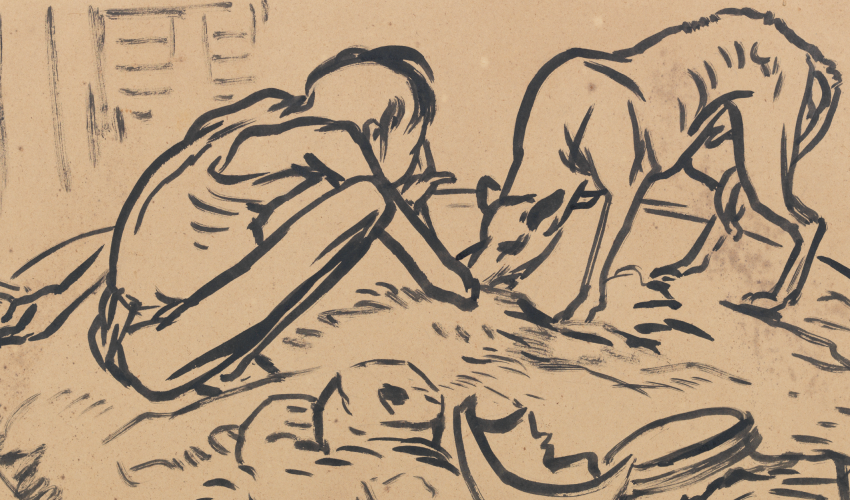
In the end, of course, it is useful to remember that Zainul Abedin indeed was an artist, or a “shilpi,” even though we resist using that word out of grave respect. His perspective was deeply human, and he struggled to bring what he saw around him into his art. And what he saw was a tremendous amount of pain, suffering, and struggle. Not exclusively, but largely. Stark black lines across rough brown paper depicting images of starvation and sickness: what could be more typically Zainul? About three years ago, Chitrak art gallery in Dhanmondi held a Zainul exhibition curated by Sumon Wahed. The exhibit was called, unsurprisingly, “Struggle,” and it was a brilliant display of 125 pieces, out of which 80 had never been exhibited before. I was at the exhibition, and even though it has been a few years, the images remained in my consciousness in a deep and lasting way.
It is no accident that Zainul Abedin holds such enduring power. His worldview is unpretentious, brutal, sparse; his brushstrokes entirely self-assured. When all the trappings of the art world, including the glamor, the gatekeeping, the free market forces fall away, Zainul’s work goes back to the basics. As I write this, the nation waits with bated breath for a very important court verdict, which comes in the aftermath of tremendous sorrow and pain for many families. For Bangladeshis, struggle is life, and that is why Zainul Abedin is the quintessential of Bangladeshi artists.
But after so many years, one may ask, what is the continuing relevance of the Shilpacharya? First and foremost, I believe a periodical reappraisal of our heroes is necessary from time to time. Politics and shallow interests often highlight this or that artist or writer, while dooming others to obscurity. It is a tragic reality of Bangladesh that it is extremely difficult for a newcomer to break into the scene in the arts and entertainment without being perceived as having a regime-friendly image. Artists such as SM Sultan, for example, for some time not talked about enough, now, in the current climate is once again getting a well-deserved critical reappraisal. It is hard to talk about Zainul Abedin without getting political. After all, he documented the suffering of our population. To that, we must ask the question: why was there so much suffering? Why is there still so much suffering? Who is to blame, and who among the powers-that-be should be held to account?
In one of Zainul’s haunting ink renderings in the Struggle exhibit, we saw an emaciated older man with a child with a distended belly sitting on the side of the road. Next to them, perched on some platform is a crow. Humanity has been brought down to the same levels as crows: such is the power of hunger. When all dignity is stripped away, we are merely beasts trying to keep our bodies alive. But are we? Merely beasts, I mean. Again and again we have demonstrated that we are capable of so much more. Music, poetry, art – that is what makes us human and elevates us. In the age of famine, Zainul demonstrated to us that within us there is a light that is capable of art and creativity, and it never dies out, no matter how difficult the circumstances.
Zainul’s eye, I believe, was ultimately one of empathy. He recognized that when we see the suffering of our fellow human as our own, that is when we truly start to realize our shared consciousness. When I see a starving child scavenging the dumpster for food, I realize that I could have been that child. There is no difference between me and that child, except a bit of luck. The haves and the have-nots are not separated by grit and talent, as many would like you to believe – it is simply the luck of the draw. And poverty, as we have seen from experience, can be a vicious cycle and notoriously hard to get out of.
It has been nearly half a century since Zainul Abedin passed away. In his life of 61 years, one may argue that he already saw too much. One wonders what he would have thought of the state of Bangladesh and the world today. What would he have thought of the obscene disparities between rich and poor, or the problem of hunger that could easily be solved if the ones who hoard the resources actually wanted to share the wealth? What would he have thought of the political violence, oppression, or the viral images of mass murder that we have seen? We cannot know his exact thoughts, but we can be pretty sure of what he would have done. He would have picked up a paintbrush or a piece of charcoal, found some rough paper or canvas, and he would have rendered his truth, no matter how painful.
Abak Hussain is Contributing Editor at MW Bangladesh.