



How Cha Gorom Uses Sylhet’s Tea Gardens to Tell a Story of Inequality
By Ayman Anika
There is a certain kind of film that refuses to entertain you in the usual ways. It does not dangle a mystery, choreograph a fight, or manufacture romance where none belongs. It simply sits you down in a place, introduces you to its people, and trusts that the truth of their lives will be enough. Chorki’s Cha Gorom is that kind of film. And somehow, against the logic of what usually goes viral or wins easy audience approval, that restraint becomes its greatest strength.
Directed by Shankha Dasgupta, Cha Gorom is set in the tea gardens of Sylhet, a location that many filmmakers would treat as instant visual poetry. However, the film does not fall into that trap. Yes, the tea gardens are beautiful, but Cha Gorom never lets beauty become camouflage. This is a world of labor, exhaustion, class difference, and long-standing injustice. The green landscape is not just scenic. It is economic, political and historical. And the film understands that.
Directed by Shankha Dasgupta, Cha Gorom is set in the tea gardens of Sylhet, a location that many filmmakers would treat as instant visual poetry. However, the film does not fall into that trap.
Two Women, Two Realities
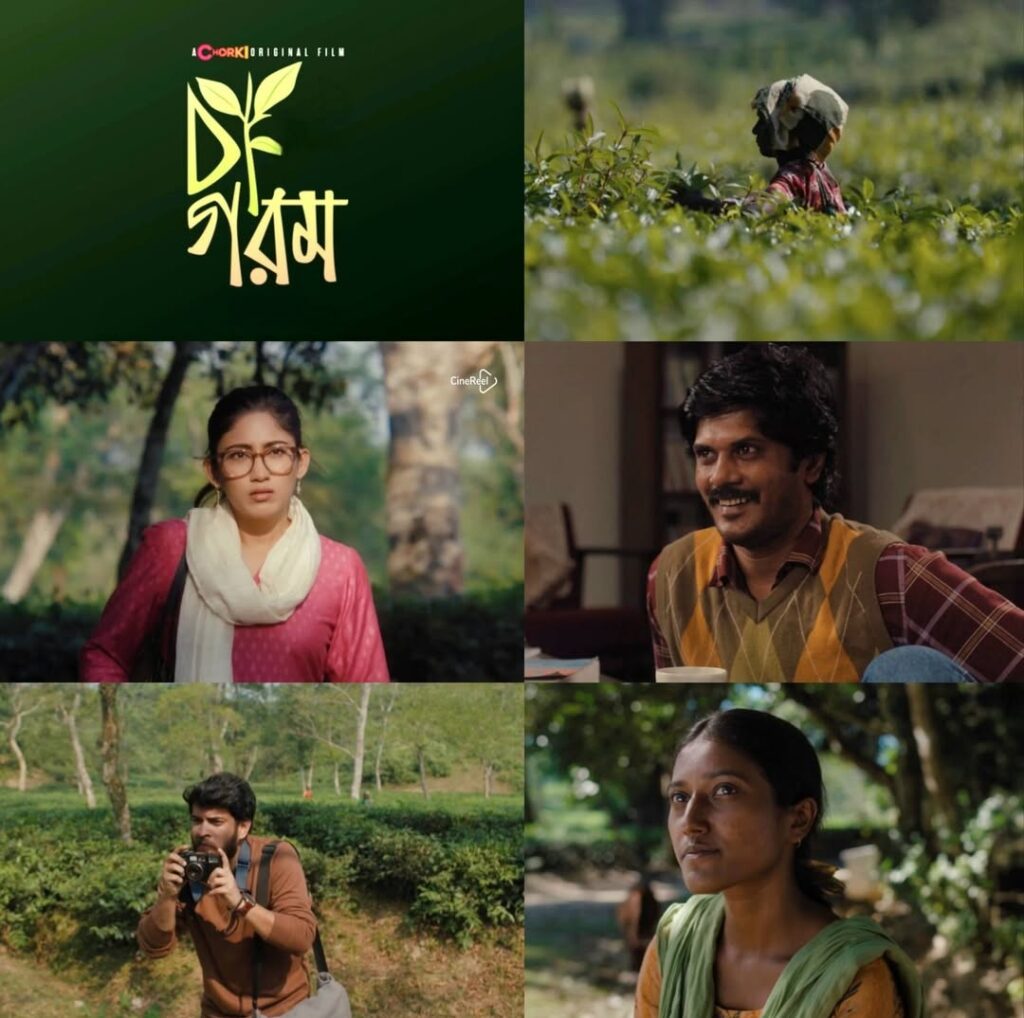
At the center of the story are two women standing on opposite sides of social privilege. Irene, played by Safa Kabir, is a doctor from Dhaka. She is educated, mobile, and shaped by a life that has allowed her ambition to become reality. Nandini, played by Sarah Jabin Aditi, comes from a tea garden worker family and dreams of becoming a doctor too. Their lives intersect when Irene is posted to a tea garden in Sylhet.
That setup is simple, but the implications are not. Irene and Nandini are linked by profession, aspiration, and womanhood, yet divided by class, access, and history. One woman has already stepped into the future the other is still struggling to imagine. That contrast gives the film its emotional core. Cha Gorom is not merely asking whether they will connect. It is asking what it means for hope to look so natural in one life and so radical in another.
The smartest thing the film seems to do is resist turning this relationship into something overly polished or symbolic. It is not just a neat contrast between privilege and struggle. It is a living encounter between two different versions of possibility.
The Tea Garden as More Than a Backdrop
One of the film’s strongest achievements is how clearly it frames the tea garden as a social structure, not just a setting. Cha Gorom tells the story of Bangladesh’s marginalized tea labourers, people who still work under forms of oppression and pay structures rooted in colonial-era systems. That reality gives the film its real urgency.
This is where the film becomes more than a character drama. It is also a quiet indictment. The exploitation of tea workers is not presented as an isolated tragedy or a random hardship. It is systemic. It is normalized. It is the kind of injustice that continues because the country has learned to absorb it into everyday life.
That is why the film’s restraint matters. A louder film might have overstated the pain. Cha Gorom appears to do something more effective. It lets the reality speak through atmosphere, daily struggle, and the contrast between social classes. The result is a film that does not scream at the audience but still leaves a mark.
At the center of the story are two women standing on opposite sides of social privilege. Irene, played by Safa Kabir, is a doctor from Dhaka. Nandini, played by Sarah Jabin Aditi, comes from a tea garden worker family and dreams of becoming a doctor too.
Safa Kabir Carries the Film’s Warmth
If Cha Gorom has a visible center of gravity, it is Safa Kabir. The film reportedly leans heavily on her charm, and that dependence makes sense. She has the kind of screen presence that can make a slow, layered film feel inviting rather than distant. As Irene, she brings ease and warmth to a character who could easily have been written too simply, either as a savior figure or as a clueless outsider.
What makes the performance interesting is that Irene seems to exist somewhere between those extremes. She is compassionate, but she is still a product of privilege. She may care deeply, but she has not grown up inside the same machinery of deprivation that defines Nandini’s life. That complexity is crucial, because without it the film would slide into easy moral comfort.
Sarah Jabin Aditi, meanwhile, appears to bring quiet force to Nandini. Her character’s dream of becoming a doctor is not just admirable. It is disruptive. In a place where structural inequality decides so much in advance, ambition becomes a form of resistance. Nandini’s dream is not a subplot. It is the moral challenge at the heart of the film.
A Gentle Chemistry That Knows Its Limits
One of the more appealing things about Cha Gorom is that it does not force itself into a conventional romantic mold. There is no traditional romance driving the story, and that absence gives the film room to breathe.
At the same time, the chemistry between Safa Kabir and Partho Sheikh is described as endearing, which suggests the film still allows tenderness to exist without reorganizing itself around love-story expectations.
That balance matters. Too many socially conscious films either strip away emotional softness in the name of seriousness or bury their ideas under romantic distraction. Cha Gorom seems to find a middle path. It allows human connection, but it knows what story it is actually telling.
The main cast also includes Rezwan Pervez, A K Azad Shetu, and Ratan Dev, helping build out the film’s social world beyond its two central women. From the names shown in the cast list, the ensemble seems carefully chosen to make the tea garden community feel inhabited rather than decorative.
Craft That Supports the Story
Barkat Hossain Polash’s cinematography deserves special mention because it reportedly captures not only the beauty of Sylhet’s tea gardens but also the reality of life within them. That distinction is important. Beautiful cinematography can sometimes soften harsh realities into something too pleasant to confront.
Here, the camera appears to do both jobs at once: it recognizes the visual richness of the place while staying attentive to the structures of labor and inequality embedded in it.
The music and editing also seem to play a major role in keeping the narrative engaging. Since Cha Gorom is not propelled by action or suspense, rhythm becomes essential. A film like this can feel hypnotic when well-paced and lifeless when not. By most accounts, Cha Gorom finds the right balance.
The Film’s Most Important Limitation
For all its strengths, Cha Gorom appears to stop just short of its sharpest possible critique. Its biggest weakness is that it does not fully identify the root causes or the real agents behind the workers’ exploitation. The suffering is visible, but the architecture of that suffering remains less defined than it should be.
That creates an uncomfortable irony. The privileged class, which benefits from the system, can end up looking like the only possible source of rescue. It gives the film a dynamic that resembles the “white savior” pattern, only translated into local class terms. That does not erase the film’s sincerity, but it does blunt some of its political bite.
Why Cha Gorom Still Stays With You
Even with that limitation, Cha Gorom remains compelling because it knows how to be quiet without being empty. It offers no fireworks, yet it leaves heat behind. It gives you a socially aware story carried by women, shaped by class realities, and grounded in a setting that feels fully lived in.
That may be why the film has found so much love. It trusts the audience to care about people before plot tricks. It trusts silence, atmosphere, and detail. And in doing so, it proves that a film does not need a conventional romance or loud drama to matter. Sometimes all it needs is a sharp eye, a layered script, and the courage to let injustice simmer in plain sight.