



In the vast landscape of Bengali literature, the name Jasimuddin evokes images of rivers flowing through green fields, village courtyards filled with stories, and songs drifting across paddy fields at dusk. He was not merely a poet who wrote about rural life. He was a poet who lived it, understood it, and preserved it with remarkable sincerity. For this reason, generations of readers have lovingly remembered him as the Polli Kobi, the Poet of Rural Life.
Jasimuddin was more than a poet. He was a lyricist, a composer, a folklorist, a researcher, and a storyteller. His works captured the emotional and cultural rhythms of Bengal’s villages at a time when rapid social changes threatened to erase many traditional forms of expression. Through poetry, ballads, songs, plays, memoirs, and folklore collections, he built a literary bridge between the oral traditions of the countryside and the formal world of modern literature.
By MWB Desk
Among his many works, two narrative poems stand out as landmarks in Bengali literature. Nakshi Kanthar Math and Sojan Badiar Ghat have long been considered masterpieces. Both poems are deeply rooted in the lives of ordinary rural people, yet their emotional themes of love, loss, and longing speak to universal human experience.
During the twentieth century, Jasimuddin emerged as one of the most influential figures in the revival of rural literature in Bengal. While many writers of his time focused on urban themes or Western literary forms, he turned his attention to the villages. In doing so, he ensured that the voices of farmers, boatmen, craftsmen, and village women found a place in the literary history of Bengal.

Poet Jasimuddin in Polash Bari, Kamalapur, 1974
© copyrighted by Photographer Nasir Ali Mamun/Photoseum
Roots in the Riverlands
Jasimuddin was born on 1 January 1903 in the small village of Tambulkhana in the Faridpur district of eastern Bengal. At that time, the region was part of the Bengal Presidency under British colonial rule. His birth took place in his maternal grandparents’ home, located about eight miles from his ancestral village of Gobindapur.
Over time, the name Tambulkhana changed to Ambikapur. The landscape surrounding the village was shaped by the powerful Padma River, whose shifting currents and seasonal floods played a central role in the life of the local people. This riverine world would later appear repeatedly in the imagery of Jasimuddin’s poetry.
He was born into a modest family. His father, Ansaruddin Molla, worked as a schoolteacher. His mother, Amina Khatun, was the only daughter of her parents and managed the household in accordance with the traditions of a Bengali Muslim family. Through her, Jasimuddin absorbed many of the customs and values that later appeared in his writing.
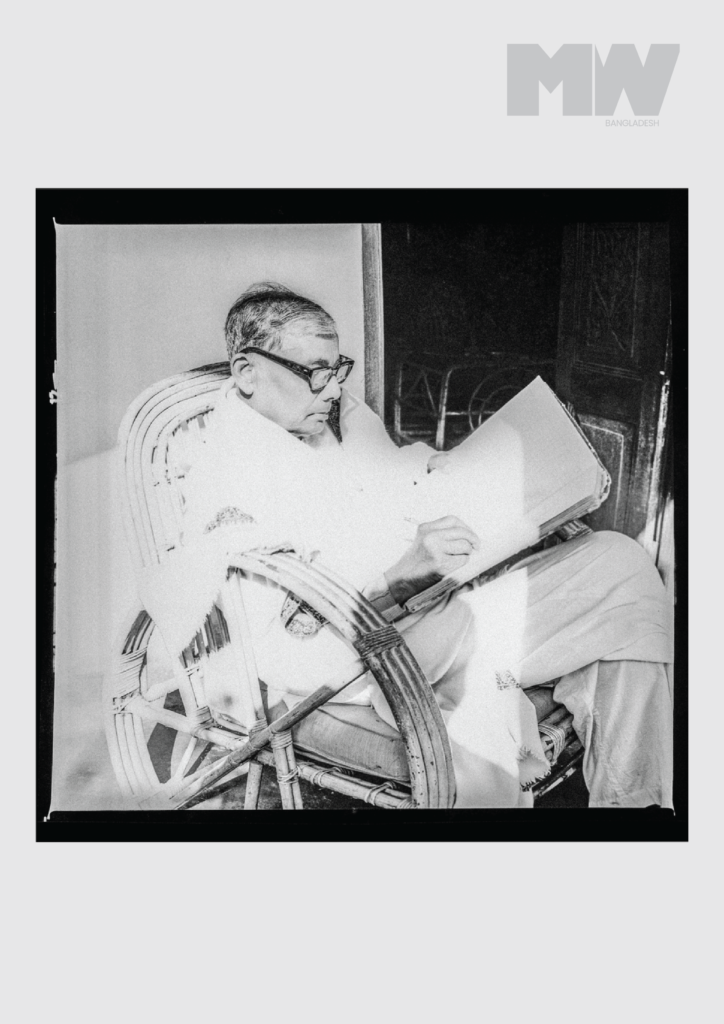
Jasimuddin at work, Polash Bari, Kamalapur, 1974
© copyrighted by Photographer Nasir Ali Mamun/Photoseum
The extended family structure that surrounded him reflected the typical rural social system of Bengal. His grandfather, Shomiruddin Molla, was a small landholding farmer. Ansaruddin Molla was his only son, and Jasimuddin grew up among five siblings, making six children in the household.
In such an environment, family relationships were deeply interconnected. Relatives lived close to one another, and mutual assistance was considered essential for survival. This close network of kinship introduced the young Jasimuddin to the communal nature of village life.
The atmosphere of his childhood village was rich with local dialects, folk songs, and religious customs. These early experiences quietly planted the seeds of a lifelong fascination with rural culture.
Father was a very simple and humble man. As we gradually grew older, the practice of his poetry became closely connected with the everyday joys and sorrows of our lives. As children, we were often amazed when we read his poems. We wondered how he could express such profound thoughts in such simple language. When we read his poetry, it feels as though the nature of rural Bengal, the laughter and tears of its people, and their joys and sorrows come alive before our eyes.
To us, father was not only a poet; he was also our teacher and guide. He always taught us to live honestly. He never forced anything upon us. Instead, with patience and affection, he helped us understand what was right and what was wrong.
– Hasna Jasimuddin Moudud
A Childhood Shaped by Stories
In the villages of Bengal during the early twentieth century, stories did not exist primarily in books. They lived in people’s voices. Elderly storytellers shared folktales under banyan trees. Farmers sang work songs while harvesting crops. Boatmen sang long, melancholic melodies as their boats drifted along the rivers.
Jasimuddin grew up listening to these sounds and stories. The oral traditions of rural Bengal became his first literary education.
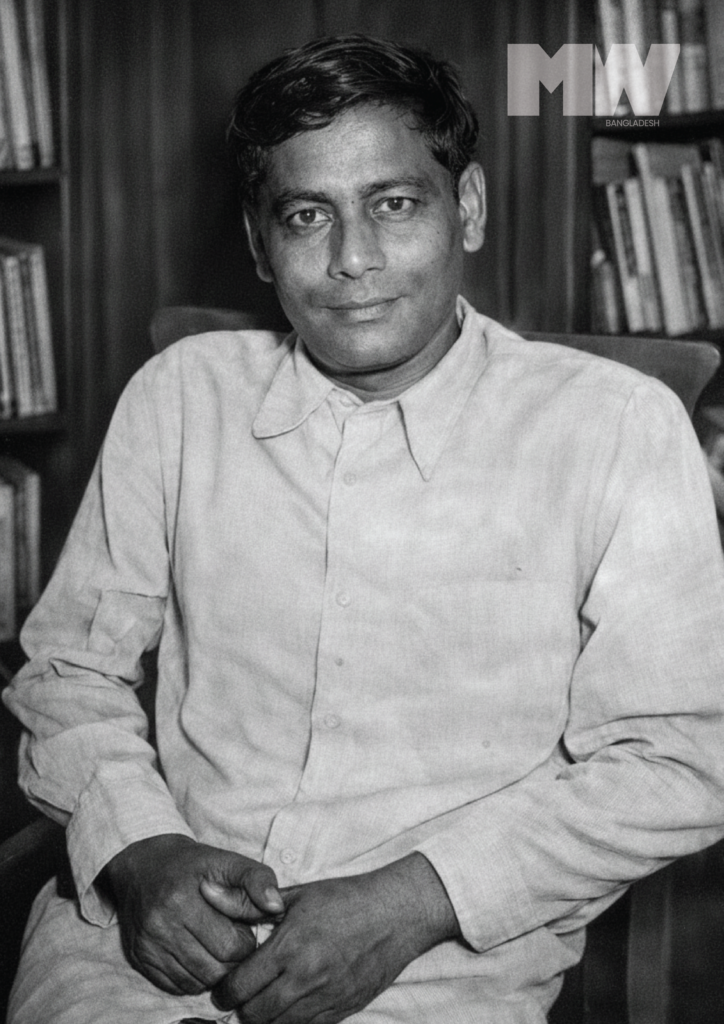
Poet Jasimuddin, Siddiq Bazar, c1950
Village markets were places where news, gossip, and stories circulated freely. During festivals connected to the harvest or to river journeys, entire communities gathered to celebrate. Through these gatherings, young Jasimuddin observed the cultural rhythms that shaped rural society.
At the same time, the village world was not free from hardship. The British colonial system had introduced land policies that placed heavy burdens on farmers. Under the zamindari system, landlords collected taxes from peasants who often struggled to meet the demands. Many families lived with constant economic pressure.
Although Jasimuddin did not directly transform these experiences into political commentary, they shaped his understanding of the realities faced by rural communities. Floods of the Padma River could destroy crops overnight. Droughts could leave farmers without income. Yet despite these hardships, village life was sustained by resilience, cooperation, and faith.
These realities later formed the emotional foundation of his poetry.
From Village School to University Halls
Jasimuddin’s formal education began at Faridpur Welfare School. Like many children of rural Bengal, he initially attended a traditional village school, or pathshala. Later, it was decided that enrolling in the school where his father taught would be more convenient. His father worked at the Faridpur Hitaishi M.E. School.
During that period, many schools carried the designation M.E., which stood for Middle English. These institutions generally offered education up to the sixth grade.
After completing his early schooling, Jasimuddin was admitted to the well-known Faridpur District School. He passed the matriculation examination from this institution in 1921.
His academic journey continued at Rajendra College, where he completed his Intermediate studies in 1924. By this time, he had already begun developing a strong interest in literature.
Eventually he traveled to Calcutta to pursue higher education at the University of Calcutta. There he studied Bengali literature in depth and earned his Bachelor of Arts degree in 1929. Two years later, in 1931, he completed his Master of Arts degree in the same subject.
University education exposed him to classical texts and scholarly analysis of language. However, even as he studied formal literature, his heart remained closely tied to the cultural world of rural Bengal.

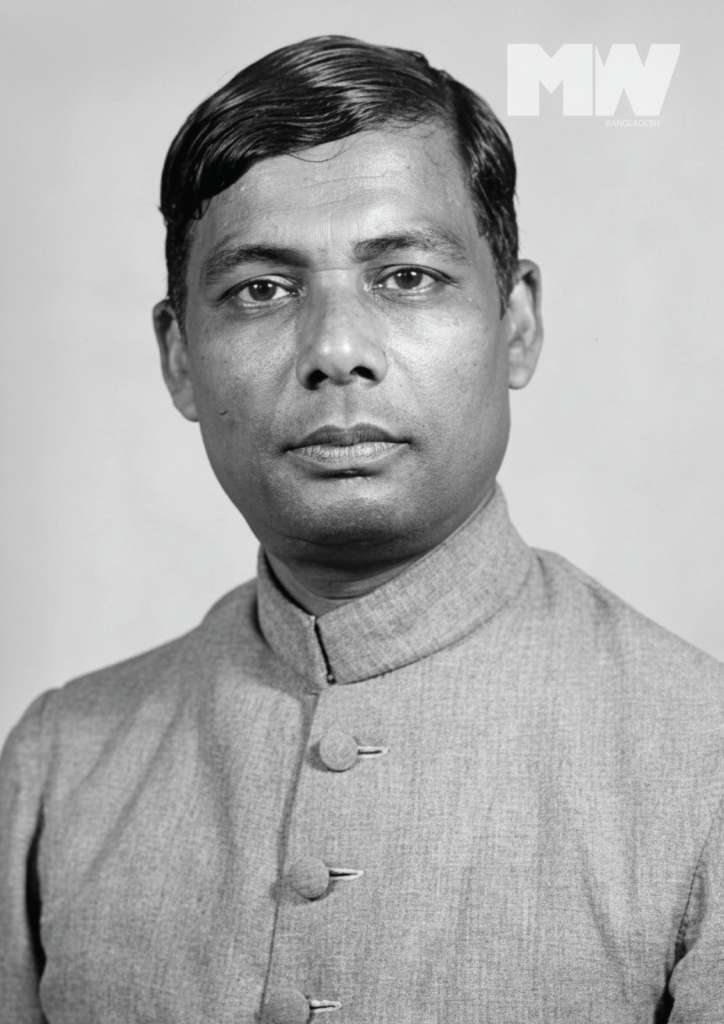
Poet Jasimuddin at a somber moment, December 17, 1974
© copyrighted by Photographer Nasir Ali Mamun/Photoseum
A Researcher of the People’s Songs
Shortly after completing his master’s degree, Jasimuddin joined Dhaka University as a Ramtanu Lahiri Research Assistant under the supervision of the distinguished folklorist Dinesh Chandra Sen. From 1931 to 1937, he worked extensively in this role.
His primary task was to collect oral literature from rural communities across Bengal. This work required traveling from village to village, meeting farmers, singers, fishermen, and wandering storytellers.
Through this fieldwork, he collected more than ten thousand folk songs.
The process was demanding. He listened carefully as villagers sang songs that had been passed down through generations. He wrote down the lyrics exactly as they were performed, preserving dialects and rhythms without altering them.
This research not only enriched academic understanding of Bengali folklore but also shaped Jasimuddin’s own literary voice. By immersing himself in oral traditions, he gained a deep understanding of the narrative patterns and poetic rhythms of village storytelling.
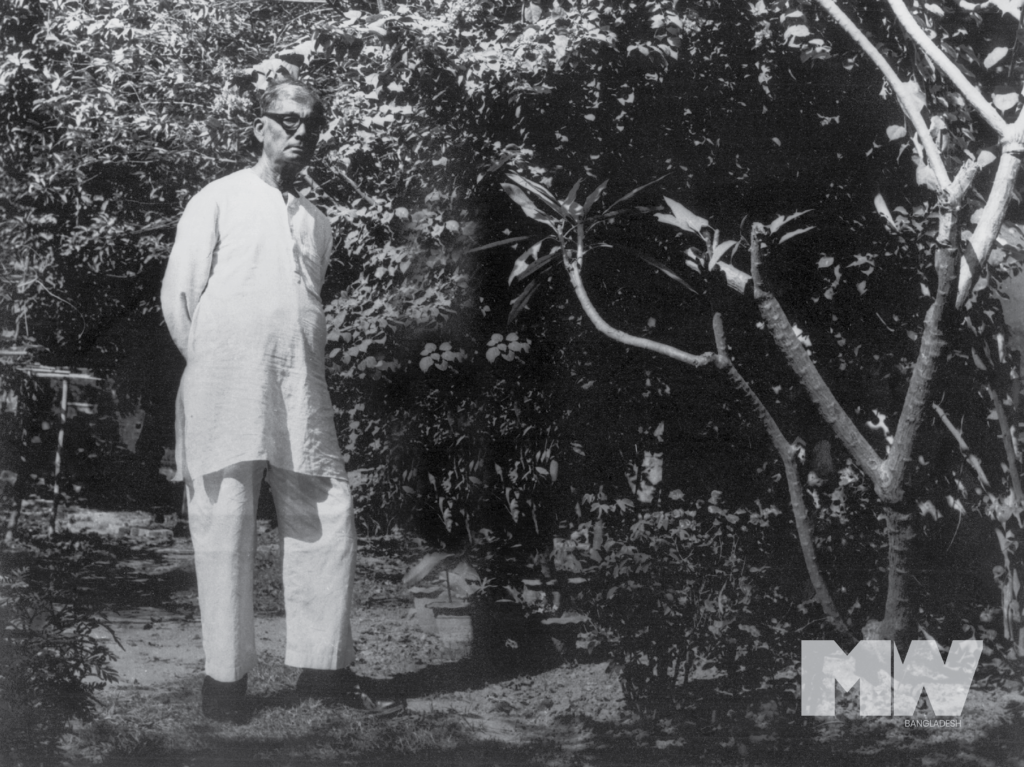
Poet Jasimuddin in his garden at Polash Bari, Kamalapur, Dhaka, 1974
© copyrighted by Photographer Nasir Ali Mamun/Photoseum
Many times, we saw our father sitting with a notebook in his hand, writing something despite his illness. Writing was a part of his life.
During times of epidemic diseases, many people were dying. Even then he continued to write about the suffering and hardships of people. He believed that literature could help ease human sorrow and awaken compassion in people’s hearts.
– Hasna Jasimuddin Moudud
A Young Poet Among Cultural Legends
While studying in Calcutta, Jasimuddin gradually gained recognition as a poet. His narrative poem Nakshi Kanthar Math had already drawn attention from literary circles.
During this time, he came into contact with many prominent cultural figures. Among them was the renowned artist Abanindranath Tagore, a member of the distinguished Tagore family.
Abanindranath admired the young poet’s work so much that Jasimuddin was invited to stay with the Tagore family for extended periods. Living in this creative environment allowed him to interact with artists, writers, and thinkers.
Abanindranath Tagore was like a guru to him. From him, he learned how to take something simple and make it profound.
– Khurshid Anwar Jasimuddin
Through these connections, he eventually met Rabindranath Tagore himself. Jasimuddin visited Santiniketan several times and spent time there as a guest.
Despite these encounters with some of the greatest literary minds of Bengal, he remained deeply committed to the stories of ordinary villagers.
Father loved animals very much. We had cows behind our house, and he used to take care of them himself. He even placed a radio in the cowshed so that the cows could listen to music.
– Khurshid Anwar Jasimuddin
Home and Family
In 1939, Jasimuddin married Momtaz Begum, affectionately known as Monimala. By that time, he had already published several poetry collections and achieved considerable literary recognition.
Together they built a family with five children. Their home in Dhaka became a gathering place for scholars, writers, and admirers. The house also functioned as a personal archive. Within its rooms, he preserved countless notes, songs, and stories gathered during his journeys across rural Bengal.
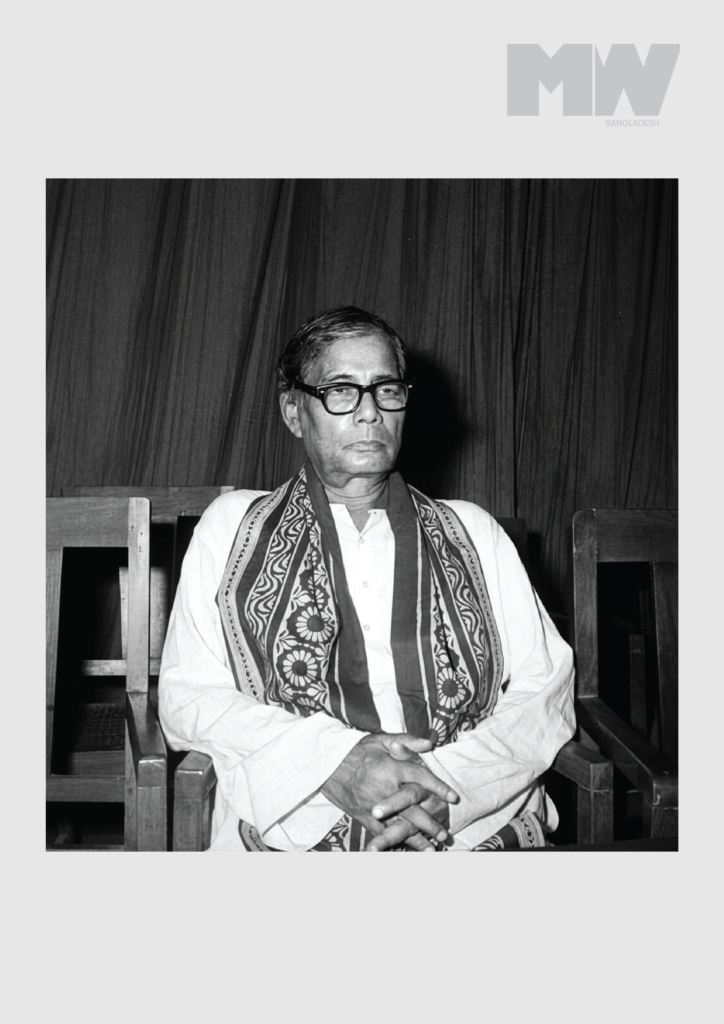
Poet Jasimuddin in a contemplative moment
The Making of a Rural Poet
Jasimuddin’s early poems were relatively short lyrical compositions. Over time, however, he began experimenting with longer narrative structures.
His travels through villages provided him with countless stories of love, hardship, migration, and resilience. These stories inspired him to develop extended poetic narratives capable of capturing the complexity of rural life.
In his poetry, he often used local dialects and folk rhythms. Many lines followed the fourteen-syllable pattern common in traditional Bengali verse. This technique allowed his poems to echo the natural cadence of spoken language.
Through this approach, his poetry retained the authenticity of oral storytelling while achieving the structure of written literature.
I first came to know poet Jasimuddin during the war years. In those circumstances, the lives of artists and poets were not easy. Yet he never hesitated to stand beside ordinary people.
I had the opportunity to observe Jasimuddin closely. He was an extremely simple and sincere person. There was no arrogance in him. The lives of the common people of rural Bengal were the main subject of his poetry.
In his poems, we see rivers, fields, trees, people’s laughter and tears, and the way of life in rural Bengal. He did not merely write poetry; it feels as if he wrote a living history of rural Bengal.
– S. M. Sultan
Jasimuddin at Home, among Animals, Letters, and Memory
Publicly, Jasimuddin became the enduring voice of rural Bengal. At home, however, he appears in his son Khurshid Anwar Jasimuddin’s recollections as a man of unusual gentleness, discipline, and quiet originality. Some of the most vivid memories are not of literary fame, but of evening rituals, animals, music, and a household shaped by freedom rather than authority.
Khurshid recalls that when his father returned home in the evening, usually around seven or eight, he would first call out to his wife, “Moni,” and then to his son.
That domestic rhythm remained one of his son’s earliest memories of him. Behind the family home, there was a large cowshed, and Jasimuddin would often go there himself. He was, his son says, a great lover of animals and personally cared for the cows.
In one striking detail, Khurshid remembers that there was even a radio in the cowshed, and sometimes singers were invited, so that music would fill that space as well. It is an intimate and unexpected image: the poet of the village not only writing of rural life, but recreating some of its tenderness and harmony within his own household.
That same private world reveals something equally important about his character as a father. Khurshid says Jasimuddin never tried to impose himself on his children, even though he was already a celebrated literary figure.
There was no insistence that they enter literature, no pressure to imitate his life. Khurshid himself was drawn to science, made model aircraft as a young man, and wanted to become an aerospace engineer. His father encouraged those interests rather than steering him toward poetry. In that sense, Jasimuddin’s generosity was not only emotional but intellectual. He allowed his children the freedom to become themselves.
According to Khurshid, he was systematic in preserving his papers and documenting his work, unlike many writers who lose track of manuscripts, letters, and drafts. This habit may have come from his early formation as a researcher and collector of folklore.
Khurshid notes that many of Jasimuddin’s letters remain unpublished and that efforts are underway to bring them into book form. If published, those letters could widen our understanding of him, not only as a poet of rural Bengal, but as a literary intellect who consciously preserved his own archive.
He is often remembered within the framework of Bengali rural literature, yet Khurshid’s account shows that his connections reached much farther. He speaks of his father’s friendship with the American folklorist Alan Lomax, who recorded Jasimuddin’s songs for the Library of Congress.
There is also a revealing account of how seriously Jasimuddin regarded his own place in literature. Khurshid says his father knew he was an important poet of the country, and he describes an early reluctance to meet Rabindranath Tagore until Tagore himself called for him.
Whether taken as pride, self-respect, or literary self-awareness, the anecdote suggests a man who understood his worth. At the same time, Khurshid emphasizes the importance of mentors such as Dinesh Chandra Sen and Abanindranath Tagore.
He describes Abanindranath as someone who taught Jasimuddin how to “look into simple things and make them big,” an idea that resonates strongly with the poet’s own art. In this recollection, Nakshi Kanthar Math appears not only as a landmark poem but as a part of a larger artistic environment shaped by close contact with the Tagore household, Jorasanko, and the visual imagination of Abanindranath.
Another powerful thread in the interview concerns preservation and loss. Khurshid speaks with pain about the destruction of the family’s Kamalapur house, once filled with trees, birds, and open space, much of which has now given way to urban construction. He says he has worked to preserve his father’s legacy by giving materials to the National Museum and supporting the museum established in Faridpur, while also arguing that the old house and the museum should be linked as part of a larger heritage effort.
He also notes that the Kamalapur house, too, deserves preservation. His memories turn this issue into more than a matter of property. It becomes a question of how a literary nation chooses to remember one of its foundational voices.
Khurshid’s reflections add one more important dimension to Jasimuddin’s legacy. He argues that his father’s poetry cannot be reduced to village scenery alone. Too often, he suggests, readers think Jasimuddin merely wrote about rustic life. But beneath the rivers, fields, and folk songs, his work also grapples with emotion, love, social discrimination, and the structure of feeling within Bengali society. That reading invites a more expansive understanding of him: not just a poet of landscape, but a poet of human relations, cultural memory, and the moral imagination of Bengal.
Seen through his son’s recollections, Jasimuddin becomes at once more intimate and more complex. He is the father who called out to his loving wife and children in the evening, the animal lover who put music in the cowshed, the disciplined archivist of his own life, the poet who moved between rural Bengal and international literary circles, and the cultural figure whose legacy is still being fought for in houses, museums, letters, and memory.
Conscience, Memory, and the Unfinished Work of Recognition
For the photographer and writer Nasir Ali Mamun, Jasimuddin is not only a poet of the past but a figure whose moral clarity and imaginative power remain urgently relevant today. His reflections bring into focus both a defining moment in Jasimuddin’s life and a larger question about how Bangladesh remembers its cultural figures.
Mamun recalls the exact circumstances surrounding Jasimuddin’s refusal of the Bangla Academy Award, a decision often surrounded by speculation. According to him, the moment was immediate, personal, and deeply principled. On the day the award announcements were being made, Jasimuddin was present at the Bangla Academy grounds as a chief guest at a separate literary gathering.
When news reached him that the award had been announced, those around him urged him to accept it. His close friend, poet Abdul Quadir, advised him not to refuse in anger, reminding him that the award would become associated with his name.
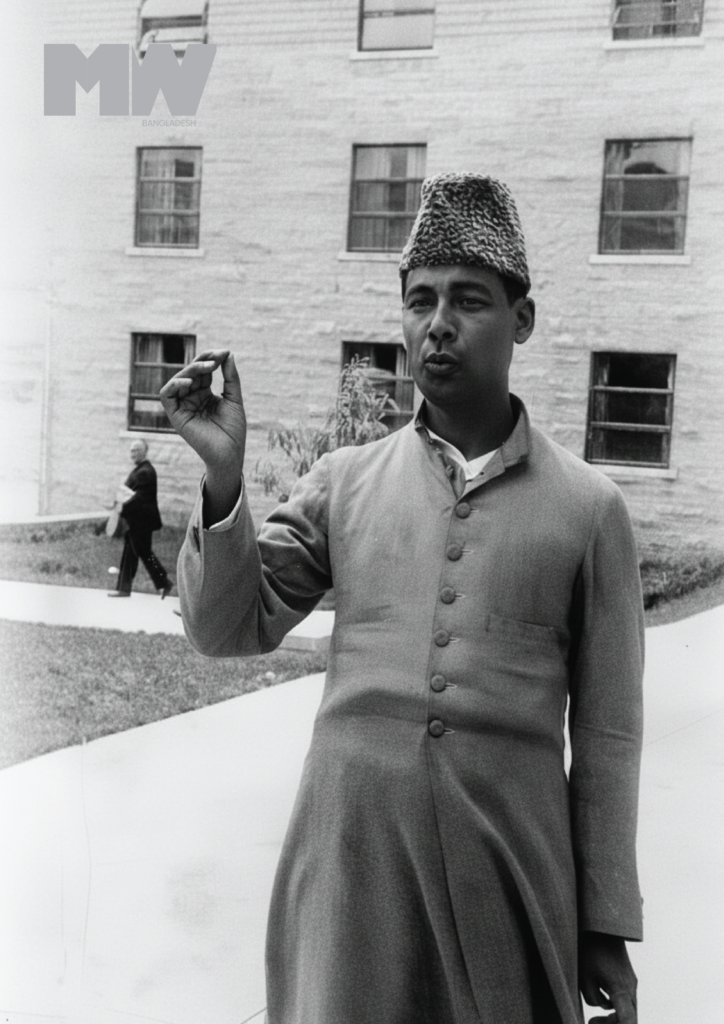
Jasimuddin in London, England, 1951, Photographer- Alan Lomax
Yet Jasimuddin did not hesitate. The refusal came from a deeply internal place, where recognition had to align with personal truth.
Mamun suggests that this moment reveals something essential about Jasimuddin’s character. He was not indifferent to recognition, but he refused to accept it if it did not meet his own sense of integrity. In that sense, the refusal becomes not an act of defiance, but an extension of the same moral sensibility that shaped his poetry.
Beyond this moment, Mamun turns to a broader concern: the uneven attention given to Jasimuddin within literary institutions. While figures like Rabindranath Tagore and Kazi Nazrul Islam have long benefited from established research centers and sustained scholarly focus, Jasimuddin’s legacy has not received the same level of institutional care. Mamun is careful to note that research on Jasimuddin does exist. Early academic work, such as the doctoral research of Dr Sunil Kumar Mukhopadhyay in 1970, laid an important foundation. Later scholars, including Dr Fazlul Huq, have also contributed significantly.
Yet, in Mamun’s view, the overall body of work remains limited compared to Jasimuddin’s importance. Much of the early scholarship has faded from active circulation, and many of the scholars who contributed to it are no longer alive. What remains is a fragmented legacy that calls for renewed attention.
For Mamun, however, the issue is not simply academic. It is imaginative. He argues that Jasimuddin’s relevance lies precisely in what has been lost. The rural Bengal that Jasimuddin wrote about no longer exists in the same form. The landscapes have changed, the social structures have shifted, and the rhythms of village life have been transformed by modernity.
But this disappearance does not diminish his importance. It intensifies it.
Mamun offers a compelling way of understanding this. Human beings, he suggests, are driven by imagination. Every act of creation begins as an act of imagining something that does not yet exist. Just as the idea of flight began in the human imagination before becoming an aeroplane, the vision of rural life preserved in Jasimuddin’s poetry can continue to shape cultural and emotional understanding.
If that world has faded, it must be imagined again.
In this sense, Jasimuddin is not simply documenting a past reality. He is offering a space of cultural memory, one that can be revisited, reinterpreted, and reimagined. His poetry becomes a form of continuity, allowing readers to reconnect with values, relationships, and ways of seeing that might otherwise disappear.
Mamun’s own work reflects this commitment. In compiling writings on Jasimuddin from across generations and across both Bengals, he has attempted to preserve not just the poet but the conversation around him. His editorial work brings together memoirs, critical essays, and reflections, carefully organized so that future readers and researchers can engage with Jasimuddin in a fuller way.
Ultimately, Mamun’s insight reframes the question of legacy. The issue is not only whether Jasimuddin has been sufficiently studied or celebrated. It is whether his work continues to live in the cultural imagination.
Because, as Mamun suggests, the village may change, landscapes may disappear, and institutions may overlook him. But the imaginative world Jasimuddin created cannot be confined or erased.
And it is precisely in that imagination that his enduring relevance lies.
The village may change, landscapes may disappear, and institutions may overlook him. But the imaginative world Jasimuddin created cannot be confined or erased.
– Nasir Ali Mamun
Preserving Folk Memory
Beyond poetry, Jasimuddin dedicated himself to the preservation of Bengali folklore. His field research resulted in the collection of thousands of songs and stories from rural communities.
Among the traditions he documented were Jari songs and Murshidi songs. These forms of music were deeply connected to devotional practices and mourning rituals within Muslim communities of Bengal.
He also played an important role in compiling the famous Purbo Bongo Gitika, a collection of ballads from eastern Bengal initiated by Dinesh Chandra Sen in the 1920s. Through this project he helped record legendary stories such as those of Behula and Chand Saudagar.
His prose works reflected the same commitment to preserving folk traditions. In the two-volume book Banglar Hasir Golpo, he compiled humorous stories collected from villages. Another compilation titled Folk Tales of East Pakistan included allegorical stories such as “The Poor Crow” and “The Three Fish.”
These works remain valuable records of rural Bengali culture.
Poetry of Fields and Rivers
Jasimuddin’s first poetry collection, Rakhali, was published in 1927. The poems in this book were inspired by the lives of shepherds and rural workers.
Later collections continued exploring village life from different perspectives. In Baluchar, published in 1930, he described communities living along river sandbanks and their seasonal migrations.
The collection Dhan Khet, published in 1932, focused on agricultural labor and the cycle of planting and harvesting.
In 1946, he published Rupoboti, a work that reflected the suffering and resilience of villagers during periods of social upheaval. Later, Matir Kanna, published in 1951, presented an even deeper portrayal of the lives of Muslim farming communities.

Jasimuddin in front of Moscow State University, 1968
The Quilt That Carries Memory
Among his many works, Nakshi Kanthar Math remains one of the most beloved.
Published in 1929, the poem tells the tragic story of a young couple named Rupai and Saju. Their love is interrupted by circumstances that ultimately lead to sorrow and separation.
After Saju dies, the embroidered quilt she had stitched becomes a symbol of her memories and emotions. The quilt, created from layers of old saris, represents the everyday artistry of rural women.
Through this simple object, Jasimuddin transforms domestic craft into a powerful metaphor for love, grief, and remembrance.
In Nakshi Kanthar Math and Sojan Badiyar Ghat, he used many metaphorical songs and narrative layers. You can always discover something new in his work.
– Khurshid Anwar Jasimuddin
Love Beside the River Crossing
Another celebrated narrative poem is Sojan Badiar Ghat, published in 1933. This poem tells the story of Sojan, the son of a Muslim boatman, and Duli, a girl from a nomadic community.
Their love faces numerous obstacles rooted in social divisions and economic realities. The story unfolds at a river crossing where travelers gather, and boats ferry passengers between villages.
Written in traditional poetic meter, the poem portrays both the beauty and the hardship of river-based life.
The Realism of Rural Life
One of the defining features of Jasimuddin’s poetry is its realism. Rather than idealizing village life, he depicted it as he observed it.
Farmers laboring in fields, families coping with floods, and communities supporting one another during difficult times appear vividly in his work.
His poems also reflect the daily religious practices of rural Muslim society. The call to prayer, the observance of Ramadan, and communal celebrations of Eid form an integral part of village life in his writings.
Through these details, his poetry presents a vivid portrait of rural society during the early twentieth century.
Recognition and Cultural Influence
During the 1930s and 1940s, Jasimuddin gained widespread recognition. Critics praised his ability to transform folk traditions into literary works of lasting value.
His writings appeared in influential magazines such as Sawgat and Probashi, helping to introduce his poetry to a wider readership.
In the 1950s, his influence expanded further through radio broadcasts. Dramatic adaptations of his poems were aired on Radio Dhaka, allowing audiences across East Pakistan to hear stories of rural Bengal.
He also supported the Bengali Language Movement of 1952 and opposed attempts to restrict Bengali language broadcasting.
Honors and Recognition
Jasimuddin’s contributions to literature were widely acknowledged.
In 1958, he received the President’s Pride of Performance award from the Government of Pakistan. This award recognized his role in portraying rural life and preserving folk traditions.
In 1969, Rabindra Bharati University in India awarded him an honorary Doctor of Literature degree.
Bangladesh later honored him with the Ekushey Padak in 1976. Two years later, he received the country’s highest civilian honor, the Independence Award
Despite these recognitions, Jasimuddin remained modest about his achievements. He often stated that the title he valued most was the one given to him by the people themselves.
“They have called me the Poet of Rural Life,” he once said. “That is the title I consider the greatest honor.
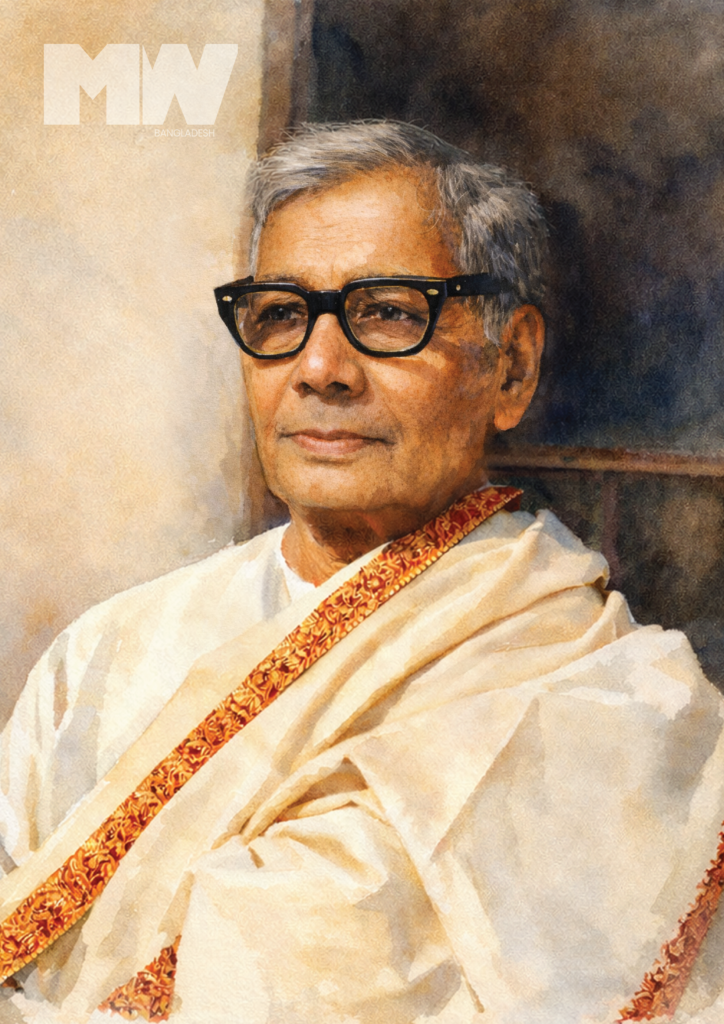
A Quiet Act of Principle
In 1974, he declined the Bangla Academy Literary Award for poetry. He believed that the recognition had come too late to reflect the true importance of his contributions.
His refusal revealed a quiet sense of integrity. For him, literary value lay not in awards but in the authenticity of the work itself.
The Final Journey
After Bangladesh gained independence in 1971, Jasimuddin continued writing and supporting cultural life in the newly formed nation.
On 14 March 1976, he passed away in Dhaka at the age of seventy-two after suffering a heart attack. He had not been ill for long.
His body was flown by helicopter to his native village of Ambikapur. There he was buried in the family graveyard.
In death, as in life, he returned to the soil of the village that had inspired his poetry.
The Enduring Voice of the Village
Today, decades after his passing, Jasimuddin’s works remain widely read and performed. His songs are still heard at cultural events and weddings across Bengal. His poems continue to appear in school textbooks, introducing new generations to the cultural heritage of rural Bangladesh.
More than anything else, his legacy lies in the way he preserved the voices of ordinary people. Through his poetry, the stories of farmers, boatmen, craftsmen, and village women became part of the literary history of Bengal.
Jasimuddin once proudly acknowledged that many titles had been given to him by universities and institutions. Yet the one he cherished most came from the people themselves.
They called him the Poet of Rural Life.
And through his words, the life of the village continues to speak.