



Hasna Jasimuddin Moudud
From my childhood, wherever I went, I received immense affection simply for being the daughter of poet Jasimuddin. With care and love, he filled our lives completely. The most beautiful days of our lives were those spent in his close presence. After his death, that joyful and tender life never returned.
As we gradually entered the world shaped by his poems, songs, essays, plays, and fairy tales for children, it often seemed to us that our own small daily concerns were more important than his poetry. Today, however, when I read his work or hear children reciting his poems at cultural gatherings, I am repeatedly struck by how great a poet and human being our loving father truly was.
He often made us write letters for him. I would try to avoid doing so, making various excuses. Now, when I think back on those moments, I feel a deep sense of regret.
My father frequently required medical treatment and spent time in hospitals. Among his many health problems were high blood pressure, stomach pain, and arthritis, which made writing difficult for him. Yet he always followed his doctors’ advice. Today, I feel sorrow that I could not care for him as much as he deserved during his illness.
Whenever we had even a minor injury, he would immediately take us to the hospital. While staying there, he would move from one patient to another, checking on them. In his youth, during times of epidemic disease, he had cared for many patients whose own relatives had abandoned them. He was extremely careful to protect us from illness. Even the famous sweets of Faridpur were boiled before being given to us. Once, after I secretly ate some sweets, he made me drink a mild solution of potassium permanganate.
He composed songs to promote public health awareness. Late at night he would wake up to study, often reading English literature. At times he would write poems or songs and compose their melodies. There was something of a detached, contemplative quality about him, almost like that of a wandering ascetic.
He did not eat beef, heavily spiced food, or onions. His clothing was simple. Most of his attire consisted of white pajamas and panjabis made of coarse cloth. Yet during winter, on special occasions, he would wear a neatly fitted suit and tie. I was the one who would help him put on the tie.
He moved me from an English-medium school to a Bengali-medium one, against my wishes, so that I could grow up among girls of my own country. While he was deeply knowledgeable in Bengali literature, he was equally well-versed in English literature. Even during my school years, he introduced me to world literature and encouraged me to engage with translated works. Later, I wrote my thesis on his life and literature and earned a Master’s degree in English from an American university. I do not know if any other daughter has written a Master’s thesis on her father. His works were studied abroad as well.
The date of his birth was given by himself, as no written record existed. He would sometimes confuse the ages of his children too. Once, at school, he mistakenly recorded my middle brother as older than my eldest brother. Yet we never felt embarrassed by his absent-mindedness.
“He deeply despised lying
and theft. I have never seen
a person as honest as him.
In times of hardship, he
would rush to help others,
regardless of their status”
He would become truly angry only under three circumstances: if there was noise during his afternoon rest, if someone mistreated a poor person, or if there was unnecessary waste. Our mother tried to manage our needs in his absent-minded household. Her own childhood had been comfortable and happy. When we were five siblings, she would stir the pot with one hand while holding a book in the other. In this way, she completed her matriculation with a second division.
Our father ensured that all of us had the opportunity for higher education. I accompanied him to many literary conferences and informal gatherings. When he spoke in Bengali before foreign guests, he would often have me translate his words into English. He came into contact with many scholars and notable individuals, and we, too, had the chance to meet them.
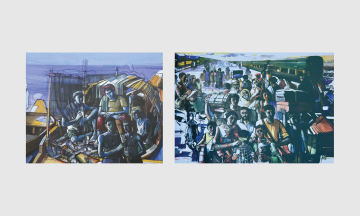
He surrounded us with examples of rural art and culture, encouraging our interest in Bengali literature and artistic traditions. The first sari I ever wore was designed by artist Qayyum Chowdhury, decorated with bird motifs, which my father bought for me. The sari I wore at my wedding was also chosen by him, a red silk jamdani. He personally selected beautiful woven jamdani saris for my mother and me.
The sitting room of our house was adorned with paintings by renowned artists of the subcontinent. Among them were works by Zainul Abedin, who designed the covers of my father’s books. There were also paintings by Nandalal Bose, Rabindranath Tagore, and Chughtai, alongside traditional scroll paintings, clay dolls, toys, and wooden horses from Dhaka. At home, we mostly ate traditional snacks and pithas.
Books were everywhere in our house. He used to say that he kept books in every room so that his children would develop the habit of reading. Even today, in my own home, books are scattered across every room, including the bedroom. Just as I was once an avid reader, my ten-year-old daughter has become one as well. This, I believe, is a continuation of the habits he instilled in us.
He had immense compassion for nature and animals. He personally cared for the cows and enjoyed drinking fresh milk. We too had to drink warm milk regularly. Our vacations were spent in the village. At that time, Dhaka was neither as crowded nor as polluted as it is today. There were villages and deep forests nearby. Yet to escape the noise and congestion of Siddique Bazar, he bought a garden house in Kamalapur. There were rice fields in front of the house and fruit trees behind it.
He deeply despised lying and theft. I have never seen a person as honest as him. In times of hardship, he would rush to help others, regardless of their status.
He loved Sheikh Mujibur Rahman deeply, and Sheikh Mujib held him in great respect. The tragic death of the Mujib family caused him immense grief. He would weep through the night, and soon after, his health deteriorated.
He was a man of deep self-awareness. As poet Al Mahmud once said, his sense of dignity set him apart completely. In the final stage of his life, he received the Ekushey Padak along with several others, his only state recognition. Even so, he accepted it in honor of the martyrs of the Language Movement.
This deeply self-aware man did not merely recommend jobs for the unemployed. He personally visited offices to advocate for them. At the time, I felt embarrassed. He would say, if I can help a young unemployed person get a job, I will do everything I can.
I have heard that during communal riots he risked his own life to save many Hindu families. During the Liberation War, although he initially agreed to hide in another house, he later returned to his own home, saying that if he were killed by the Pakistani army, it might help the cause of the war by drawing international attention.
During that dangerous time, he wrote poems about the Liberation War under the pseudonym Tojammar Ali and ensured they were circulated both within the country and abroad. In the United States, I translated those poems, helping inform the world about the genocide.
Feature Image: Hasna Moudud with poet Jasimuddin at Polash Bari, 1974