


Mainul Abedin on family, country, and the art that disappeared
By Ayman Anika
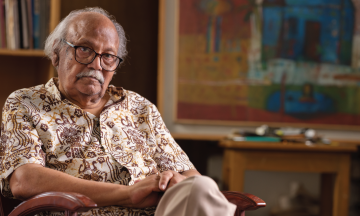
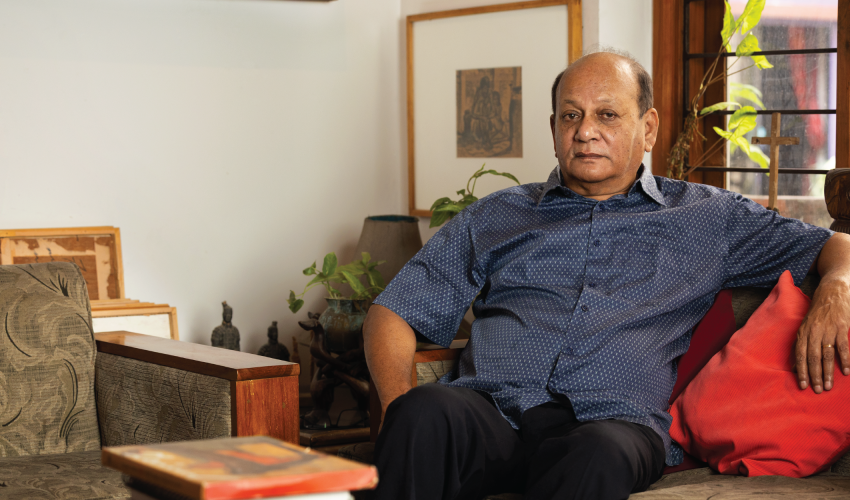
When the MWB team stepped into the narrow street in Shantinagar, Mainul Abedin welcomed us at the door with the quiet familiarity of someone used to being surrounded by stories. A civil engineer by profession, he has spent his working life designing and building power plants across Bangladesh. But over time, another job emerged: the invisible labor of preservation. With little fanfare, he began recovering artworks, artefacts, letters, and memories related to his father, Shilpacharya Zainul Abedin, whose lines shaped how a new nation saw itself.
Between the tales of his love for owls and the artworks of Shilpacharya Zainul Abedin, he detailed to us the fondest memories of his childhood, his lifelong dedication to preserving the arts of the Shilpacharya, and what brings him peace these days.
You spoke beautifully about travelling with your father as a child, following him through towns, watching him stop for fish markets, clay pots, and tea stalls. Looking back, how did those everyday journeys with him shape your understanding of art, or of how to see the world?
Those trips were never rushed. What would be a four-hour journey often took nine, because he’d stop constantly. He’d see fishermen by the river, and he’d get out, just to watch. He’d light a cigarette, ask what they were catching. We’d cross a ferry, and suddenly he’d want to explore a local market. He’d buy clay pots, talk to shopkeepers, sit at a tea stall and listen.
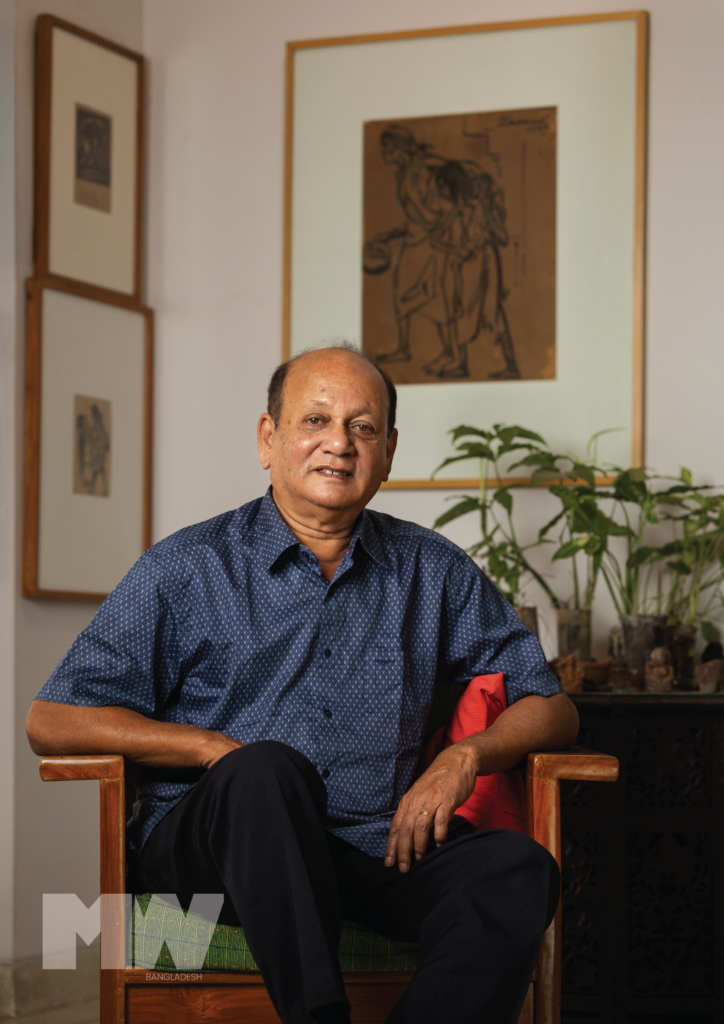
Being with him, I learned how to slow down and look. He didn’t separate art from life. Everything was part of the same fabric. He never preached, but by simply being beside him, I absorbed that rhythm of observation. That still shapes how I move through the world today. Even though I’m not a painter like him, I think I inherited that gaze, the instinct to pay attention to what most people walk past.
Being with my father, I learned how to slow down and look. He didn’t separate art from life. Everything was part of the same fabric.
You mentioned that your father had to sell artworks, even in Pakistan, to help pay off loans while building the house. Could you tell us more about that period?
Yes, he had taken a loan while building the second floor of our house. At that time, he went to Karachi, worked on paintings there, and sold not just one, but several of his works. That money helped pay off the loan. It’s something people often forget: he wasn’t just a revered artist, but also a resourceful one, when life demanded it.
Many of his best paintings, actually, ended up in Pakistan, in both public museums, institutions, and private collections. One of them, for instance, was gifted by him to a Pakistani publishing house, I think around 1968. That work traveled a long path, from an auction in the UK, to a Bengali buyer, and finally, I bought it back. I still have it. These works carry stories not just of art, but of movement, displacement, and survival.
You shared that you once intended to join the art college, but didn’t, and even tried for the Air Force. Can you walk us through that time in your life, and your father’s role in those choices?
After I finished matriculation, I wanted to get into an art college. That was my plan. But my father didn’t allow it. He had his reasons: there were tensions at the college back then, incidents he didn’t like. He used to say, “You’ll become an artist anyway if it’s in you, you don’t have to go to an institution for that.”
Later, I got into engineering and eventually into the Air Force, actually. I really wanted to be a pilot. But again, he was strongly against it. He was angry, even. He said it wasn’t necessary. So, I ended up completing engineering. A subject I didn’t love, honestly, but I finished it.
Looking back, I can see that he was trying to protect me in his own way. He wanted stability for me. But he also believed that if something creative was truly within you, it would come out without formal permission.
How would you describe your personal relationship with him, growing up in that atmosphere?
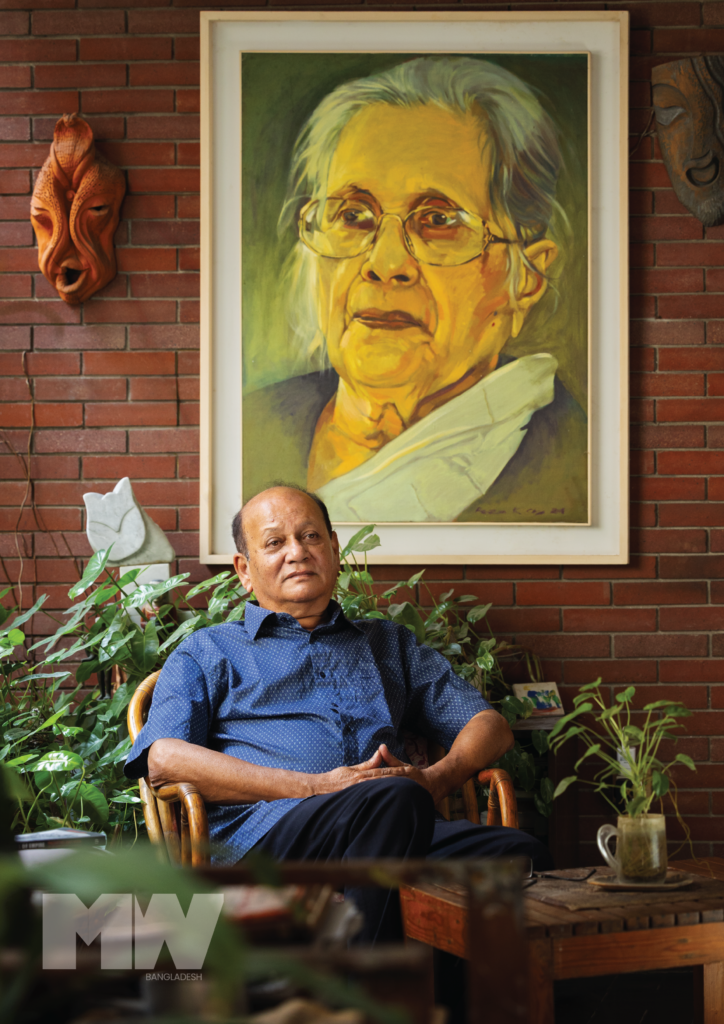
He was always working. He showed affection, yes, but there was a kind of respectful distance too, the way many fathers were back then. He wasn’t someone who explained much. Even when he was painting, he wouldn’t tell us what he was doing. After he finished, he would ask, “So, how does it look?” That was his way of including us. He also remained busy building art institutions.
I wasn’t scared of him, but my brothers were (laughs). He carried a presence, a kind of quiet authority. And I think I instinctively stayed away from his work, gave him space. He needed that. It was only later in life that I began to understand the discipline and inner world that fueled his art.
You’ve seen your father at work. What was his creative process like?
With oil painting, he was extremely methodical. He would often prepare three or four canvases at once. Then he would start layering, one coat, let it dry, wait ten days, come back, and work again. The process could take months, three, four, or even five. It wasn’t rushed. He had a rhythm, and he respected the time the work needed. As for watercolor paintings, he didn’t need much time. He could finish it within a few hours.
Watching that process gave me a quiet appreciation for how much patience goes into serious art. It’s not just about vision, it’s about endurance.
You’ve spoken about the difficulties of preserving your father’s work, both practically and institutionally. What has your experience been like working with Bangladeshi museums and state institutions, and what do you think needs to change?
The truth is, the state of our institutions is deeply disappointing. I’ve tried many times to collaborate with museums here, to donate or preserve my father’s work, or even discuss publishing. There’s no system, no professionalism, and frankly, no accountability.
That’s why I’ve said before. If things don’t improve, I’ll consider giving important works to museums abroad. Not because I want to, but because I have to. What’s the point of storing priceless works in places where they are decaying or disappearing? My father gave so much to this country, and I’m asking for the bare minimum in return: competent care, respect, and transparency.
In your involvement with the documentary Monpura 70, you supported a deeply personal project, one that revisited your father’s scroll painting of the Bhola cyclone. Beyond the immediate tragedy, what broader meaning did you want to convey through this work?
Monpura 70 was very personal for me, not just because of the painting, but because of what it represents. I wasn’t the director, but I provided material, insights, and historical grounding. The director was Pradip Ghosh, but in spirit, it felt like mine.
What I wanted to bring out was that in 1970, the people of the Bhola region were completely neglected. The Pakistani government didn’t just fail to help. They erased the suffering from the media, from public attention. And that silence, that erasure, was one of the many wounds that led to the Liberation War of 1971.
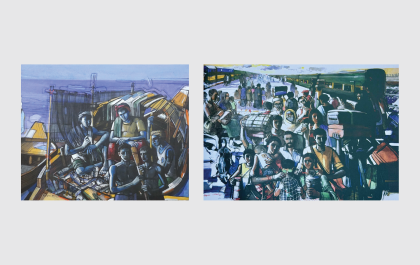
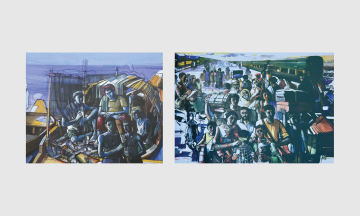
If you look at the scroll painting, really look, you’ll see something striking. All the bodies are swollen. That’s not artistic exaggeration, it’s observation. People who drown swell. My father didn’t paint symbols; he painted reality. In contrast, his famine sketches, whether from 1943 or 1974, show the opposite: bodies reduced to skin and bone. Thin, hollow. But in both, there’s one common element, hope.
At the end of the Monpura scroll, a man is sitting with his head down. Everything, cows, goats, people, is lost. But that one figure remains. That’s not defeat. That’s resilience. My father always left room for hope, even in the darkest places.
And yet, we as a country are often unwilling to confront our history fully. For example, after independence, there was a famine in 1974. My father documented that, too.
But it’s almost taboo to talk about it. I once posted a few of those drawings on Facebook, along with a historical note from Wikipedia. The backlash was immediate. I had to delete it.
That’s the problem: we want to celebrate selective parts of history, not the whole truth. My father didn’t work like that. He painted what was, not what people wanted to see. And that kind of honesty is still uncomfortable for many.
In both famine and cyclone, the bodies are different, but the message is the same: even in suffering, there is hope
Your father was invited by the Arab League in 1970 to visit the Middle East and document the Palestinian refugee crisis through his art. Can you tell us more about that experience, and what eventually happened to the 72 sketches he created there?
Yes, in 1970, just before the Liberation War, my father was invited by the Arab League to travel to the Middle East. He visited Beirut, Cairo, Syria, and Jordan, and most importantly, he went to Palestinian refugee camps in the West Bank, at a time when the crisis was intensifying. He spent about a month in Cairo, sketching what he saw, what he felt — not just faces, but history, struggle, survival.
He made 72 large drawings, all centered on the Palestinian people. The plan was to hold an exhibition in Cairo through the High Commission of Pakistan and sell the works to raise funds for Palestinian refugees. But after the war of 1971, when Bangladesh became independent, our connection to that part of the world was cut off. We tried to follow up, we wrote to the Pakistani embassy, to officials in Cairo, but we never heard back. The drawings vanished.
No one knows what happened to them. Maybe someone kept them. Maybe they were discarded. What’s painful is that these were not just artworks. They were testimonies. And now they’re lost. I still have a few sketchbooks and some of the Palestinian-themed pieces; one is with Bangladesh Bank, another is in a museum, and some are with me. But the core of that body of work is gone. And that’s a loss not just for us, but for history.
Have you ever thought about writing a memoir or a personal account of your relationship with the Shilpacharya, not just as a legendary artist, but as your father?
To be honest, I don’t think I can write something like that, not the way it should be written. I’ve thought about it many times. I even wrote a short piece once, maybe 7 or 8 pages, and it was published a long time ago. That’s the only proper thing I’ve written about my father.
There’s also a small book, I can’t remember the title now, but it was a collection of writings and letters from people who knew my father, from Bangladesh, India, elsewhere. One of my pieces is included in that. It was edited by the late artist Matlub Ali. He passed away not long ago. That book was a beautiful initiative, full of real, personal reflections, not just praise.
But beyond that… I’ve never written a full memoir. Sometimes I think, maybe I should’ve. Not to glorify him, but to share the quiet things: the way he smoked his cigarette while watching fishermen on the roadside, or how he’d walk into a village market and lose track of time. That version of him, the human version, is what I lived with. But I don’t know if I could ever do justice to it in words.
How do you spend your time these days, now that you’ve stepped back from engineering work?
I’m a civil engineer by profession. I ran my own firm and worked for decades, from buildings in Narayanganj in the early days to power plants later. In total, I’ve worked on around 32 power plants, ranging from 7 megawatts to 310 megawatts, civil, mechanical, everything but electrical. I’ve poured a large part of my life into infrastructure.
But now, I’ve mostly stepped away from that. The younger engineers I trained have gone on to start their own companies. That’s the way of things, they grow, they branch out. And I’ve moved into something quieter.
These days, I spend time doing social work, especially for artists and educational institutions. I’ve helped develop libraries in three schools, worked with art institutions in Dhaka, Chittagong, Trishal, Kushtia, and Rajshahi. I still try to give back, not through big gestures, but through consistency.
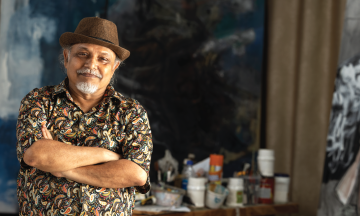
I don’t read books much anymore. I watch YouTube, listen to Rabindra Sangeet, and sometimes sketch. I became a bit of a pandemic artist, just for myself. I don’t share my drawings. I draw because it brings me peace.
I’m fully retired now. I still keep an office open, more for habit than for work. Mostly, I try to stay involved, to support, to stay useful in small ways.
I don’t draw to show anyone. I draw because it brings me peace
And finally, for young people today, especially those who may not know Shilpacharya Zainul Abedin well, what would you want them to understand about your father? How should they discover him?
It’s hard to give a message directly. I hope that young people come to know not just my father, but all the figures who helped shape this country, in art, in music, in thought. People like Abdul Hamid Khan Bhashani, Jasimuddin, Abbasuddin Ahmed, Sufia Kamal, Begum Rokeya. These were not just historical names. They were people with ideas, with service, with sacrifice.
I believe role models should be introduced through concise biographies in textbooks. Not just freedom fighters, but people in agriculture, science, arts, and education, people who helped build this country in different ways. That’s how you inspire young minds, not by only telling them to become engineers or doctors, but by showing them the many paths to purpose.
So, if I have a message, it’s not about my father alone. It’s about remembering all those who contributed quietly. And about teaching children not just how to succeed, but how to live meaningfully.
You inspire young minds not by telling them to be engineers or doctors, but by showing them the many paths to purpose
Photographed by Salek Bin Taher