


By MWB Desk
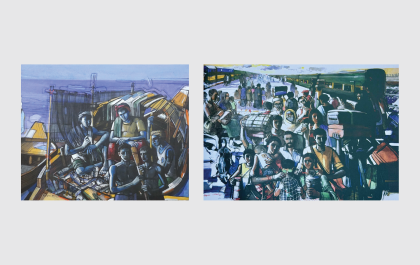
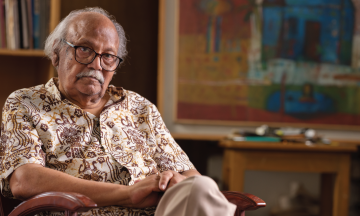
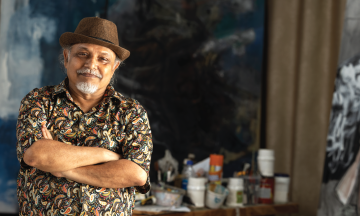
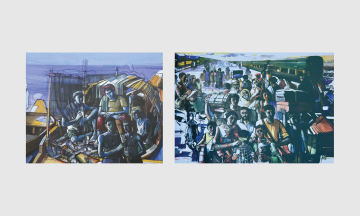
Sheikh Afzal Hossain’s work stays rooted in memory, in soil and in ordinary time. Raised in Jhenaidah, a southwestern district of Bangladesh, he grew up in landscapes of green fields, riverbanks, village women in conversation, and children in motion. These were not subjects waiting to be aestheticized; they were already complete. His realism emerged not from a desire to document, but from a need to hold on.
Hossain’s formal training began at Dhaka’s College of Art and Crafts, where he studied under figures like Mohammad Kibria and Rafiqun Nabi. In the early 1980s, he moved to Japan on scholarship, earning a master’s degree from the University of Tsukuba. The years that followed brought awards, exhibitions, and international recognition, but his palette remained anchored to the everyday. His paintings repeatedly return to rural life, not out of nostalgia, but because it offers something that modern life erodes: quiet presence.
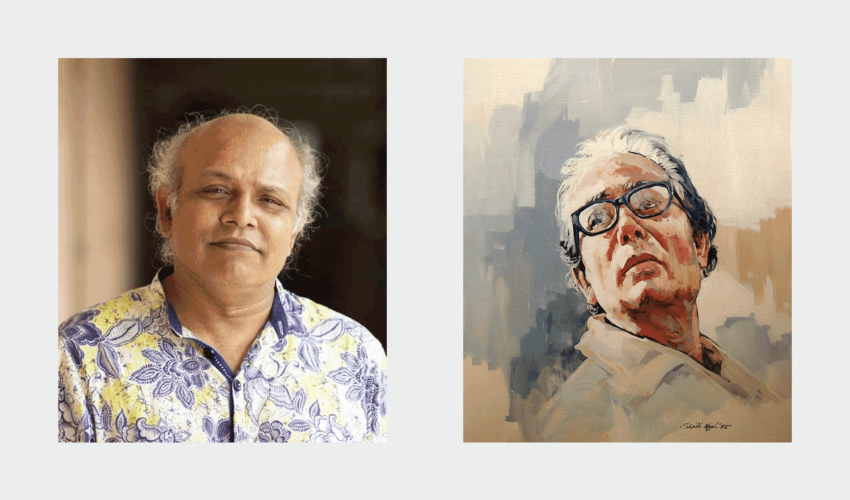
The artwork featured on this cover is a portrait of Shilpacharya Zainul Abedin, painted in 1985 for the Charushilpi Sangsad. Created not for a gallery but for an annual artists’ gathering, the portrait was completed in a matter of hours using mixed media on Markin cloth. It measures 6 x 5 feet and was based on a small photograph.
The portrait resists traditional realism. Built through choppy brushstrokes and layered tonal variation, it creates movement within stillness. It doesn’t freeze the subject but evokes his presence, less a likeness than an impression that lingers. Shilpakala Academy later took it and eventually transferred to the National Museum. Its current location is unknown.
Much like the painting, Hossain’s own practice has largely remained outside the frame of spectacle. His career has included teaching, exhibiting, and decades of quiet contribution to Bangladesh’s art scene. He has received national and international awards, including those from Shilpakala Academy, NHK Japan, and the Nikikai group in Tokyo.
But what defines his work isn’t the recognition; it’s the refusal to abandon the world he came from. In a time when much art chases speed and novelty, Sheikh Afzal Hossain paints what persists. This portrait, unseen for years, returns not as history, but as continuity, an image grounded in a deeper kind of realism.
We hope that in turning this page, readers will find not just a portrait, but an encounter with a painter, a teacher, and a memory made visible again.