


By Ayman Anika
I entered the darkened auditorium for Utshob, heart fluttering the way it does before a heartfelt confession. By the time the lights dimmed, I was ready not for another Eid spectacle, but for an uncommonly tender miracle. Here’s the story of how Tanim Noor’s film seeped into my soul.
It began with a scene that felt like slipping into last Eid’s memory—a reunion with something warm and familiar. As the whispers around me crescendoed—“khaishta Jahangir!”—I realized this wasn’t a typical Eid romp. This was something curated, hand‑stitched from nostalgia, emotion, and gentle humour.
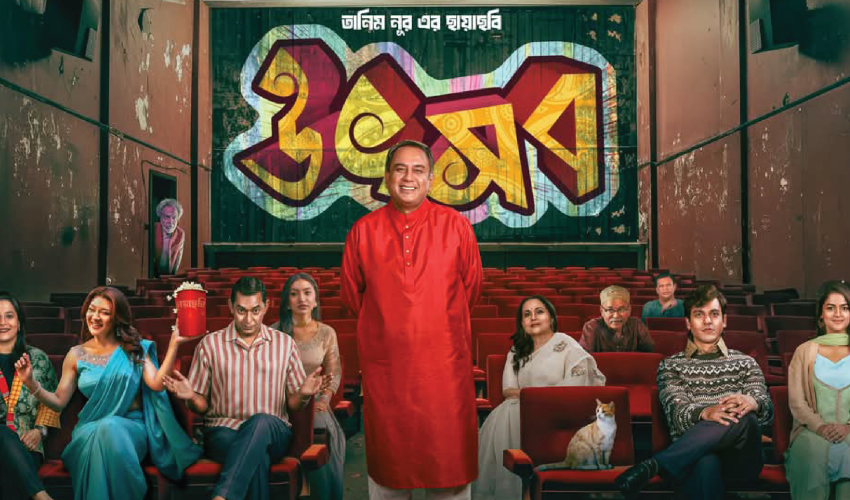
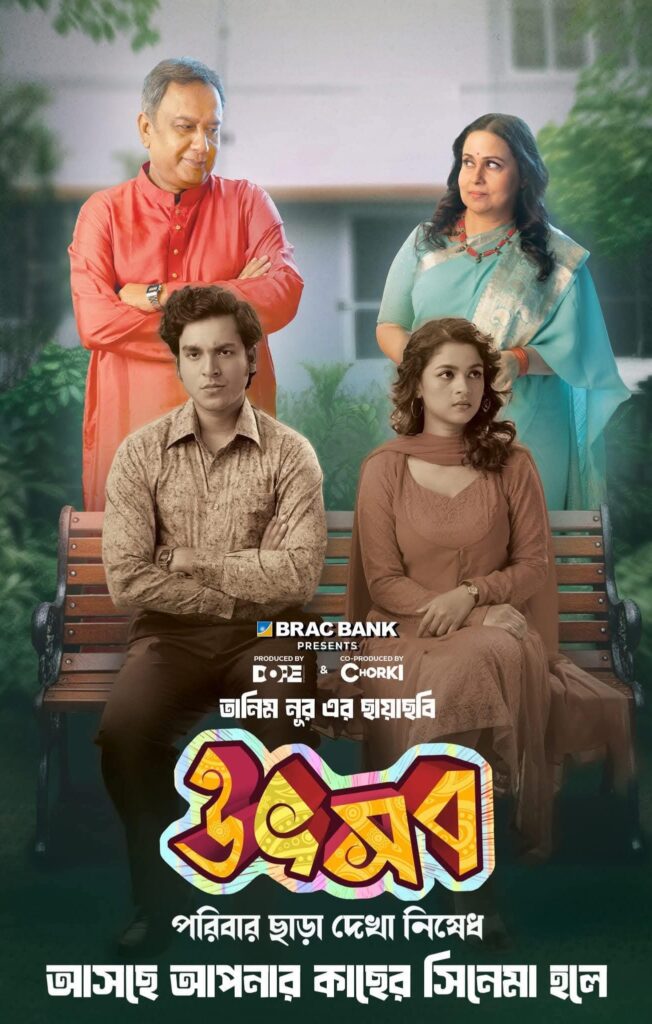
When the grumpy, miserly Jahangir—brilliantly embodied by Zahid Hasan—first appeared, I braced for a barrage of slapstick or spectacle. Instead, I found restraint. His bitterness wasn’t shouted; it was simmered in silence, in a twitch at an untied shoelace, in a glance that accidentally burned someone’s joy. This restraint was the film’s heartbeat.
Noir draws from Dickens’ A Christmas Carol, but he does so with a Bangladeshi twist—set not on Christmas Eve, but on the night before Eid.
There’s a magic in that recalibration. The Eid spirits—Chanchal Chowdhury, Jaya Ahsan, Aupee Karim as Past, Present, and Future—don’t spook; they coax. Their interventions aren’t terrifying: they’re intimate, like old friends tugging on your sleeve.
One memory — shared by me and many others in that audience—became breath-stopped hush. It was the moment when young Jahangir faced the fragmentations of his past, and I faintly heard someone next to me exhale in recognition. That hush is intimacy, cinematic communion
What delighted me even more was the film’s humour: organic, unforced.
Like when Past‑ghost Chanchal asks Jahangir, “Ki, bhoy pachchhis?” — a line soaked in everyday wit and nostalgia for 90s Dhaka.
And about that nostalgia—Utshob is that rare Eid gift that doesn’t rely on guns or glamour. Instead, it lovingly resurrects a time when going to theatres was a ritual, when Artcell on a cassette could touch your teenage heart, when wandering relatives dropped in door to door, and Eid biryani meant shared histories.
The drone footage contrasting brick lanes of Geneva Camp with upscale Dhaka made me ache for those invisible divisions, yet feel hopeful for bridging them.
Musically, it hit home. Artcell’s “Dhushor Shomoy” wasn’t just a song—it was a portal. I’m sure, like me, any 2000s teen cradled by that melody felt recognition swell like a long-lost hug.
The film’s other track, “Tumi” by Level Five, framed the arc between young lovers in a way that didn’t feel contrived—just shards of common warmth.
Watching Jahangir transform—reconnecting with his cousin Mobarak’s memory, finding his daughter Esha, rediscovering the tenderness in Jesmin’s smile—it struck me: this isn’t just a redemption arc. It’s a reminder. That plot, devoid of villainous side‑plots, excessive songs, or the stereotypical “item number,” amplifies the quiet revolutions of the ordinary: “In the film of life, there is no main character,” the narration whispers.
At the final crescendo, with a gasp and collective laughter—hands wiped, shoulders brushed—I felt that cinema‑hall alchemy: strangers turning intimate, healing together.
Yes, the last act leans toward sermonizing, but by then, I didn’t mind. Because I had fallen in love again—with the idea that cinema could cradle humanity, could nudge us back to kindness, could let us feel again.
I walked out blinking into streetlights. I remembered Christmas Carols, yes—but I also remembered Eid’s warmth, the rice fire‑burnt at the threshold, the echo of children’s laughter in dusty lanes. Tanim Noor’s Utshob gave me two hours of that feeling. And that, for me, is the greatest gift Eid could ask for.