


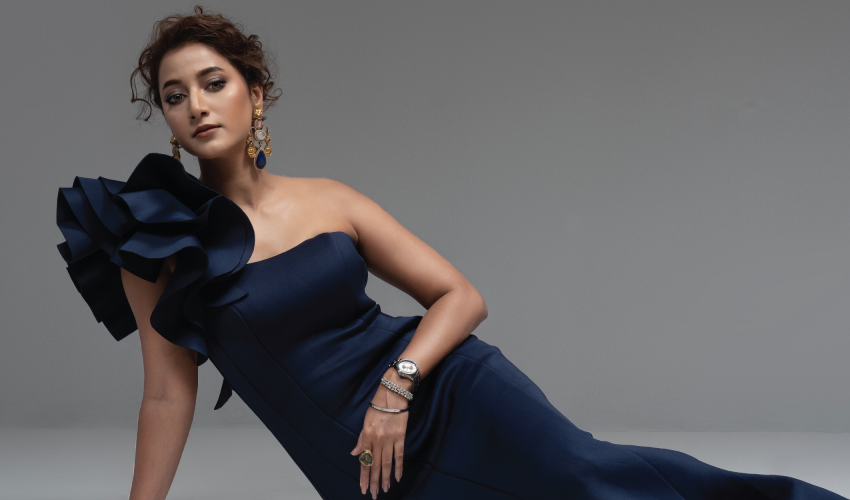
In conversation with Neel Hurerzahan on the quiet art of becoming
By Ayman Anika
When Neel Hurerzahan speaks, you don’t just hear words—you sense a quiet conviction. She’s not the kind of performer who was “born for the spotlight,” nor did she grow up dreaming of lights, cameras, or a life in media.
In fact, for a girl from Feni, the idea of becoming an anchor, actor, or poet wasn’t even on the radar. But somehow, by following small instincts, leaning into curiosity, and saying yes to unfamiliar paths, Neel found herself stepping into roles—on stage, on screen, and on the page—that now seem unmistakably hers.
She doesn’t chase headlines or put on a persona. What she does instead is observe, absorb, and show up—again and again—with sincerity, whether she’s hosting a show, crafting a poem, or taking a solo flight to see her favorite comedian’s final stand-up tour. Her work isn’t built on a grand plan; it’s built on small decisions made with intention.
In a conversation with MWB that moves seamlessly from childhood memories and creative rituals to her love-hate relationship with coffee and a deep admiration for Ellen DeGeneres, Neel reflects on how storytelling became second nature—first in neighborhood games, later in studios and sets.
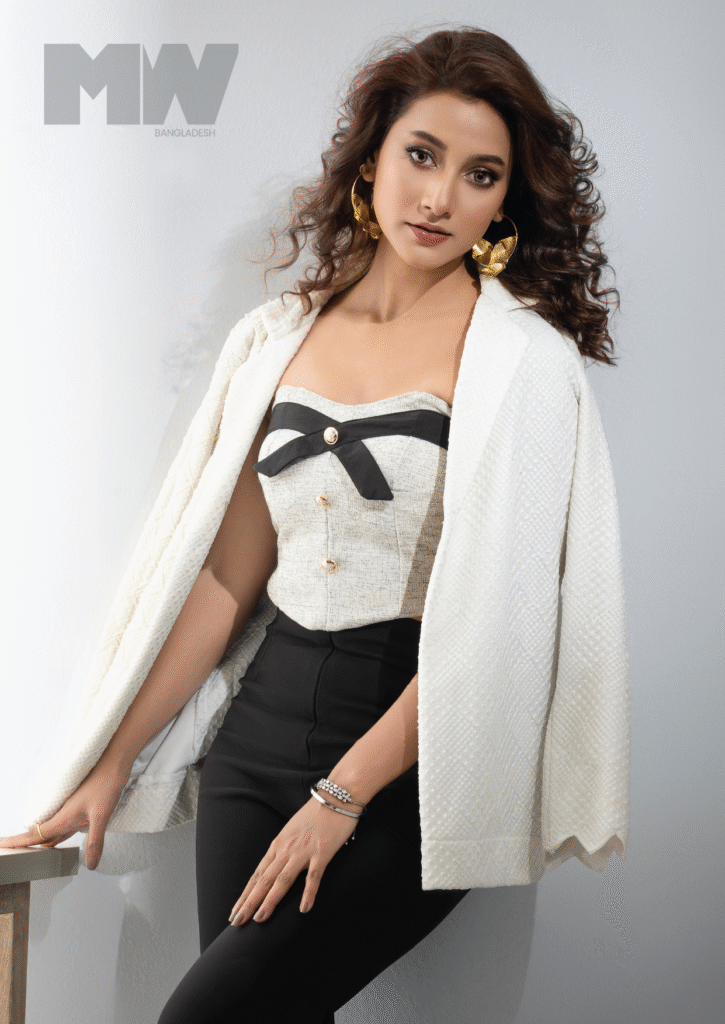
When you look back at your childhood, were there any particular moments that hinted you were destined for storytelling or performance?
To be honest, I never thought I’d end up in the media. It wasn’t even a dream. Growing up in a small town like Feni, I didn’t know such a career was possible—let alone how someone could actually get into this field. There was no one in my family or surroundings connected to media, and I had no idea how it all worked. In Dhaka, I suppose it’s more common for young people—especially university students—to explore these paths, but for me, it wasn’t something I could even imagine back then.
That said, I was always very active as a child. I was a multitasker from the start—balancing my studies with sports (I played on actual fields, not just in theory!), singing, dancing, poetry recitation, and debates. I was involved in all kinds of cultural activities. And my teachers often encouraged me—they’d say, “You should keep doing this, it suits you.”
When I finally moved to Dhaka for college, I had a teacher who used to joke, “Hmm, you’ll become a model someday.” I never took it seriously. It felt like a passing comment. But looking back now, maybe there was something to it—something they could see in me before I even realized it myself.
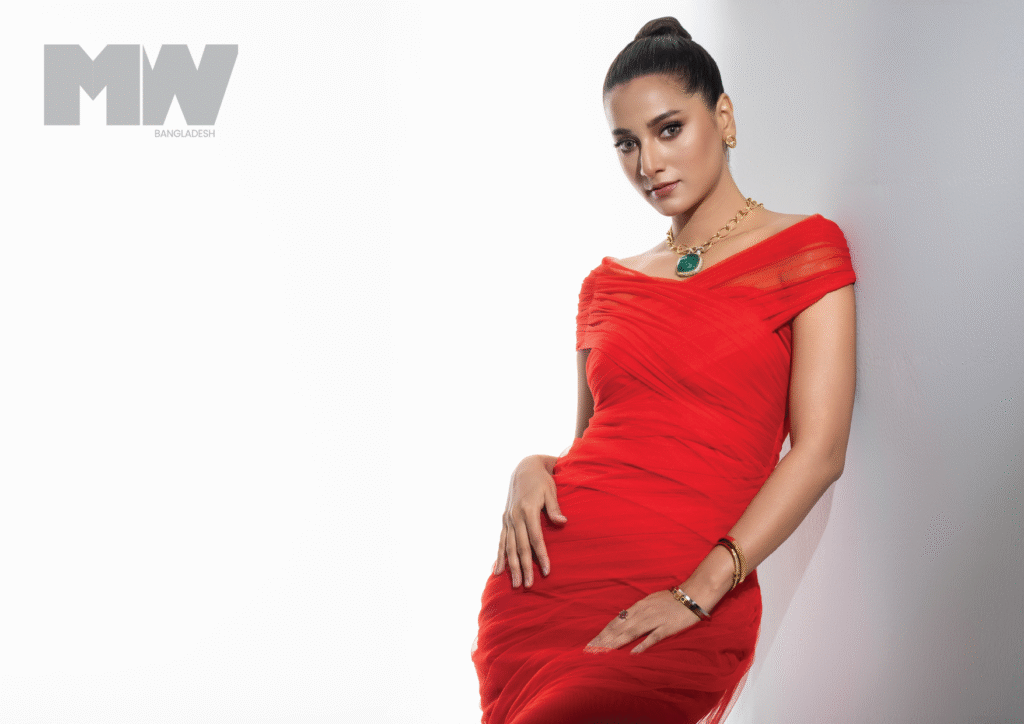
I remember one specific moment clearly. Back in Feni, I was reading a newspaper article one day—it mentioned that university students in Dhaka often worked part-time jobs in super shops or as RJs. That really stuck with me. It sounded so exciting and independent. I’d always been drawn to the idea of self-reliance.
I think part of that came from reading Western books—stories like The Three Investigators, where the characters always had part-time jobs alongside school. I found that very inspiring. The idea that a student could work, contribute, and manage things on their own—it felt cool. Even though I didn’t fully understand how it all worked, that image stayed with me.
So, I casually thought, when I go to Dhaka for college, maybe I’ll do part-time work too. Maybe I’ll be an RJ. It was just a passing thought, innocent and spontaneous, but maybe that’s what made it special. It came from a place of pure curiosity and desire. And somehow, it came true.
“I was a multitasker from the start—balancing studies with sports, singing, dancing, poetry recitation, and debates.”
Did you grow up watching or listening to anyone who inspired you to speak or act?
I wouldn’t say there was any one specific person who inspired me—it was more like everyone around me contributed to shaping that part of me. I used to talk a lot as a kid. I read a lot too—everything, actually. From books to newspapers to the back of a peanut packet. Even when I was in the car, I’d read every billboard and poster we passed, almost like it was a race. I felt this urgency—I had to finish reading it before we drove past. I think that’s why I developed the habit of reading fast. And maybe that’s also why I speak fast. The two just blended into each other.
The people around me often appreciated this side of me—though, to be fair, sometimes they scolded me for talking too much! But more often than not, they encouraged it. They’d say I spoke like I was telling a story, that I could hold attention, that I was articulate. So naturally, anytime there was a cultural event at school or college, I’d end up as the host. Even when we played games in our neighborhood, we’d create these mock magazine shows—there would be singing, dancing, poetry recitations, and even award ceremonies. And I would host those too. It was all very playful, very spontaneous, but looking back, it shaped me in subtle ways.
I think the biggest push came from those around me. I didn’t chase the spotlight on my own. For example, during college, there was an event coming up, and I had no intention of auditioning. But my friends kept pushing me—“Neel will go! Neel, you have to go!”—and I ended up going. They handed me a topic on the spot, and I spoke. The reaction was immediate. People were impressed. That was the first time I officially presented something on a formal stage. It was our college’s orientation program—and I hosted it. So if you ask me where it all began, I’d say that was the moment. The first step into something I had never planned but maybe was always inching toward.
Did anyone support you strongly in the beginning, or was it more of a solo journey?
It was a bit of both, really. In general, I’ve been lucky to receive a lot of support, especially from my family. From a very young age, both my parents—particularly my mother—always encouraged me to follow my curiosity. If someone ever complained, “She’s being too mischievous,” or said I was doing something unnecessary, my mother would calmly say, “Is she hurting anyone? No? Then let her be. She’s doing it out of her own initiative, and that’s how she’ll grow.” That mindset shaped a lot of who I am today. She believed that if a child is doing something from their own will, it should never be discouraged—because that’s where mental and emotional development begins.
But when it comes to my career, it’s been a more solitary path. No one in my family or surroundings had any direct knowledge about the media industry, let alone guidance to offer. I was the first to step into this world, and in the beginning, I was completely clueless. I had no blueprint. I had to figure it out on my own, learning little by little as I went along.
That being said, I did find good people along the way—colleagues and mentors at work who offered valuable guidance. But still, the primary navigation was something I had to do myself. I’m someone who tries to learn from everything—whether it’s from nature, a book, or a conversation with someone new. So, I kept observing, absorbing, and growing.
In that sense, I didn’t have a strong guiding figure or system of support when I first started in the media. And yes, I had to struggle—not in a negative or bitter way, but in a constructive, forward-moving way. It was a gradual process. I started from the very first rung of the ladder and climbed up step by step. There were no shortcuts. I embraced each phase as it came.
You do so many things — act, anchor, write. What brings you the most joy?
I genuinely enjoy doing a lot of things. Any creative pursuit where I can discover a part of myself, or experience something new—that excites me. Whether it’s something I’ve done before or something I’m trying for the first time, if I can do it with love, honesty, responsibility, and dedication, that’s what gives me the most joy.
“I always love to explore—whether it’s people, places, or personalities. Acting lets me do that again and again.”
To me, every piece of work has its own story. The beginning is always hard—starting something new takes courage. But seeing it through to the end, finishing it with care, that’s equally difficult. Many people struggle to complete what they start—and I’m no exception. But when I do manage to take something all the way, when I see a project completed with sincerity and intention, that feeling of fulfillment is hard to describe. It’s profound.
Even in something like hosting, which I do a lot—each event, each show is its own separate world. Every single one is a new assignment. It begins and ends with that specific moment. So, every day, I take on a new job. And when I walk off that stage and hear someone say, “You did beautifully,” or when the client, the brand, the audience appreciates it—that moment gives me such deep satisfaction. I feel grateful. I feel proud.
With acting, the joy comes from inhabiting a character fully. When I know I’ve given it my all, when I’ve completed that emotional arc—I feel something shift within me. That’s a quieter, more internal joy.
But writing… writing is a completely different space. It’s like finding a new self that I didn’t even know existed. When I write, I’m not always writing about myself. Sometimes I’m speaking on behalf of a tree, or a stranger, or an invisible voice. Writing allows me to channel all those versions of myself that live quietly inside. But it’s also unpredictable. Inspiration doesn’t always arrive on demand. It comes in waves, often unexpectedly. And when it does—when I feel that irresistible pull to write, and I manage to shape those feelings into something real, something complete—nothing else compares to that high. It’s a kind of creative clarity that feels sacred.
Actually, there’s something exciting related to that. A few of my poems from my book Hariye Jabar Shuru are being transformed into music. We’re releasing an album titled Amar Hariye Jabar Shuru, where five of my poems have been turned into songs by Rafa. He’s composed both the music and melody. We’ve already released a teaser for one song. So, that’s a new adventure—seeing my words take on a musical life of their own.
At the end of the day, I think what brings me joy is the act of creating something honest—whether it’s a performance, a page of writing, a show on stage. That moment of completion, where something inside me becomes something outside me, and it’s received with love… that’s what I live for.
Your recent OTT projects span from noir thrillers to psychological drama. How do you emotionally prepare to shift between such diverse roles?
You know, acting and anchoring—though both are performance-based—come from very different places emotionally for me.
When I’m hosting, I never “act” in the conventional sense. It’s not about playing a character. Even if I’m on stage, laughing through something difficult or being upbeat despite personal burdens, I’m still essentially myself. I react candidly, speak honestly, and bring my natural rhythm to the moment. Hosting, for me, is about presence. I remain Neel in those moments—just maybe a more polished or prepared version of myself.
But acting is an entirely different journey. When I step into a role, I have to leave myself behind. The first thing I do is try to deeply understand the character—her name, her background, her inner world. I ask questions: Where does she come from? What’s her family like? What shaped her personality? I often sit with the director and explore these aspects. Once I begin to internalize her life, only then do I feel I can portray her truthfully.
It’s not just about memorizing lines—it’s about becoming her. I try to speak how she would speak, feel how she would feel. I let that identity seep into me. That process of transformation—it’s honestly magical. I fall in love with acting all over again every time I go through it.
In one of my recent web series—which sadly may not get released because of policy issues surrounding OTT platforms and ministry grants—I played the lead role. It required the most emotional and intellectual preparation I’ve done to date. We shot over an extended period, and I had to really live with that character. I gave it everything. And while it might never be seen, the experience of embodying her left a lasting impact on me.
Ultimately, I believe this is what makes acting such a powerful medium. Every role is a new life. And the more honestly you live it, the more it comes alive on screen. That’s the magic of it.
What kind of roles or stories do you wish people would offer you more?
There’s nothing very specific, to be honest. But I do crave roles that challenge me, that allow me to truly explore. Something that feels meaningful. Off the top of my head, I’d love to play a rockstar. Or someone in a high-paced action setting. At the same time, I’d be equally excited to embody a character drawn from the pages of Sarat Chandra or Rabindranath Tagore—a classic Bengali heroine full of emotional depth.
I guess what I’m really drawn to is variety—characters that push me out of my comfort zone, roles that require me to break myself down and rebuild as someone entirely new. Whether that character is modern, edgy, and unpredictable, or rooted in tradition and subtle emotion, I want to taste all of it.
I love to explore. I explore when I travel, when I meet new people, and when I take on new roles. Every character gives me the chance to live a new life, and that’s what keeps it exciting for me.
What do you do to relax after a long day?
Honestly, even if I’ve been working non-stop, shooting all day long, I find it refreshing to spend just a little time with close friends before heading home. That half an hour—grabbing a coffee, sitting down, talking about random things or deep topics like politics or cinema—those are the moments that refuel me.
It doesn’t happen as often now since many of my closest friends live in different cities, but when it does, it really lifts my spirits. Even after a 12-hour shoot, if I can steal a little time to be around meaningful people, I feel rejuvenated.
I think that kind of face-to-face connection is slowly fading in this era of social media, but for me, it remains essential. It’s how I recharge—not by escaping people, but by leaning into them.
That small window of time, with people I trust, makes all the difference. Even ten minutes of laughter or meaningful conversation can wash away the fatigue of an entire day.
What’s your comfort food?
To be honest, I’m not much of a foodie. I enjoy good food, sure—but I don’t crave it or live for it. If I had to name a comfort item, though, it’s definitely coffee. There was a time when I truly leaned on it. During work, just holding that cup—taking the first sip—felt like clearing my mind.
I was quite dependent at one point. I even managed to cut back, but then a new job came along… and the cups started piling up again. (laughs) Now I’m reminding myself, once more, to slow down. It’s a cycle.

But coffee isn’t just a drink for me—it’s a moment. A pause. A small ritual of warmth and control in an otherwise busy day.
Do you have a role model in the media or art world whose path you admire?
There isn’t one single role model for me—I’ve always tried to learn from the people, moments, and work that move me. But if I had to name someone from the world of hosting who’s inspired me since childhood, it would be Ellen DeGeneres. I admired her not just for her humor, but for the depth and kindness she brought to every show.
One of my most memorable life experiences is tied to her. During a work trip to the US, I took a solo detour to Seattle—just to catch her final stand-up tour. That moment, being in the audience, felt like something deeply personal, almost full-circle.
So no, she may not be my only inspiration, but she’s someone I truly admire—for her authenticity, generosity, and the joy she brings into her work.
Also, recently I have started watching podcasts hosted by Jey Shetty. I think he is really good.
What’s next for Neel Hurerzahan?
Right now, I’m trying to move away from scattered work and focus on projects that really resonate with me. I’ve realized that if I don’t carve out time for myself, I’ll stop growing creatively—I’ll get stuck in the same loop. So, I’ve consciously cut back on TV shows and chosen to do more events and curated work that excite me.
Recently, I produced two shows based entirely on my own concepts: Out of Frame, which is outdoor-based, and Neel & Now, a podcast-style indoor show. I’m currently in talks with a channel, so if everything goes well, one of them might go live soon.
There’s also a new kind of reality show I’m considering. It’s a different format and I’m quite interested. At the same time, I’ve been working on a music project for over a year and a half. The teaser for one of the songs is already out, and the full music video and album—Amar Hariye Jabar Shuru—should be released very soon. We’re even planning a launch event.
Beyond that, I’ve joined a new startup where I have a major role, which is both challenging and exciting. So yes, a lot is happening behind the scenes. I’m building toward something new and meaningful, and honestly, I’m really enjoying this phase.
“I’ve realized that if I don’t carve out time for myself, I’ll stop growing creatively—I’ll get stuck in the same loop.”
Fashion Direction & Styling: Mahmudul Hasan Mukul
Photographed By: Ishtiaque Ahmed
Make up & Hair : Sumon Rahat
Jewellery: Dazzle By Sonia