

Ayman Anika
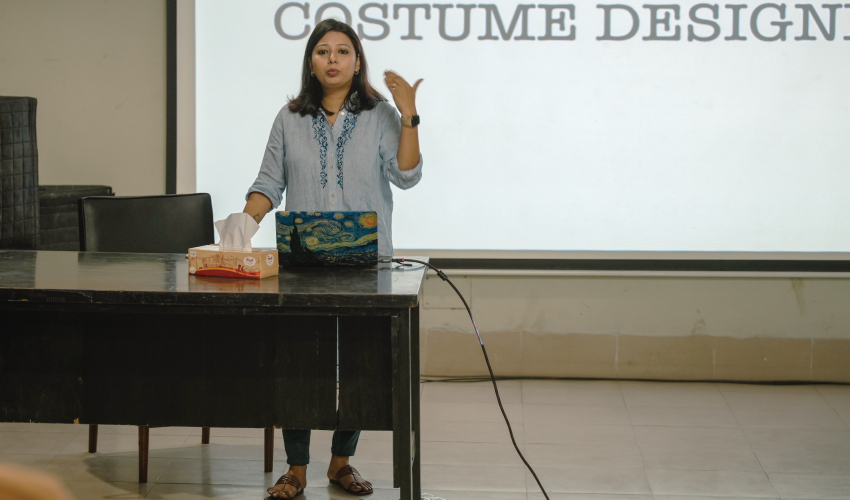
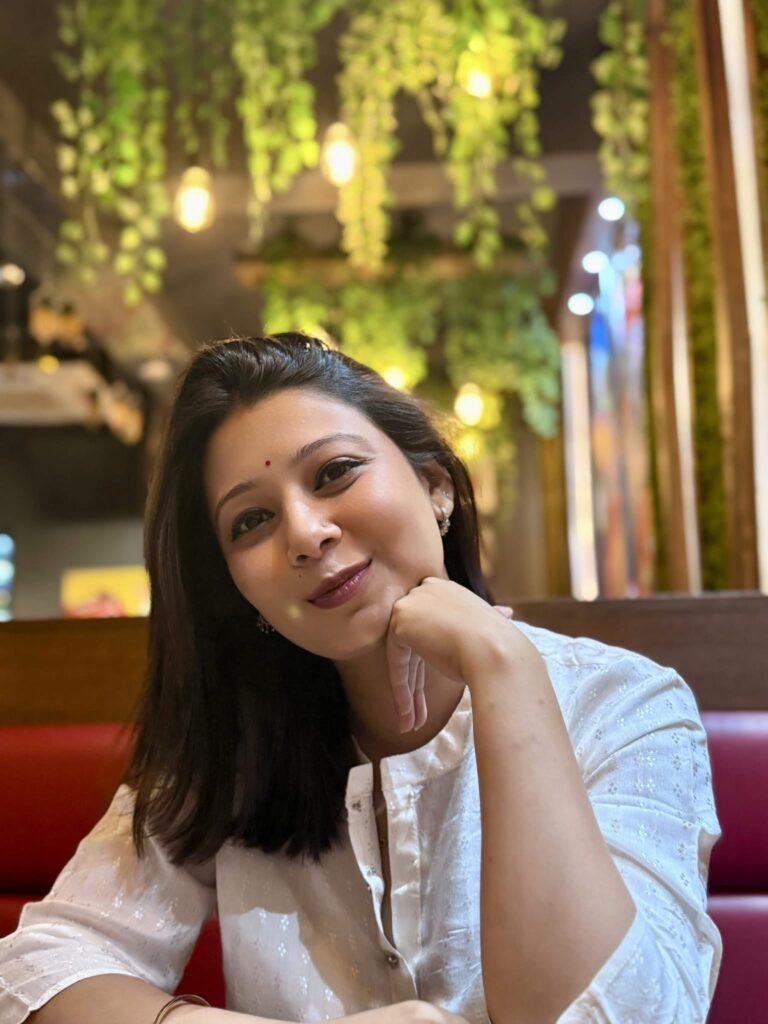
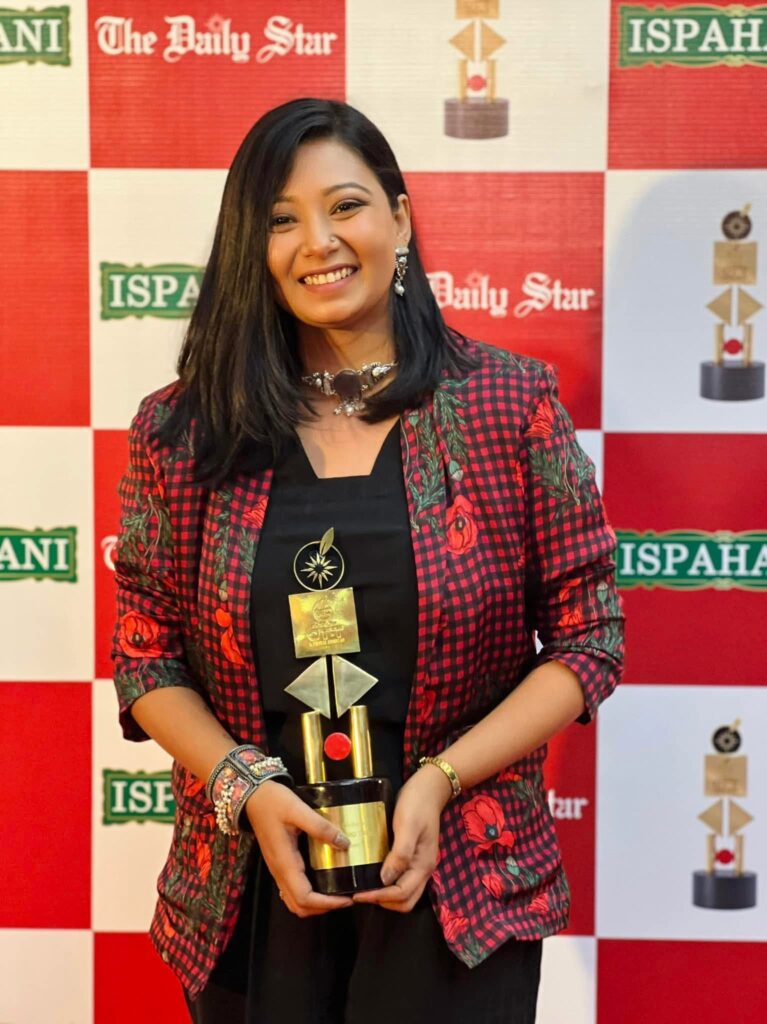
In the often-overlooked world of costume design, Edila Kasrin Farid has quietly built a legacy – one character at a time.
Beginning her journey in 2009 as an assistant director, she found her true passion in costume design and never looked back. From Nonajoler Kabbo (2020), which earned her the National Film Award, to the acclaimed web series Syed Ahmed Shawki’s Taqdeer, Mostofa Sarwar Farooki’s Something Like an Autobiography, and Nuhash Humayun’s Dui Shaw, Edila’s work bridges story-telling and style with striking emotional clarity.
Whether it’s the playful energy of Horlicks HO HO HO, or the sleek aesthetics of OPPO F17 Pro, her designs speak through texture, tone, and character. With MWB, the talented Edila Kasrin Farid opens up about her journey – from naming her studio after her beloved cats to what she envisions for the future of Bangladeshi costume design.
You started your career in visual media as an assistant director. How did that early experience shape your transition into costume and character design?
I began my career in visual media in 2009 as an assistant director at Applebox Films, and that early experience played a crucial role in shaping my transition into costume and character design. At the time, I had little idea of how the industry worked.
However, being an assistant director back then meant much more than just assisting the director. Unlike today, we didn’t have fully established, independent departments for costume, art direction, or production design in Bangladesh. So as an assistant director, I had to support every department – costume, makeup, art, casting, even the camera team.
That hands-on exposure taught me a lot of the behind-the-scenes processes and helped me understand the dynamics of each role. Gradually, I realized that costume design had real potential as a career path, especially because there were so few professionals working in that area at the time. It wasn’t a saturated field, and the competition was relatively low, which gave me space to explore and grow. That’s when I started preparing myself more seriously for a career in costume design.
Another important factor was my academic background. Although I originally wanted to study fashion design, I didn’t get the necessary support from home for that route. So, I chose filmmaking instead – specifically direction – because that was more acceptable to my family. Ironically, this ended up being a huge advantage. My training in direction continues to benefit me today, especially when it comes to visual story-telling. It helps me understand a director’s vision more clearly and translate it into costume and character design that fits the overall narrative.
Because of my assistant directing experience, I’m also technically equipped to think through execution – how something will work logistically, what’s feasible on set, and how to bring a concept to life practically. So, in many ways, those early years gave me a well-rounded foundation that still supports my creative process every day.
What was the turning point when you realized costume design was your true calling in the industry?
The real turning point for me came when I worked on the film Matir Projar Deshe (English title: Kingdom of Clay Subjects), directed by Bijon Imtiaz. At that time, I was still identifying as an assistant director and had no formal training in costume design. In fact, I didn’t even intend to take on the costume responsibilities. It happened quite unexpectedly – mostly due to the film’s tight budget, since it was an independent project. The producer pushed me into handling both AD work and costume design, simply because they needed someone who could multitask.
Initially, I was hesitant. But once I saw my costume designs come to life on the big screen, something shifted. That was the first time I realized that I could contribute something meaningful in this field – and perhaps even do it better than I expected. Seeing the visual impact of my work and how it helped shape the characters on screen sparked a deep interest in me. That experience showed me that costume design wasn’t just a task – it was a craft I could grow into.
So yes, Matir Projar Deshe was the turning point. After completing that project and returning to Dhaka, I gradually began to shape my path more seriously as a costume designer. That film didn’t just change my professional direction – it gave me the clarity I needed to realize where my true creative passion lay.
What are some of the major challenges you faced early in your career?
One of the biggest challenges I faced early in my career was the complete lack of recognition for production design in our industry – particularly in terms of the three key departments: costume, art, and makeup. At that time, there was no formal costume department. It simply didn’t exist as an independent role. Costume work was typically handed off to assistant directors like myself –we’d go to the market, buy outfits based on what the client or director approved, and that was it. There was no creative process, no dedicated team, and certainly no budget specifically allocated for costume design.
So, in the beginning, the real challenge was just to establish costume design as a legitimate, standalone department. That meant not only advocating for its creative value but also convincing producers to set aside a separate budget – enough to make it a sustainable livelihood for someone. It required constant promotion and education just to get people to acknowledge that costume design was necessary, let alone essential.
Back then, this idea hadn’t even occurred to most people. There simply wasn’t a mindset in place to support the idea that a dedicated costume designer could improve the story-telling. But things slowly started to shift, especially through advertising projects where our work started gaining some acceptance.
However, the real turning point came with the rise of OTT platforms in Bangladesh. That changed everything. Fiction content became more character-driven, and audiences grew more discerning. Viewers now demand depth and believability in characters – and that can’t be achieved without intentional costume design. In a typical web series today, there might be 30–35 speaking characters. It’s impossible for a single director to develop the visual identity for all of them. This shift led to a kind of revolution in our industry. Costume design, which was once barely acknowledged, is now seen as vital to character development and story-telling.
Of course, the challenges haven’t disappeared – they’ve just evolved. But compared to the uphill battle of establishing the department in the first place, today’s struggles are far more manageable and centered around growth rather than survival.
How much do you allow intuition to guide your design process, and when do research and references take the front seat?
For me, the design process is a balance – almost exactly 50-50 – between intuition and research. On one hand, I always begin with the director’s brief and background research. That’s my foundation. But the rest comes from my own imagination – though even that imagination is grounded in real life. I don’t believe in building characters out of thin air. I always think: whoever this character is, someone like them exists around us. So, I try to find that person. I go outside, I observe people, and I search for someone whose energy or personality matches the character. That fieldwork and R&D play a big role in my design thinking.
Of course, you can never replicate a real person entirely for a fictional character. That’s where intuition steps in. The smaller details, the nuances, the visual personality of the character – all of that comes from brainstorming and creative interpretation. And in that process, collaboration is key. My designs are not made in isolation. The art department, the makeup team, and others are deeply involved. So, while I guide the vision, I never take full credit. It’s always a team effort, and I believe the best results come when every department contributes to shaping the character. That’s essentially how I work – research-backed, imagination-driven, and always collaborative.
Your studio is named after your cats, Oscar and Blue – a beautiful, personal touch. How does Team Oscar Blue reflect your values and creative independence?
Team Oscar Blue is more than just the name of my studio – it’s a deeply personal symbol of love, resilience, and creative freedom. After I got married, my husband gifted me two cats, Oscar and Blue. Over time, they became my emotional anchors, especially during my most difficult moments. I never had children, so they truly felt like my babies. I knew they wouldn’t be with me forever, but I wanted a way for them to remain a permanent part of my life. That’s why I named my studio after them – so their memory would live on in the heart of my creative journey.
The spirit of Team Oscar Blue reflects my core values: emotional connection, independence, and a grounded sense of creativity. My studio didn’t start big. I rented a small tin-shed house in Tejgaon when I had very little, just the dream of having my own space to create. That little room eventually evolved into what is now Team Oscar Blue Studio – a 1200-square-foot space where all my creative work takes shape.
For me, the studio is not just a workplace – it’s a sanctuary. It’s where I brainstorm with my team, experiment with designs, conduct look tests, and collaborate closely with artists. When an actor walks into my studio, we don’t just try on clothes; we discuss, refine, and co-create a character’s visual identity. That kind of hands-on, team-based approach is what defines my creative process, and the studio makes it possible.
It also represents a clear boundary in my life. Inside that space, I’m a costume designer – focused, expressive, and creatively free. But the moment I step outside, I return to other roles: wife, daughter, sister. Each role matters, but the studio is where I am purely myself, where my ideas and imagination flow without interruption. That’s the essence of Team Oscar Blue – a personal and professional safe space where creativity, memory, and identity come together.
Do you have any favorite fashion eras, textiles, or folk styles that you keep going back to in your work?
If I had to choose a favorite fashion era, I’d say the 1980s and 1990s really speak to me –especially the styles from when my mother was young. I didn’t live through that time myself, but I grew up seeing old photographs of my mother and others from that era. Even though Bangladesh didn’t have a strong pop culture presence back then, those images still captured something bold, expressive, and culturally vibrant. The color palettes were retro, vivid, and playful – there was a sense of stylish madness that I find incredibly inspiring. I still draw from that aesthetic today. For instance, I often incorporate velvety textures or retro silhouettes into my work as a subtle nod to that era.
As for present-day influences, the rise of OTT platforms like Pet Kata has been a game-changer. Especially in its second season, we got to experiment with a wide range of styles, including folk elements in the final episode, which previously wouldn’t have been possible. Earlier, creative decisions were tightly bound to client demands, which left little room for experimentation. But with OTT content, there’s a lot more freedom to explore diverse aesthetics – folk, classic, even avant-garde.
That’s what makes this moment so exciting for costume designers in Bangladesh. We now have a platform to explore our creativity more fully and bring in references from various eras, regional styles, and textures. It’s not just about dressing a character anymore – it’s about building visual identities that connect with both past nostalgia and modern story-telling.
You’ve been in the industry for over a decade and worked on many notable projects. Has the industry matured in how it treats costume design, from budgeting to creative input?
Absolutely – the industry has come a long way in how it treats costume design, both in terms of budgeting and creative input. When I first started, the environment was very different. Costume design wasn’t viewed as a specialized field, and there wasn’t much understanding or appreciation for what it brought to a production. Budgets were minimal, and creative input from costume designers was often overlooked or undervalued.
But over time, things have shifted significantly. The industry has matured – not just in costume design, but across all technical departments. For example, earlier we had sound technicians who were skilled through experience but not always formally trained. Now, we’re seeing educated, technically sound professionals entering the field, which has raised the overall standard of production.
This evolution has extended to costume design too. There’s more awareness now about how crucial character design is to story-telling. As a result, costume departments are being taken more seriously, with better budgets and more space for creative collaboration. It’s a promising time, and I genuinely believe even better days are ahead for our industry.
If you were to design for a global collaboration or Netflix original, what would your dream project look like?
That’s a tough one – because honestly, I feel like I haven’t even completed my dream project in Bangladesh yet. There’s still so much I want to explore and achieve here, in my own context, with my own stories. So before thinking about designing for a global collaboration or a Netflix original, my focus is on fulfilling that creative vision at home.
What’s next for you?
Up next, I have three exciting projects lined up for release this Eid. The first is Gulmohar, directed by Syed Ahmed Shawki; then there’s Bohemian Gora by Amitabh Reza; and lastly, I’ve just wrapped up work on a film by Sanjay Samaddar Insaaf. These have kept me deeply involved recently, and I’m really looking forward to seeing how audiences respond to the costume work in each of them.
Beyond that, there are a few more projects in the pipeline that I’m currently in discussions or early development for – but due to confidentiality, I can’t speak about them just yet. Let’s just say, there’s more character-building and visual story-telling on the horizon!
Photo Source: Courtesy