

By Abak Hussain
Sam Fussell, a better writer than an athlete, describes in his only published book how slipping into a bookstore for refuge pulled him into the rabbit-hole of competitive bodybuilding back when he was a skinny, nerdy twentysomething. The memoir is Fussell’s first and only published work, and is in equal parts sad, tragic, and profound. It came out almost 35 years ago, and it has been over two decades since I myself read it as an undergrad; my own copy, purchased at a Barnes and Noble in Appleton, Wisconsin, is long lost.
So bear in mind I am recollecting from memory and please excuse any inaccuracies, but his account goes something like this: Sam is a young, British scholar in New York for higher studies. One day, while walking down the street at night – remember, this is New York in the 1980s, so things could get pretty shady – he senses that he is being followed by an unstable fellow with a crowbar. Sam picks up the pace, but is unable to shake off his pursuer. Seeing the bright lights of a bookstore, he slips in. It is the legendary Strand bookstore, on the corner of Broadway and East 12th street. A son of Oxford dons, Sam has found refuge in bookstores his whole life, and here he starts to feel safe. Trying to calm his frayed nerves, he shuffles through the shelves, browsing randomly, until he chances upon Arnold Schwarzenegger’s biography.
A little ashamed of himself for feeling scared and vulnerable, he looks at Arnold’s victorious smile and invincible physique on the cover, and on the spot, a decision is made. He will become a bodybuilder. What follows is a bizarre and absorbing tale of a journey into the world of sweaty gym bros, rusty barbells, protein, steroids, and bullying. After taking his athletic pursuits as far as they can go, losing himself, and finding himself again, Fussell writes his terrific memoir (Muscle: Confessions of an Unlikely Bodybuilder, 1991), thereby coming full circle and returning to where he always belonged – in the world of books.
The Strand bookstore in New York still stands, thankfully, after countless other bookstores in the city both small and large have shuttered permanently, unable to compete with Amazon and e-books. If it survives for another couple of years, it can celebrate its centenary. How much longer will it survive? That’s anybody’s guess. Bookstores, globally, for a good number of years have been having a long and drawn out existential crisis. Many of these paperback sanctuaries fed our hungry imagination, created worlds in our minds, helped us find our calling – these spots are disappearing. Why not take a moment to honor these sacred places, these bookstores which made us feel safe and are now gone for good?
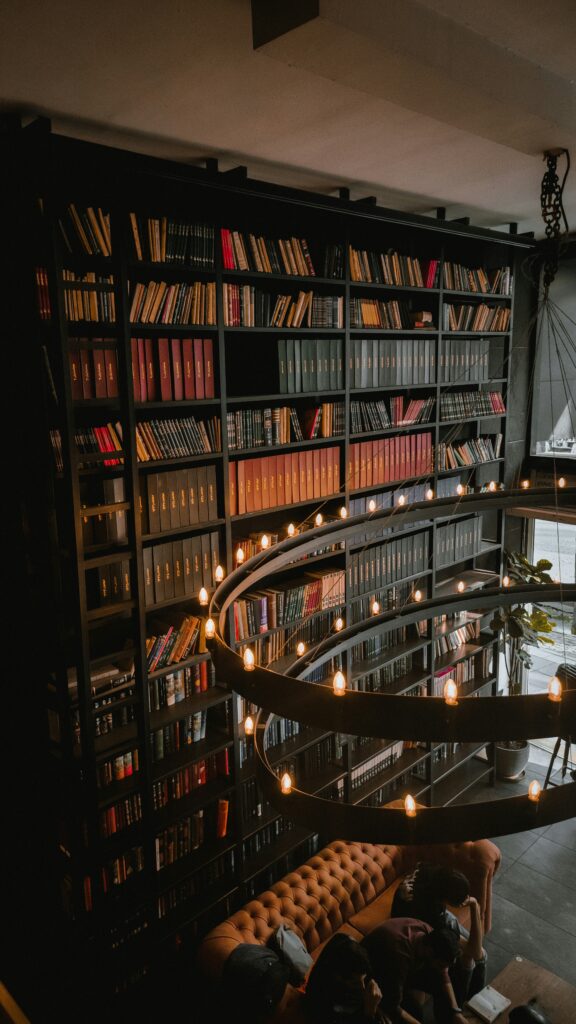
Photo Source: Shahrooz Rabbani
In our hometown Dhaka, there was Zeenat Book Supply. It was a fixture of New Market and a fixture of many lives from 1963 to 2023. As a child, for me a trip to Zeenat and being allowed to pick out a book held a kind of magic that is hard to find anymore. Now that I think about it, many of my early reading choices were based on simply what was available and on display in Zeenat. It started with early hardback Ladybird editions of children’s books, then Tintin comics, then Enid Blyton’s Famous Five series. At one point I started to organically outgrow Zeenat, and the store also started to feel a little depressing – it was dimly lit, cramped, and the service wasn’t great. Still, the nostalgia factor stayed on, so during trips to New Market a quick stop at Zeenat was mandatory. Run by old-school book stalwarts, Zeenat never quite evolved with the times, like branching out into social media or responding to DMs. That’s fine, not everything has to jump into the digital age – Zeenat was very special for a lot of people for a long time, and it came to its natural end after sixty years of operation a couple of years ago. Not a bad run, and we will always cherish its contribution to Dhaka’s reading culture.
If the bookstore of my childhood was Zeenat, for my university years in the US it was Conkey’s, in downtown Appleton, where I spent four years for my undergrads. Students from my college would crowd there at the beginning of every term, because Conkey’s was the place you went to for all your textbooks. In the middle of the term or during breaks Conkey’s always felt serene and cozy. The ground floor was the general section, and if you went down the stairs, there was a drop in temperature and you found yourself in the part where textbooks and other materials were arranged by course. You could also get stationery and university merch over there. I never got the chance to splurge much on extracurricular books – since all my cash went towards required readings, and some textbooks (hardbacks especially!) could be eye-wateringly expensive. Conkey’s stood in its iconic home at College Avenue for 113 years. When it closed down for good about 15 years ago, it was the oldest running bookstore in Wisconsin. Now it’s just a cherished memory of the place where I picked out my assigned volumes of Kierkegaard and Nietzsche which still sit on my shelf, Dostoevsky’s Notes From Underground which blew my tender Freshman mind, and Calculus and Analytic Geometry by Stein and Barcellos – which I never want to see ever again.
And here we are back home, strolling through the picturesque Shahabuddin Park – and here’s Bookworm. Maybe it’s not right to talk about Bookworm while reminiscing about bookstores of days past – Bookworm is very much alive, and very much part of the current era. It’s the default bookstore for a lot of people I know, and has a special place in my heart. Though not gone yet, it deserves an honourable mention, because it has had a couple of near-death experiences. Its old location was at that iconic spot at Old Airport Road – many have driven past it without going inside. But it had a loyal following, and when they visited Bookworm, they went with purpose and intent. You couldn’t just wander into Bookworm back in those days, the location was the last thing from walkable. But for reasons too complicated to bring up here, Bookworm lost that spot, and many wondered if the store would meet its demise.
Thankfully, it was born again in Shahabuddin Park, where the crowd is a bit different – the store is seeing much greater foot traffic for sure, but the book-buying energy has changed. Many pass through because they happened to be in the park area, many see it as a nice spot for Insta pictures, which is why Bookworm now has a no-pictures policy. But at least people are coming to a bookstore, and that makes me glad. Recently, Bookworm went through another scare – there was chatter on social media that it may close down, for real this time. Thankfully, that threat was dodged.
Things move fast in today’s world. Changes in tech and the rules of capitalism constantly upend things we once loved. Real estate is at a premium, and it is hard for booksellers to sustain a good physical location. New forms of accessing knowledge have exploded – things like smartphones and Wikipedia and Youtube tutorials and e-readers and chatGPT were unheard of in the analogue glory days of bookstores, back when they were the uncontested hubs of learning. As for paper books that are still in demand, the marketplace has shifted online, and I can’t even begin to imagine what innovations there will be in the years and decades to come. So I never take a trip to the bookstore, any bookstore, for granted. Any day could be its last. But the finitude kind of adds to the beauty, doesn’t it? Oh, my paperback sanctuaries …
Abak Hussain is Contributing Editor at MW Bangladesh.
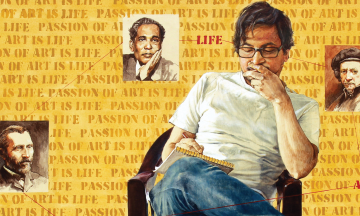
Feature image by Arstin Chen