



By Abak Hussain
Last year, an unlikely museum exhibit popped up in Germany, which ran for a couple of months – it was a “museum of bureaucracy.” While immersion in bureaucracy is literally no one’s idea of relaxation or cultural enrichment, from time immemorial, humor has been a way of dealing with that which traumatizes us, has it not? And so Germans, less tolerant of inefficiency than most other countries, were the first to turn the joke into high art. Visitors walking into the 350sq-km space found themselves going through a massive, hollowed out tree, which was intended to represent the enormous amount of paper – in Germany’s case 52 trees per day – which were sacrificed in order to provide paper to the government. You could get shackled (consensually!) to a symbol representing the German legal code – if you are into that sort of thing, or play the claw machine where the prizes are little watches, symbolizing getting back your time that has been stolen by the bureaucracy.
Leave it to the Germans to know the value of time, which the rest of us seem to have accepted as a sunk cost. Our system yanks us through a maze, buries us in nonsensical paperwork, and we sigh with a resigned It-Is-What-It-Is. But surely we can do better – in a post-July Bangladesh where we are interrogating all that went wrong for us under authoritarian rule, surely we can go back and restore things to a platform of common sense, human dignity, and basic ethics?
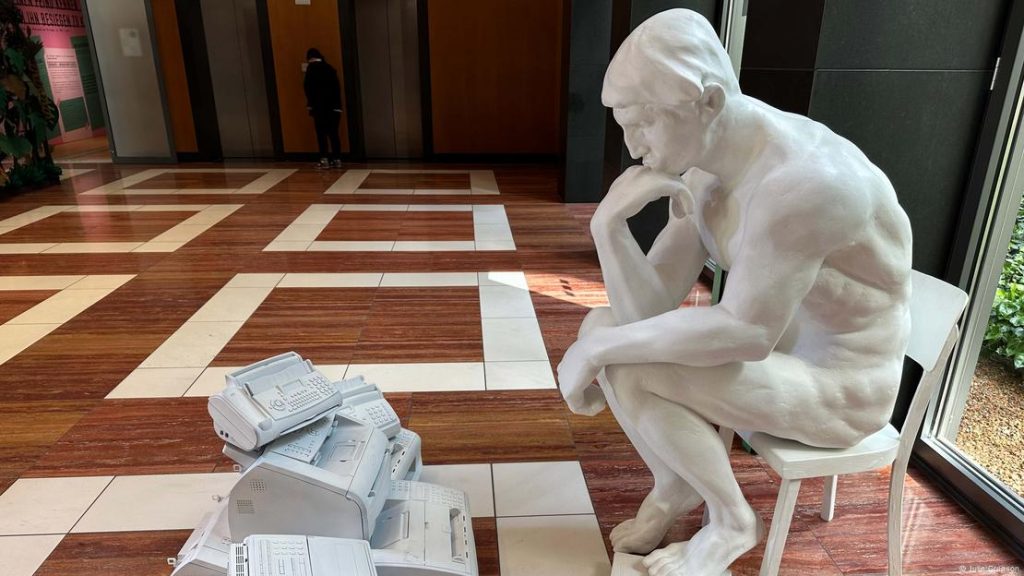
Photo Source: Julie Gregson
The problem is, these ethics for us are faded abstractions, and for many, all we can do is look back in anger rather than build better for the future. Unfortunately, we don’t quite have the blank slate that many had hoped for – what we have is a densely packed, brutalized population, many of them too thirsty for revenge to engage in positive nation-building, and many of them members of the League of It-Was-Better-Before, whose only agenda is to create as much violence, chaos, and turmoil as possible to make the current caretaker government’s noble efforts look like a failure. Our CA, an extremely talented and well-intentioned individual, makes great strides and lifts Bangladesh’s image to the world against unfathomable odds, and a sub-section of society only tries to bring him down. While many of us are eager to take back the time that was stolen from us by the previous government, these troublemakers want to lay waste to every effort at reform.
And hoo boy, do we need reform. Our bureaucracy – government offices which are in theory meant to operate free from shallow political objectives so they may serve the people – has been rotten to the core, infected with cronyism, corruption, and inefficiencies that those German satirist-curators could not have dreamt even in their most Kafkaesque nightmares. For one thing, it was practically impossible to get decent, respectable service in government offices without some sort of prior connection with someone on the inside. And then there was the total and utter disorganization one faced. If you have not had to experience trying to get some sort of service from a Bangladeshi government agency as a non-VIP regular citizen, count yourself lucky, because the experience is often weirder than Dorothy walking up the yellow brick road hoping she is on the right track. Instructions are vague, information is in flux. Those working behind the counters and desks least bothered – they are part of a broken system and they do not feel any urge to fix it.

Photo Source: Julie Gregson
And should you finally cut through the lines and confusion and get lucky enough to get some attention, you may be subjected to inane questions, or be given requirements that you were not at all prepared for. Oh for this you need to go get a photocopy of your office ID. Oh but in your case you need to submit a GO. But this address isn’t matching the address in your NID. Oh but we’ll need your permanent address. You don’t have a permanent address? But you simply must have a permanent address! Sorry lady, I get that you live in a rented place and don’t own property, but I don’t know what to tell you, we can’t process this without a permanent address. Then the bored, tired bureaucrat looks beyond your shoulder and waves through the next person, and there goes your day, your week, your month, or even your year.
These are the areas where reform is needed – for they are the things that affect the lives of people. And here we are at such an exciting juncture in our history. The regime change has handed us an immeasurably valuable opportunity to fix things that in the past we couldn’t even complain about. The permanent address requirement, for example, reeks of Awami-era control – a mechanism to keep people in their place, and a weapon brought out at will against hapless citizens who do not know their own basic rights. Every single Bangladeshi, as legitimate citizens and as human beings, has the right to move around the country as they – as we – please. We can rent, we can own, we can live with family as we choose – these are inalienable human rights, so let’s start there: scrapping the inane obsession with permanent addresses. We can finally ditch the absurd buzzwords like “Digital Bangladesh” and actually work on digitalizing files and minimizing paperwork. NIDs and passports are already biometric, so you know very well who I am – no need to demand a stack of papers just for the pleasure of harassing me or a chance to seek bribes.
Bureaucracy tosses us through hoops of absurdity to the extent that we become too tired or shell-shocked to even question it. We meekly fill out our forms, and with trembling hands reappear in front of the person behind the desk hoping this time – this time – it will all be OK. But that is not how things should be. In this new era, we have a chance to start again, and this time, in the words of Franz Kafka: “Start with what is right, rather than what is acceptable.” Acceptable has generally been code for that which the government is willing to accept – acceptability in bureaucracy, hence, is a tool of authoritarianism. We need to get back to the basic principles of service – what is just, what is good, what is fair. My words may sound laughably naïve – idealism divorced from the reality of our toxic culture – but we need to start somewhere.
Abak Hussain is Contributing Editor at MW Bangladesh.
Feature Image By Rabeebur